
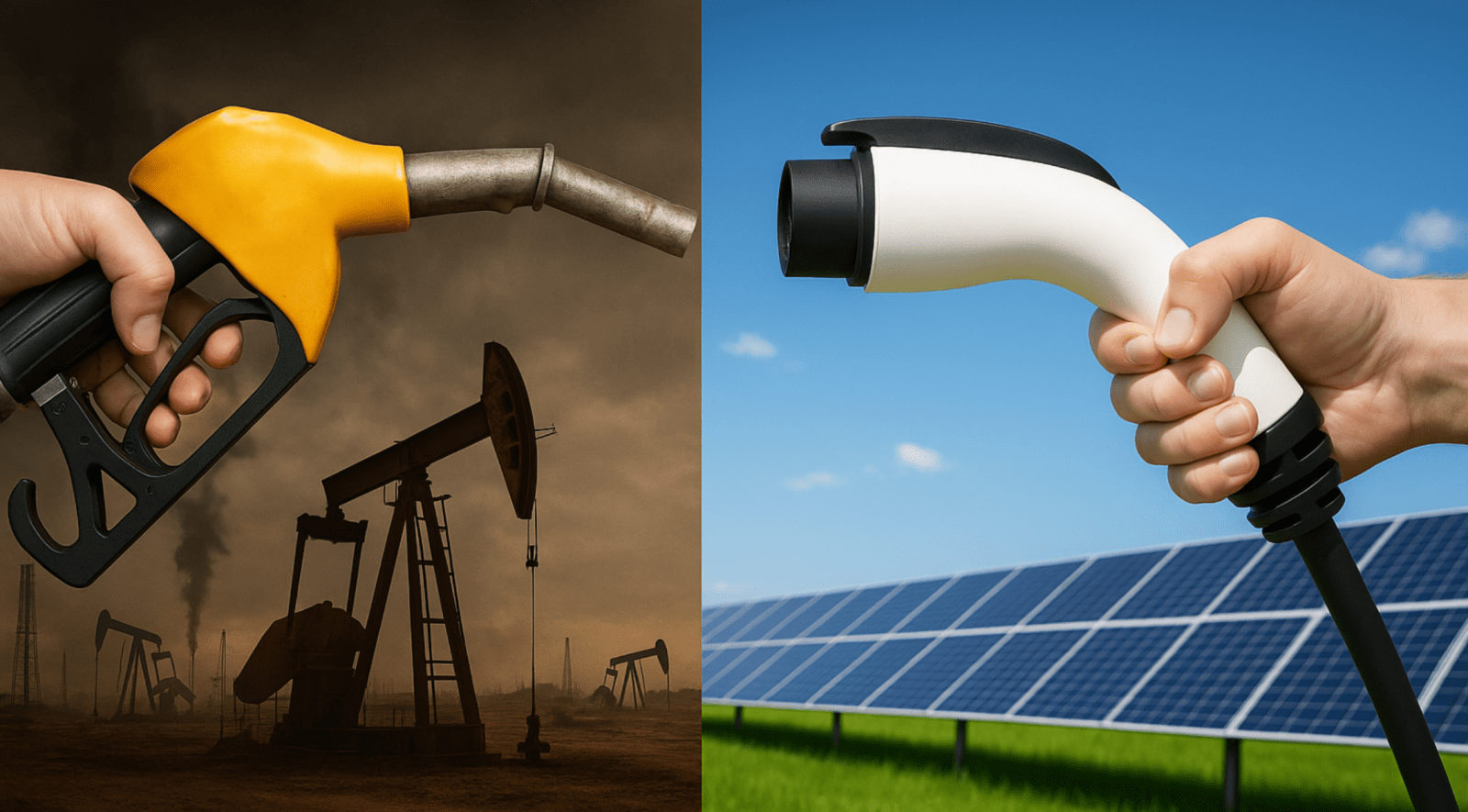
With the news of the US and Israel’s actions in Iran in the last ten days, which caused oil prices to surge by +50%, we are reminded again of how reducing oil demand can lead to less conflict and more energy independence – and electric vehicles are every country’s best bet for getting there.
Ten days ago, US dictator Donald Trump, who cannot legally hold US office, joined Israel in an attack on Iran, killing many of the country’s leadership and also murdering hundreds of schoolgirls, among thousands of other civilian deaths.
US republican leadership has stated the goal of the attack was “to make a ton of money” by stealing the country’s oil.
In response to the unwarranted attacks, Iran declared that it would close the Strait of Hormuz. This is a narrow chokepoint at the end of the Persian Gulf where 20% of the world’s oil passes through, and it’s all within miles of Iran’s coastline, offering the nation easy options for stopping traffic from large oil tankers.
Putting aside any opinions of Iran’s leadership, the US and Israel’s actions are an unjust and unwise escalation regardless, and this moment reminds us of one of the benefits of EVs: that they will help to put an end to this sort of conflict, and mitigate the effects of these disruptions for everyone, including countries that have nothing to do with them.
Oil prices spike, and some countries could run out
As a result of these attacks and subsequent closure of the Strait, oil prices spiked by over 50% over the weekend, to over $100 a barrel. They now hover closer to $90, well above the ~$60 average of the last year, as Israel says it will continue the fight.
Even in countries that don’t get much oil from the Strait of Hormuz, prices have risen. Oil is a global commodity, so disruption anywhere causes disruption everywhere. In the US, average gasoline prices spiked upwards by about a dollar a gallon.
(Accidents can cause similar disruption – recall when the Suez Canal was blocked for a week by a container ship that ran aground)
But it’s not just prices that matter, it’s also availability. A number of countries have immediately reached crisis status, recognizing that if this conflict continues – as idiotic first strike attacks are wont to do – they might run out of oil.
This is of particular concern in Asian nations which get their oil through the strait. Some that are highly reliant on Strait oil, like Japan (with one of the lowest EV shares in the world), could be in trouble in the coming months.
New Zealand could also be in trouble, with only weeks of oil in reserve, and its current conservative government would be partially to blame. The country previously had high EV market share until the current government put a punitive tax on EVs, causing EV sales to fall and oil reliance to rise. NZ could have been fueling more of its vehicle fleet with abundant, cheap hydropower produced domestically, but instead its reaping the uncertainty that its conservative government sowed by doubling down on fossil fuel reliance.
Meanwhile, China also gets much of its oil from the Strait, but due to the country’s oil reserves increasing in recent years and its oil demand plateauing due to rapid electric vehicle growth, it is in less immediate trouble than other Asian nations.
These are just a few immediate examples, but they put a point on how oil reliance isn’t just some theoretical problem, and how EVs can help countries to get away from it.
Electric vehicles are the primary route to energy independence
The majority of oil is used for transportation purposes, and more than half of that goes into the engines of the ~1.5 billion personal vehicles on the road today. After being extracted from the earth where it has spent millions of years, it is burned one time to move your car down the street a little bit, and cannot ever be used again.
This creates high demand for this unrenewable resource, which gives massive amounts of control and wealth to the nations that happen to have ready access to it. It also causes global markets of everything to be disrupted significantly when oil markets are disrupted, due to global overreliance on this single resource.
So, to reduce oil consumption, we need to reduce its use in transportation, and specifically in light-duty vehicles.
Electric cars do that, because they do not need to use oil to propel themselves. Instead, they can power themselves from any number of sources of electricity, which can be sourced with whatever energy resources any given country has access to domestically, whether that be wind, solar, hydropower, nuclear, or whatever else. This means countries can be more self-sufficient or flexible, and thus reduces the opportunity of resource cartels to abuse power.
The resources EVs use are also not as primed for global conflict – most of them are used in much smaller amounts per car, are well-distributed geographically, and are recyclable, not burned.
Of course, there are other ways we can reduce oil consumption – electric bicycles, which we also cover here on Electrek, have reduced oil consumption even more than electric cars have, and sold in greater numbers globally.
And that same EV technology can be applied to freight and transit, cutting those chunks of oil use too.
All of these need to be adopted as rapidly as possible, and will cut the need for oil to a tiny fraction of a traditional gasoline-fueled vehicle (given that all plastics make up ~2-3% of oil use).
But all of these solutions are opposed by rich, powerful, and violent groups which have benefitted from being the drug dealer behind the world’s addiction to oil. This is why US republicans and their oil industry donors actively work to harm electric cars and renewable energy, and it’s why OPEC constantly proffers its wishful thinking that the oil age will never end.
EVs are by no means the only solution to reduce oil dependence, they are just the largest solution. Oil is also used for home heating and methane gas is used for electricity generation.
Both of those suffer from the same problems, but luckily solutions are also available in the form of renewable electricity generation, which can be used to fuel both electric vehicles and heat pumps, to heat homes in a cleaner and more efficient manner.
Oil doesn’t just harm your health, it also creates conflict
This conflict once again reminds us that the combustion of oil is responsible for many social ills, beyond the obvious harmful air pollution and climate change.
We were reminded of this just two months ago with the US’ unwarranted actions in Venezuela, and we are reminded of it again now.
Ever since oil became such an important transportation fuel, it has fueled global conflict. Many wars of the 20th and 21st century have been centered around oil, and that includes the military action initiated by US and Israel.
The current conflict between Russia and Europe also has oil at its center – when Russia annexed Crimea in 2015, the international community’s reaction was mild at best, largely because Europe was addicted to Russian gas and oil. After this trial balloon went off without a hitch, Russia was emboldened towards a greater invasion of Ukraine. Europe reacted with a rush to get off of Russian oil and gas, which led to energy price spikes across the bloc of nations which could have been avoided had they electrified sooner.
(incidentally, US/Israeli attacks on Iran benefit Russia’s war effort, as Asian nations seek to buy from Russia as reprieve from the immediate shortage, with the US acceding to these purchases)
Even the US Department of Defense recognizes this, acknowledging that climate change is a threat which will drive global conflict, even beyond the concept of resource wars.
Oil companies also tend to throw their weight behind causes that are harmful to humanity, and at the very least, the centralization of political and economic power into one industry does not help lead us to a more pluralistic society.
So it is clear that the addiction to this resource must stop, must stop as rapidly as possible, and that doing so will reduce conflict. And here, electric vehicles have already shown themselves to be the answer.
Oil is already nearing its peak
It turns out, oil consumption in the US is already falling, and it’s falling because of EVs.
US oil consumption reached a peak in 2019, dropped significantly in 2020, and has not recovered to its 2019 peak since then. It may inch up a little more from here due to republican actions, but it has likely already reached the point at which historians will mark the start of its long term decline, largely due to consistently increasing EV sales and other technologies to reduce oil use (e.g. heat pumps for home heating).
The same is true globally – Norway already passed peak oil demand, China is passing peak oil demand right around now, and the entire planet will pass peak oil demand by the end of this decade. A long term decline in oil consumption is inevitable with the advance of technology and energy efficiency.
This had resulted in lower oil prices. In the highly-leveraged global oil market, small drops in demand can lead to large drops in oil prices. The growth of EVs has driven oil prices lower in the longer term, the last week notwithstanding. (Though republicans in the US are pushing policy that they themselves acknowledge will push oil prices even higher)
Top comment by JRD
Good article. People become numb to the sensitivity of gasoline pricing to world events until something bad happens (war, weather events, other catastrophes). I suspect we’ll see a healthy bump in EV sales as a result of these recent events.
It is clear that this transition could still be had faster. Rather than retreating from goals, nations that want to reduce conflict should accelerate further forward, to help avoid needless disruption like the one happening now. The faster we move away from oil, the faster we can reduce these sorts of conflicts, and the cheaper it will be on everyone’s health and in terms of the costs of climate change.
And since oil is a global commodity, this solution is not limited just to the countries that are misbehaving or being misbehaved upon. Replacing gasoline infrastructure anywhere on the planet limits the power of cartels to abuse others, so you (or more pointedly, whatever government you are represented by) can strike a blow to stop this nonsense no matter where you are.
So, if you want a solution to yet another idiotic oil disruption that US dictator Donald Trump has started, the solution could be right in your driveway.
Charge your electric vehicle at home using rooftop solar panels. Find a reliable and competitively priced solar installer near you on EnergySage, for free. They have pre-vetted installers competing for your business, ensuring high-quality solutions and 20-30% savings. It’s free, with no sales calls until you choose an installer. Compare personalized solar quotes online and receive guidance from unbiased Energy Advisers. Get started here. – ad*


FTC: We use income earning auto affiliate links. More.





Comments