
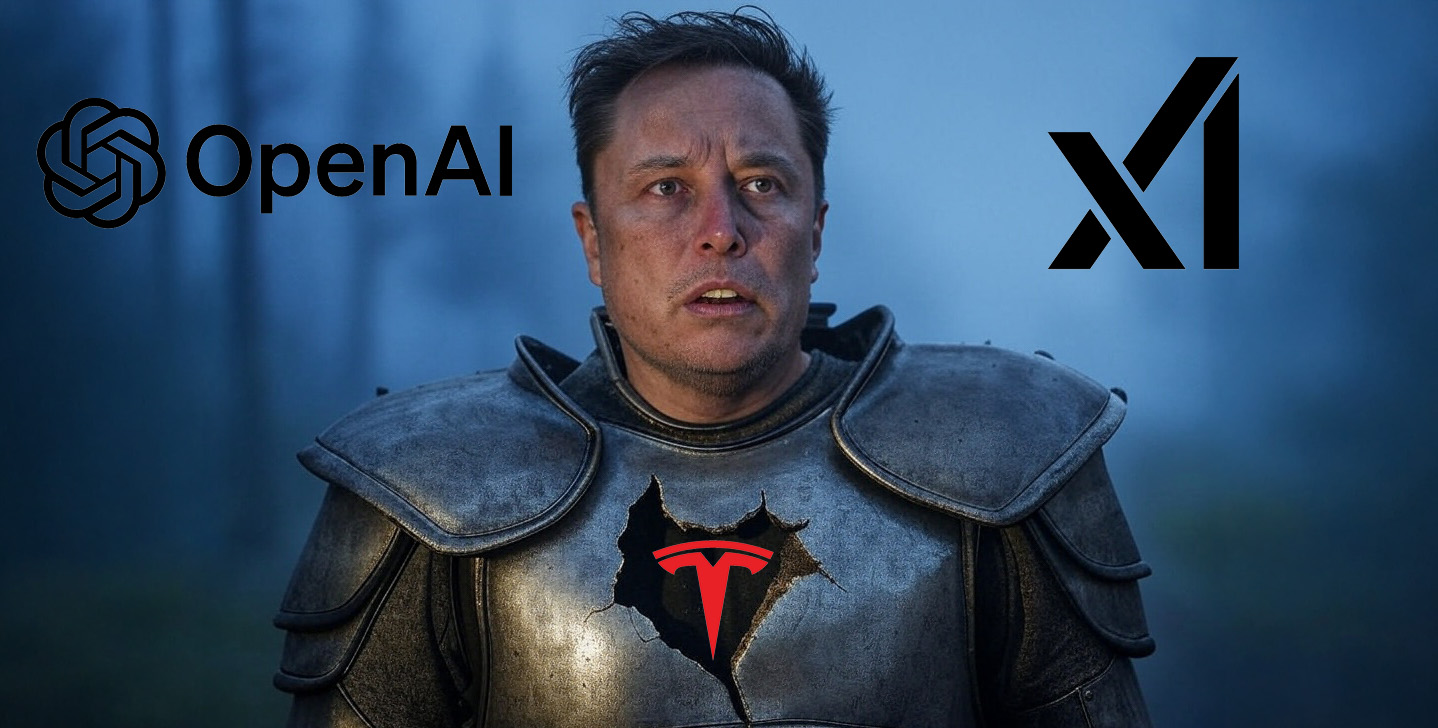
Elon Musk declared today that Tesla will be “one of the companies to make AGI” and “probably the first to make it in humanoid/atom-shaping form.” It’s the latest in a long string of grand AI predictions from the Tesla CEO.
The problem is that Musk has been making similar claims about AI breakthroughs for years, and he has been wrong every single time. Now, with Tesla’s sales declining for a second consecutive year and earnings crashing, this looks like yet another attempt to attach Tesla to the AI hype cycle.
A pattern of wrong AI predictions
Musk’s relationship with AI timelines follows a predictable pattern: make a bold prediction, miss it, then quietly push the goalpost forward.
In 2023, Musk claimed that Tesla cars had “a mind” and that the company had figured out “some aspects of AGI.” In 2024, he predicted AGI would arrive by 2025. When 2025 came and went without AGI, he pushed the timeline to 2026. Earlier this year, he declared that “we have entered the Singularity” and that “2026 is the year of the Singularity.”
Now, he’s claiming Tesla specifically will be among the first companies to develop AGI — in “humanoid/atom-shaping form” through its Optimus robot program.
This is the same playbook Musk has used with Tesla’s self-driving promises. He first announced in 2016 that all Tesla vehicles had the hardware necessary for full self-driving. From 2019 through 2025, he claimed every single year that Tesla would deliver the capability by year’s end. It never happened. As we documented in our year-end review, Musk’s top 5 Tesla predictions for 2025 didn’t happen. Tesla’s “Robotaxi” fleet in Austin still consists of roughly 30 vehicles, most of which aren’t in operation most of the time and still require safety monitors inside the cars.
Even on hardware, the promises don’t hold up. In November 2025, Musk was hyping Tesla’s 8th generation AI chip while he still hadn’t delivered on the self-driving promises made for the 3rd generation chip. In January 2026, he said the AI5 chip design was “almost done” — six months after claiming it was “finished”.
Tesla’s business tells a different story
While Musk talks about AGI and the Singularity, Tesla’s actual business is deteriorating.
Tesla delivered 1.63 million vehicles in 2025, a 9% decline from 2024 — marking the second consecutive year of falling deliveries. Revenue declined roughly 3% to $94.8 billion, the first year-over-year revenue drop in the company’s history. Earnings per share fell an estimated 33% from the prior year.
In Q1 2025, Tesla missed big on already terrible expectations, with profits dropping 71%. In Q2, earnings were down 23%. By the end of 2025, the decline in sales was confirmed to be accelerating.
Meanwhile, BYD delivered 2.26 million EVs in 2025, overtaking Tesla as the world’s largest EV maker. Tesla’s market share is eroding in Europe — with sales plunging 48% in Germany and 40% in France — and in China, where domestic competitors continue to gain ground.
Despite all of this, Tesla’s stock still trades at a massive premium over every other automaker, with a market capitalization of roughly $1.5 trillion. That valuation is entirely predicated on the idea that Tesla is not a car company but an AI and robotics company. It’s the narrative Musk needs to maintain at all costs.
The xAI conflict
The AGI claim is also complicated by Musk’s own actions. For years, he sold Tesla investors on the promise that the automaker would be the world’s leading real-world AI company. But then he founded xAI, a private AI company he controls, and began shifting AI resources and talent away from Tesla.
Tesla investors sued Musk for breach of fiduciary duty, alleging he used Tesla’s resources and reputation to build xAI’s infrastructure. As we reported, xAI has told its own investors it will build the AI for Tesla’s Optimus robot — meaning the AI that is supposed to justify Tesla’s premium valuation may not even be developed in-house.
Just yesterday, we covered how Musk’s xAI data center is undoing Tesla’s climate work — all in the name of AI. It’s a tangled web of conflicts.
Electrek’s Take
This is Elon Musk’s desperate attempt to attach Tesla to the AI bubble — a bubble that Tesla shareholders haven’t really enjoyed, given that the stock has mostly traded sideways over the past three years when you account for the volatility.
Top comment by Beario
The Pied Piper Musky keeps selling his promises. That's only part of the issue. Even large corporations like Bank of America bought into the narrative. They changed their rating of Tesla to a buy rating so of course the stock will be up today. Empty promises and the promise of future profits is all it takes.
We’ve been tracking Musk’s AI and self-driving promises for years, and the pattern is unmistakable. He makes a bold prediction, the deadline passes, and he moves on to the next thing. In 2023, it was “Tesla cars have a mind.” In 2024, it was “AGI by 2025.” In 2025, it was the Singularity. Now it’s Tesla making AGI in “atom-shaping form” — whatever that means.
As Tesla’s sales decline, revenue drops for the first time ever, and earnings crash, Musk is always looking for the next shiny object for investors to focus on. Robotaxis didn’t materialize. Optimus can’t reliably serve popcorn. The vague AI promises in Master Plan Part 4 haven’t translated into products. So now it’s AGI.
The uncomfortable truth is that there is no consensus in the AI research community on when, or even if, AGI will be achieved in the near term. There’s not even a clear, agreed-upon definition of what AGI means. But Musk keeps making these declarations with unearned certainty, and the financial media keeps amplifying them, because it’s good for clicks and good for Tesla’s stock price, at least temporarily.
Tesla shareholders would be better served if Musk focused on reversing the company’s sales decline and building competitive vehicles instead of posting about the Singularity on X.


FTC: We use income earning auto affiliate links. More.


Comments