
Are you wondering how much it would cost to charge up your EV if you added a home solar system to your roof? One EV owner did just that. After 14,000 miles of driving, he’s sharing his results online — and the real-world data might surprise you!
Last week, PeakD user KSteem took to the platform’s Solar Energy forum to share the data he’s collected powering his EV — a 2024 Chevy Blazer RS AWD that he’s put more than 14,000 miles on over the last two years — with electrons generated by his home solar system.
“I don’t drive a whole lot of miles compared to some,” writes KSteem, “but the total for the the 2 years is 14,480 miles, or about 7,000 per year. This averaged about 3.4 miles per kWh. I don’t drive softly, or attempt to conserve energy, I like to punch it and feel the acceleration way too much, so you could say these are conservative estimates, lol.”
KSteem estimates that driving similar miles in a vehicle that gets 20 mpg would cost about $2,100 (at $3/gallon), or about $1,400 at 30 mpg — which is right inline with the 22/29 mpg estimates for the ICE-powered Chevy Blazer. His costs, however, were much, much lower: $617.65 at an average price of $0.15/kWh.
“So as you can see, generally half or one third the cost of gas for the vehicle. However, that’s not all the savings or total ROI, this is what many leave out,” he adds. “Other cost savings occur through not having to oil changes, brake pads lasting years longer due to regenerative braking, no tailpipes to rust out, no mufflers to replace, no spark plugs to foul, no points to tune, no carburetor to tune or jets to clog, no catalytic converters to be stolen or replaced, etc., etc., etc.”
The only maintenance he’s done in the last two years? A tire rotation.
Diving into the data
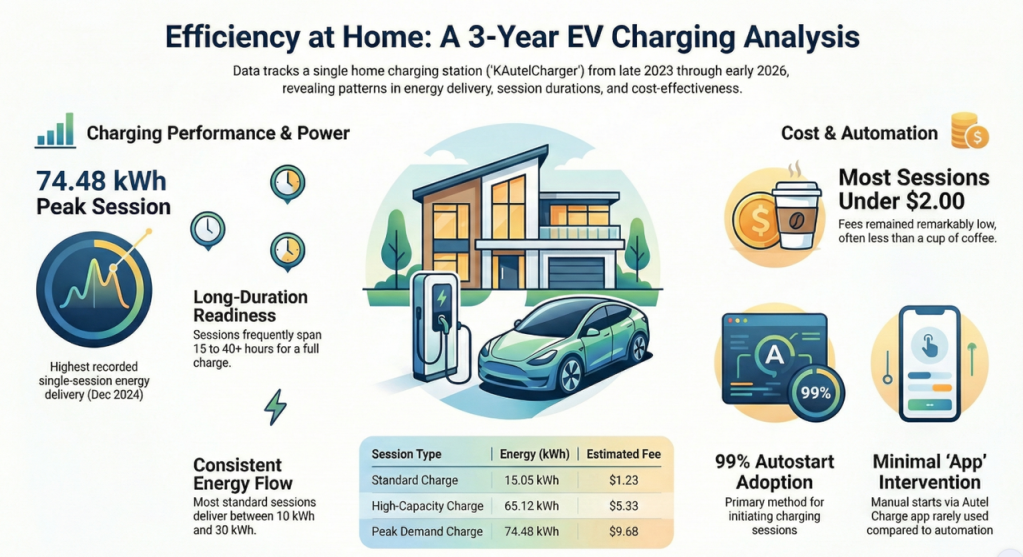
KSteem used Notebook LM to visualize the data he’s collected, which breaks down the cost of different charging session types on his Autel home unit as well, showing that even a maximum “top-off” charge at Peak Demand rates comes in at under $10, with most of his charging sessions costing less than $2.00.
“You will definitely want a Level 2 charger,” he writes. “I had to install a higher 50 Watt 220volt power breaker in the breaker box and run dedicated line to the Autel charger. This level 2 charger will recharge the battery for about 33 miles per hour of charge. This easily puts me at full charge in the morning, even from empty tank … I get right about 285 miles range from a full charge if driving normally. Only used a public charger once as a test on this vehicle, and only twice in my over 6 years of owning an EV.”
That’s the cost of charging as presented in kWhs and utility rates, but KSteem’s home solar system changes that equation quite a bit.
The solar data
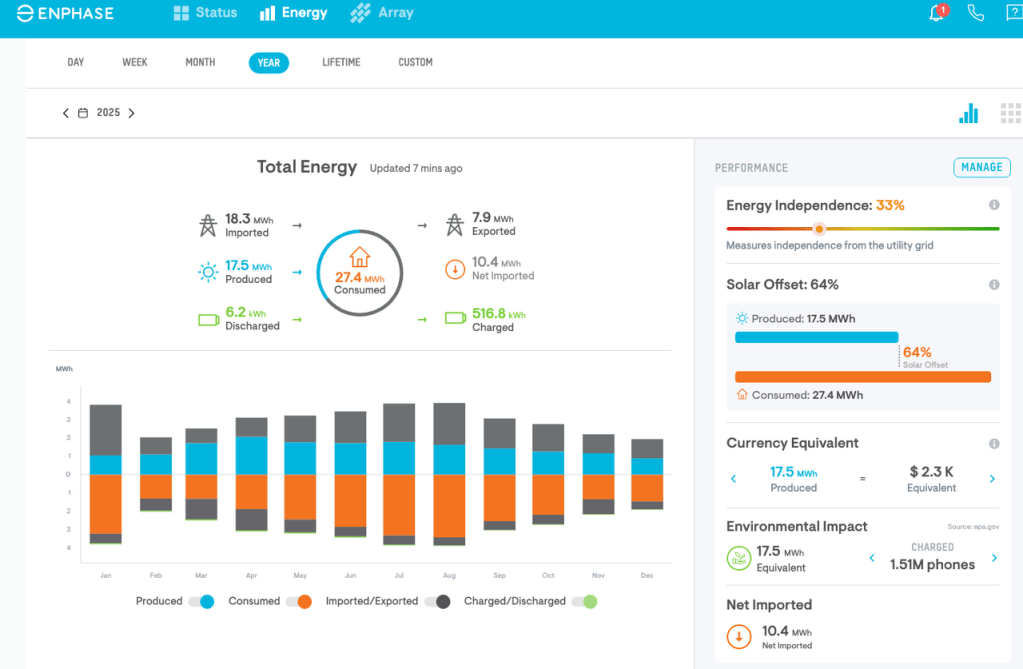
Looking at theyear 2025 as-a-whole, KSteem’s home consumed a total of 27.4 MWh of energy and generated ~17.5 MWh of energy, shaving about $2,300 off his total energy bills and producing about $2,042 more KWh of energy than his Chevy Blazer used that year.
That’s the real benefit of pairing an EV with a home solar system — the ability to make your own fuel, and help set the price of refueling by selecting when you want to charge, when you can. And, for KSteem’s part, he absolutely gets it.
“How much do you spend on gas and oil for your legacy fossil fuel car?” he asks. “I’m loving the avg. $20-$25 per month annual average that I spend in total is less than two oil changes!”
Same, buddy. Absolutely same.
Top comment by Oliver
Living in the Pacific Northwest, we were fortunate to have a large south facing roof and installed 29 solar panels costing about $25K after rebates. Our previous electric bills averaged about $300 per month plus we were spending another $300 to fuel two ICE vehicles. After replacing both vehicles with BEVs and charging at home or monthly bill is always $16.00...that's just for the service and fees and taxes. We generate more electricity than we use even through the rainy months from November to February. It's been about a year and a half, so another year and a half and it will have paid for itself.
Head over to PeakD to check out more of KSteem’s data and in-depth analysis, as well as more of his work compiling and analyzing his home solar data and energy savings, then let us know if you’ve got your own, similar data to share with us in the comments.
YOU MIGHT ALSO LIKE:
- Homeowners share surprising, real-world data after installing solar panels.
- Yes, an EV really CAN power your home – if it’s one of these [update]

If you’re considering going solar, it’s always a good idea to get quotes from a few installers. To make sure you find a trusted, reliable solar installer near you that offers competitive pricing, check out EnergySage, a free service that makes it easy for you to go solar. It has hundreds of pre-vetted solar installers competing for your business, ensuring you get high-quality solutions and save 20-30% compared to going it alone. Plus, it’s free to use, and you won’t get sales calls until you select an installer and share your phone number with them.
Your personalized solar quotes are easy to compare online and you’ll get access to unbiased Energy Advisors to help you every step of the way. Get started here.


FTC: We use income earning auto affiliate links. More.




Comments