

Like EVs, solar panels are sold with warranties – but what happens when the warranty runs out? A Swiss university study of solar installations from the 1980s and ’90s found many still generating most of their original power.
A team of researchers from the University of Applied Sciences and Arts of Southern Switzerland led by Ebrar Özkalay recently completed a study that solar panels can last a lot longer than their typical 25-year warranty might suggest.
Özkalay’s team looked at six solar systems installed between 1987 and 1993 that have been in continuous operation since, and found most panels still producing more than 80% of their original output after nearly four decades.
That’s a critically important number, since (in 2023), more than 70% of the renewable electricity capacity added came from PV, and total installations reached more than 1.6 TWp at the beginning of 2024 and covering 8.3% of global electricity demand. As such, it’s nice to know all those solar installation are going to be providing clean, emissions-free energy for decades to come.
Solar array degradation data
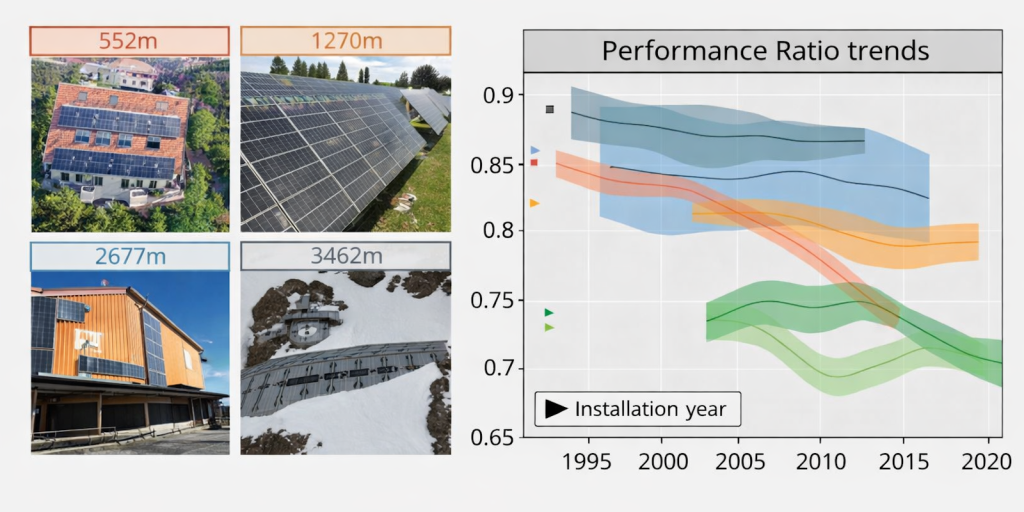
The sites provided the study with decades of performance monitoring data with lab tests on selected modules to see how output changed and what physical wear looked like inside the panels, finding that physical loads on the panels (high winds, extreme cold, physical impacts, etc.) were the biggest drivers of degradation, but the team also zoomed in on the materials that make up a module, sometimes called the bill of materials, or the full “ingredient list” of components. And that list can vary from module to module, with the study finding clear differences between to material quality, even within the same module family.
These findings highlight the durability of early 1990s module designs featuring EVA encapsulants, Tedlar backsheets, and robust framed glass/foil structures, supporting lower levelised cost of energy (LCOE), reduced carbon footprints, and extended performance warranties.
Taken altogether, it seems like the end of a solar array’s warranty – like the 3 year/36,000 mile warranty on a new Toyota – marks a financial milestone, not a technical ending. So, while PV energy output may decline over time, the slow and predictable degradation seen in these systems challenges business models, replacement schedules, and recycling policies designed around that “25 years” number.
In other words: your home solar array is probably going to last a lot longer than you think – and you shouldn’t be worried about buying a home with a 5-10 year old system already in place.
Top comment by Ben
Very reassuring that these dont just recover their initial investment, but continue to deliver value way beyond the period of depreciation.
Also, going off the rails a bit here, in these times of denigration of science, this is a nice reminder of how immensely useful it is to pragmatically collect measurements over many years to have clarity about something as opposed to shooting from the hip, using “common sense” (another word for guesswork), intuition, and prayers, when trying to determine what’s good for us and what’s bad.
People have a natural tendency to favour the latter over the former, because, we’re still 99,9% monkey on the inside. And with politics and other manipulators exploiting this tendency to favour instinct over calm observation and evaluation, these little nuggets of the scientific method at work are useful reminders of what we aspire to be.
You can explore the study titled, “Three decades, three climates: environmental and material impacts on the long-term reliability of photovoltaic modules” and explore its methodology and findings for yourself, then let us know what you think in the comments.
SOURCE: EEAS Solar, featured image by EnergySage.

If you’re considering going solar, it’s always a good idea to get quotes from a few installers. To make sure you find a trusted, reliable solar installer near you that offers competitive pricing, check out EnergySage, a free service that makes it easy for you to go solar. It has hundreds of pre-vetted solar installers competing for your business, ensuring you get high-quality solutions and save 20-30% compared to going it alone. Plus, it’s free to use, and you won’t get sales calls until you select an installer and share your phone number with them.
Your personalized solar quotes are easy to compare online and you’ll get access to unbiased Energy Advisors to help you every step of the way. Get started here.


FTC: We use income earning auto affiliate links. More.




Comments