
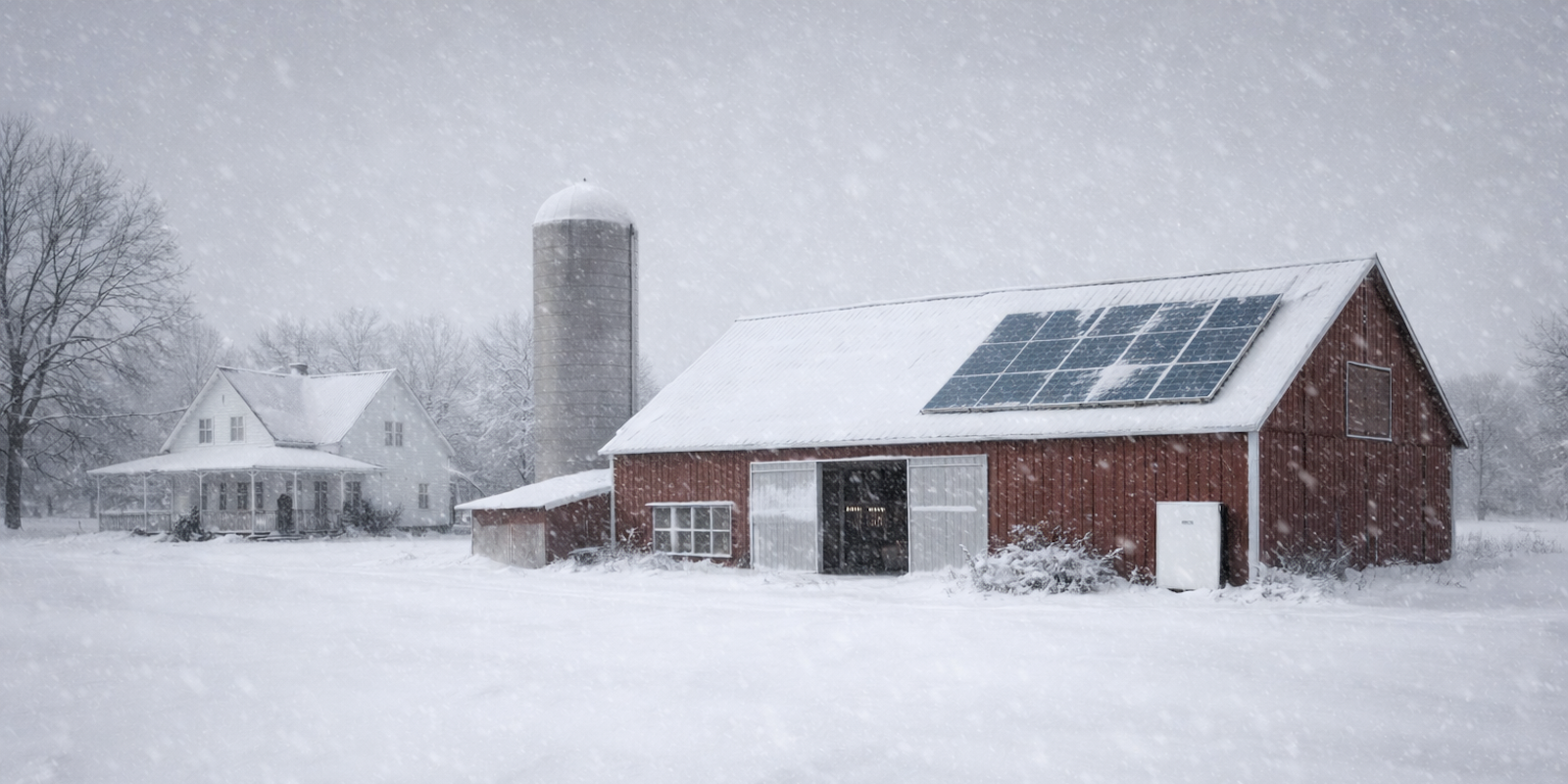
There’s no shortage of advice on how to size a home solar and battery system, but most of it assumes a suburban home with city services and outages measured in hours, not days. Rural homes play by different rules, especially during major winter storms. When ice and snow take down lines and your utility prioritizes restoring power to urban neighborhoods, having a home battery isn’t about convenience — it’s about damage control.
Power outages caused by severe winter storms can often last for days, not just hours. Unlike weather events in the summer, snow and ice compound your troubles, making it harder for restoration teams to reach lines and stretching response times 2–4 days or more in some parts of rural America. where crews have farther to travel and utilities have other priorities.
To make sure they’re not dependent on the grid, many Americans are turning to rooftop solar systems for their homes and (like my family) their barns – but solar panels alone won’t keep your lights on when the grid goes down. For that, you’ll need a battery.
Those facts together suggest a practical question: if the grid is out for several days, how much battery would you need to run your entire household as-is? And if that number’s out of reach, what can you live without to stretch the energy stored in a smaller battery?
Home battery, by the numbers

When sizing your home’s battery, Tesla suggests understanding your current energy use as a first step. That energy use is measured in kilowatt-hours (kWh), and represents the total amount of electricity your house consumes. To get a sense of your daily usage, take a recent utility bill and divide the total kWh by the number of days in the month. To keep the math simple, let’s say you used 900 kWh in 30 days. 900 kWh divided by 30 days equals 30 kWh/day.
30 kWh is a lot – but keep in that utility bills are often cyclical, and air conditioners (usually a home’s largest electrical load in the summer) aren’t usually a factor in winter months. The US Department of Energy (DOE) recommends identifying a limited set of your most critical loads, and using that as a baseline to drive daily energy use to about 12 kWh.
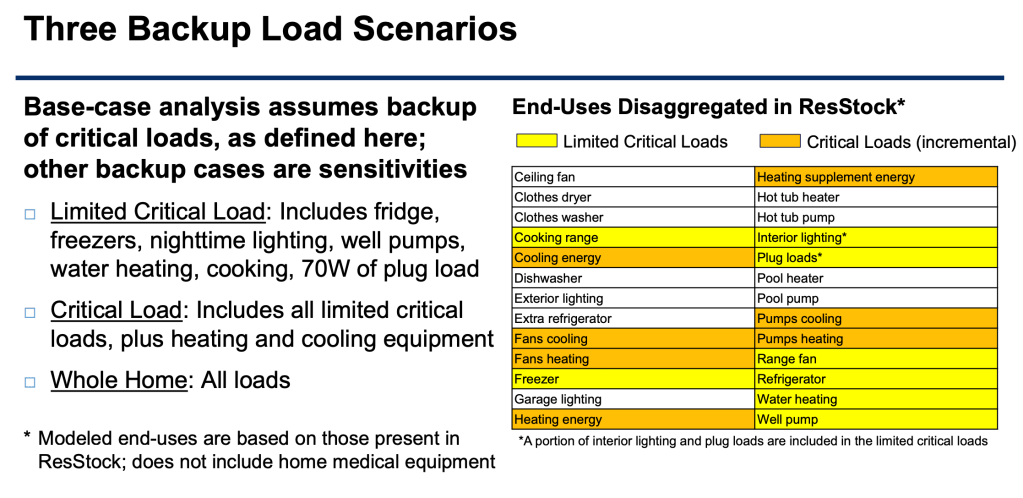
Next, size your battery system based on how long you want backup power. Tesla provides the following examples on its website using that Berkeley Labs 12 kWh/day number.
- Short outage (6 hours): Multiply your consumption by the fraction of a day an outage may last; example: 12 kWh/day x (6hrs/24hrs in a day = 0.25) = 3 kWh needed.
- Multi-day outages (2 days): Multiply daily consumption by number of days; example: 12 kWh/day x 2 = 24 kWh needed.
Then, you need to understand your power needs. This is the part that can get confusing, because while energy capacity (expressed in kWh) tells you how long your battery can run, power output (expressed in kW) determines how many things it can run at the same time. That’s important because some relatively high-capacity batteries out there offer just 3–5 kW of power, often just enough to power lights, a fridge, the occasional microwave or coffee pot, and not much else.
The good news if your budget forces you to go for one of the smaller battery options is that things like well pumps, microwaves, and even refrigerators don’t need to run constantly, or for very long, to effectively provide you with needed water during a prolonged winter storm outage – and a little planning can go a long way toward stretching a limited battery capacity.
You can check out some typical loads in the table, below …
| Electric Appliance | Typical Rating |
|---|---|
| Refrigerator | 0.8 kW |
| Wi-Fi | 0.15 kW |
| 70W of lightbulbs | 0.07 kW |
| Electric Stove/Range | 10 kW |
| Microwave | 1.2 kW |
| Single speed pool / well pump 1hp | 1 kW |
| Clothes washer | 1.2 kW |
| Clothes dryer | 6.5 kW |
… and figure out what kind of power needs you’ll need to keep you and your family happy during an outage. From there, check out the Tesla Powerwall (or one of the dozen other great options out there) and see which one is right for you.
SOURCES: Tesla, Berkeley Labs, via ETA Publications.

If you’re considering going solar, it’s always a good idea to get quotes from a few installers. To make sure you find a trusted, reliable solar installer near you that offers competitive pricing, check out EnergySage, a free service that makes it easy for you to go solar. It has hundreds of pre-vetted solar installers competing for your business, ensuring you get high-quality solutions and save 20-30% compared to going it alone. Plus, it’s free to use, and you won’t get sales calls until you select an installer and share your phone number with them.
Your personalized solar quotes are easy to compare online and you’ll get access to unbiased Energy Advisors to help you every step of the way. Get started here.


FTC: We use income earning auto affiliate links. More.



Comments