
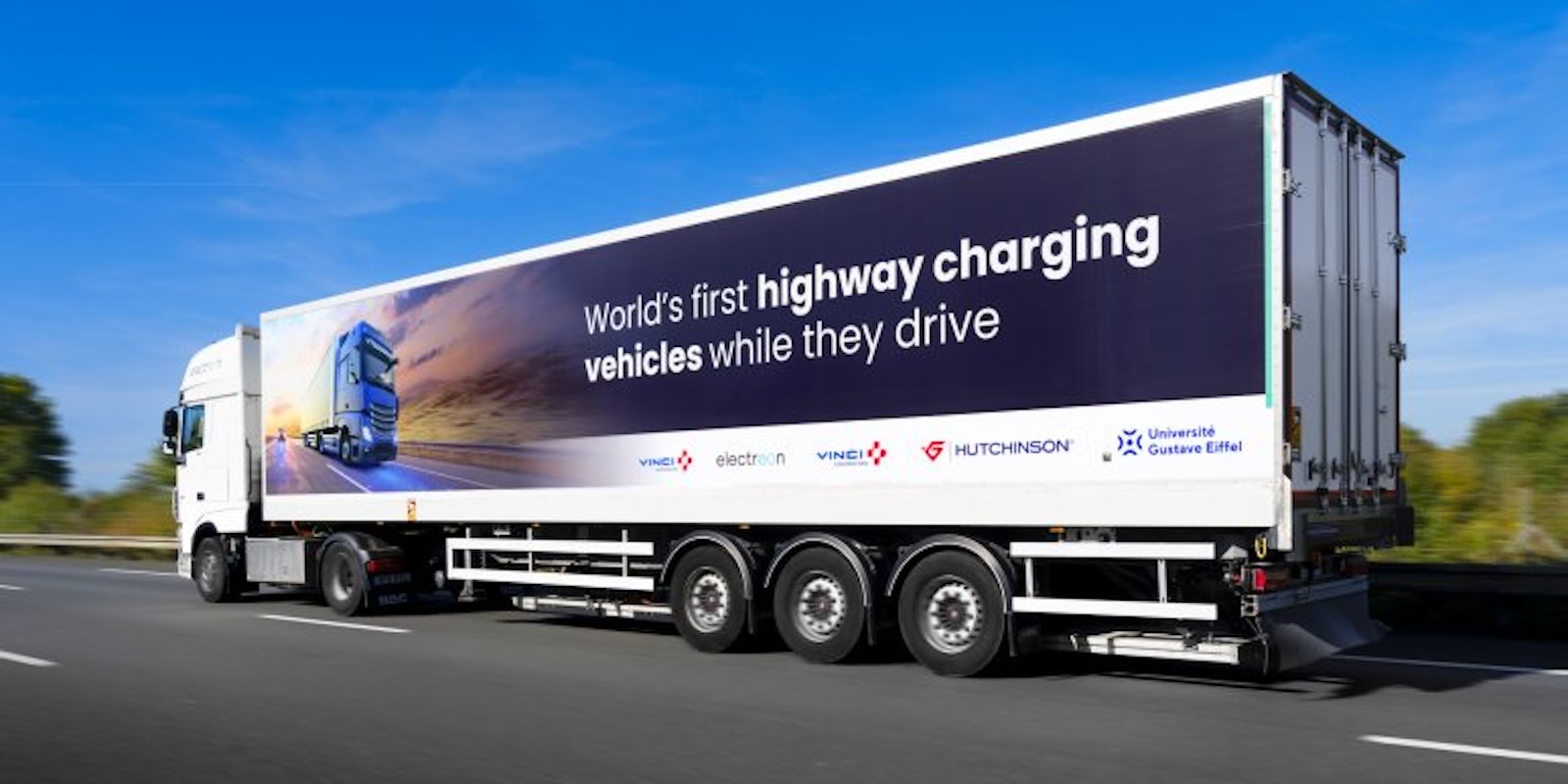
We’ve seen wireless charging, we’ve even seen in-road charging – but we haven’t seen anything like this. In a world’s first dynamic wireless charging trial on a 1.5 km stretch of road, four vehicles were able to charge at up to 300 kW!
Last week, four lightly modified battery electric vehicles – a semi truck, a box van, a passenger car, and bus – drove across a mile-long stretch of France’s A10 outside of Paris in a real-world test of a new wireless charging system’s performance. The result? The new wireless charging tech being co-developed by Electreon and Wireless and Vinci Group could transfer more than 300 kW of peak power (and more than 200 kW of average power) to the vehicles as they drove.
In case you missed it – that’s nearly as fast as the very latest Tesla Superchargers, without wires and without stopping.
Electreon says that, by deploying high-speed, in-road wireless charging in strategic locations along a transit bus fleet’s route in Tel Aviv, Israel, pilot project, they were able to reduce the size of the bus’ batteries from 400 kWh to about 45 kWh – a nearly 90% reduction in battery size, weight, and material needs without compromising uptime.
No word yet on next steps for this high-speed wireless charging tech.
Electrek’s Take


By proving that battery electric vehicles of all sizes can co-exist on a single stretch of charging road AND gain a meaningful number of miles of range in just a minute or two of driving, the Electreon and Vinci Group teams have proven that the technology is at least potentially useful. And, since you can’t insulate against magnetism, would work in snow, ice, or rain without putting operators and drivers at risk of slip and fall, or exposing the chargers to situations that could lead to excessive corrosion.
Top comment by Doggydogworld
gain a meaningful number of miles of range in just a minute or two of driving
A semi needs ~100 kW to maintain 100 km/h (62 mph) and ~150 kW at the faster speeds common on US highways. With 200 kW average charging power you'd need to wire 50% of highway miles for slow trucks and 75% for faster ones.
At 1 MW you'd only need to wire up 10% of the highway miles for slow trucks.
Burying the wires is sexy, but overhead catenary wires are cheap and well-proven with trains and buses. Power levels can be much higher, too. The US has ~50k miles of interstates a similar amount of primary non-interstate highways. At a made-up $1m/mile it'd cost $10 billion to wire 10% of our main highways with catenaries. You could reduce battery cost by ~100k per truck, so simple breakeven is around 100k trucks. But wires last a lot longer than trucks, so breakeven is actually more like 50k trucks. And smaller battery pack means the truck can carry more payload. And payload is what pays, so economic breakeven is even better.
It's a no brainer, but no company can do it alone and Musk would rather have "500 mile range" bragging rights than use his influence with government to actually improve GDP.
Besides, anything that makes it easier to charge an EV is worth celebrating.
SOURCE | IMAGES: Vinci Group.

If you’re considering going solar, it’s always a good idea to get quotes from a few installers. To make sure you find a trusted, reliable solar installer near you that offers competitive pricing, check out EnergySage, a free service that makes it easy for you to go solar. It has hundreds of pre-vetted solar installers competing for your business, ensuring you get high-quality solutions and save 20-30% compared to going it alone. Plus, it’s free to use, and you won’t get sales calls until you select an installer and share your phone number with them.
Your personalized solar quotes are easy to compare online and you’ll get access to unbiased Energy Advisors to help you every step of the way. Get started here.


FTC: We use income earning auto affiliate links. More.




Comments