
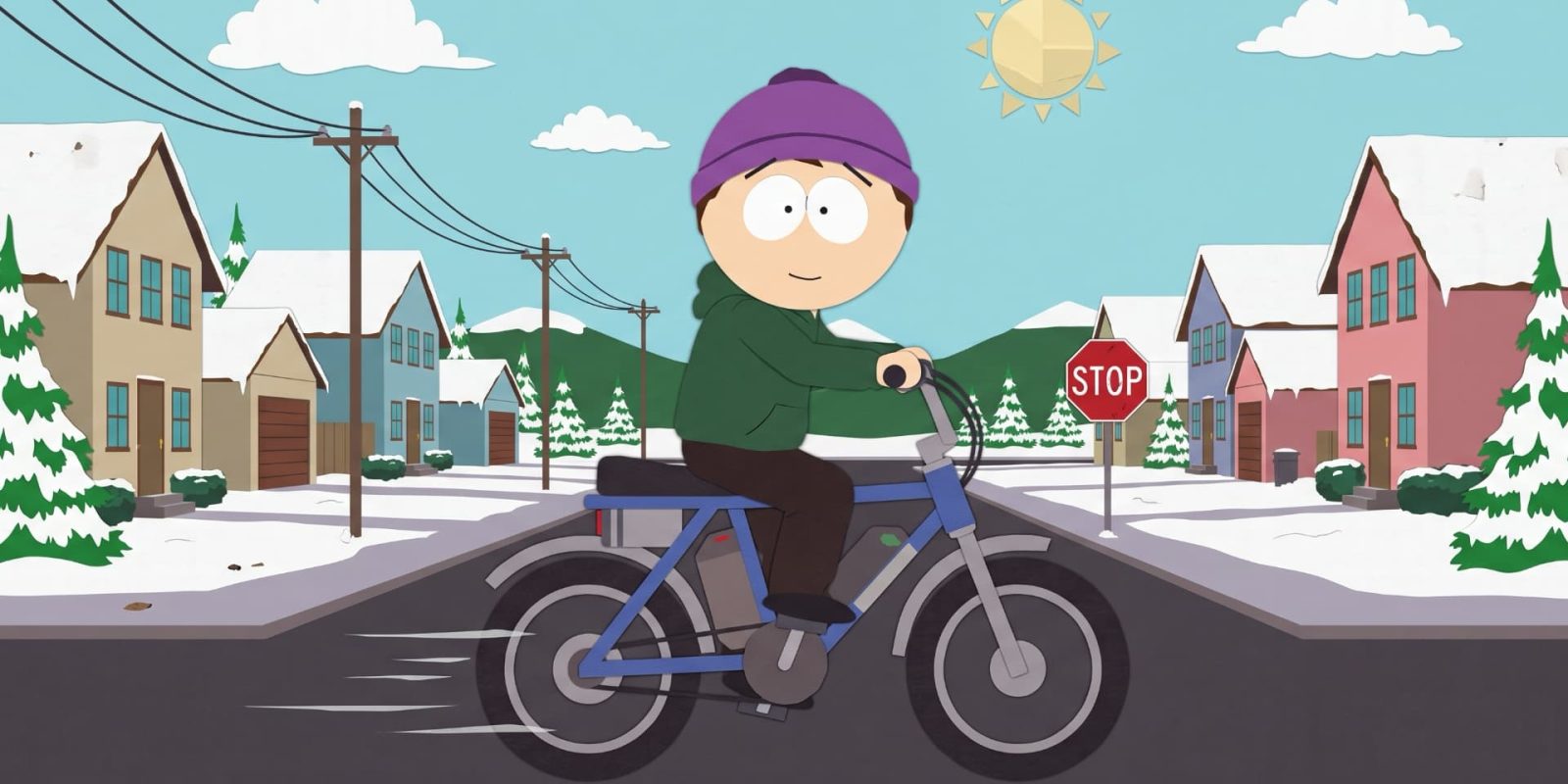
South Park has finally come for e-bikes. And perhaps surprisingly, underneath all the explosions, biker gangs, racist caricatures, and general South Park-ness of it all, the show actually managed to make some pretty insightful observations about the current state of e-bikes in America.
The Season 29 premiere, “South American Biker Gangs,” aired last week and revolves almost entirely around the growing popularity of e-bikes among kids – and the growing backlash against them.
As someone who has spent years covering this exact issue, I went into the episode expecting mostly cheap e-bike jokes. Instead, I found myself thinking, “Okay, they actually kind of understand this.”
But they also get plenty wrong.
Spoiler alert from here on out, but you probably knew that.
The episode begins with Cartman, a canonically 10-year-old child, convincing his mother to buy him a $2,000 Class 3 e-bike. At the bike shop, the salesman gives his mother perhaps the most responsible e-bike sales pitch ever delivered in South Park:
“That’s a very specific kind of bike, ma’am. I can sell it to you, but there are a lot of restrictions on where your son could ride it. He’d have to respect a lot of rules of the road.”
Approximately five minutes later, he’s dressed like a miniature hooligan, complete with a hoodie and face covering, blasting through red lights, terrorizing pedestrians, riding on sidewalks, and eventually launching through the front window of a Denny’s.
So far, the satire hits thick but is rooted in reality. Many young kids get their first e-bike this way, by begging their parents, and it’s often one of the faster models that parents don’t fully understand.
Obviously, most kids riding e-bikes aren’t jumping them through restaurants. But the show captures a very real problem: A relatively small number of highly visible, irresponsible riders can quickly become the public face of e-bikes.
We’ve watched versions of this play out in cities across the US. Someone riding responsibly at 20 mph (32 km/h) in a bike lane isn’t particularly memorable. Someone popping a wheelie through traffic certainly is.
The out-of-class e-bikes are perhaps just as big a problem
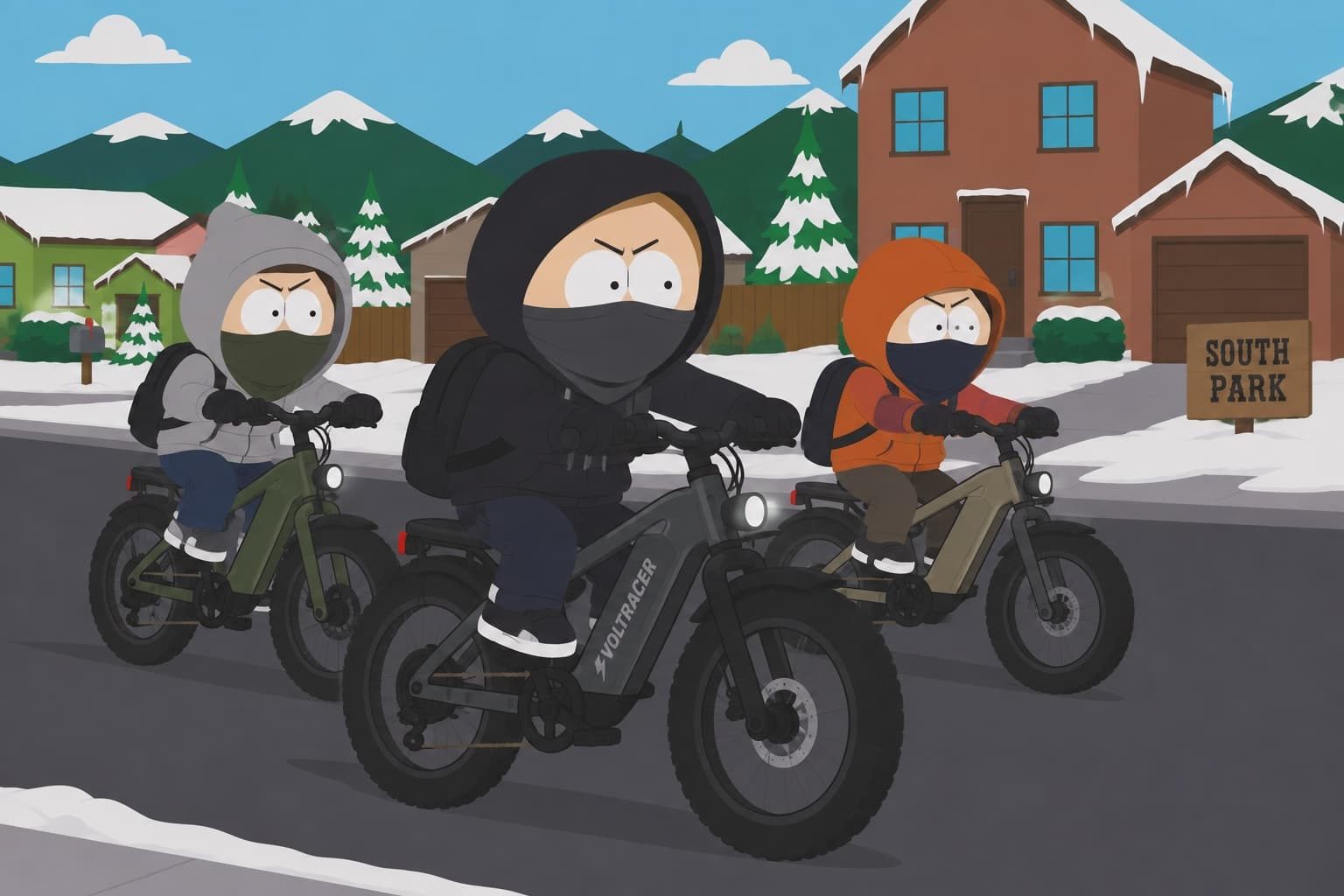
The episode also has fun with the increasing lengths e-bike retailers are going to offer riders higher performance, even if that pushes the bikes past legal limits.
Cartman’s bike is repeatedly described as a Class 3 e-bike. But eventually, his friends Stan, Kyle and Kenny discover a shop selling much cheaper Chinese e-bikes.
The kids pool their money to buy three e-bikes. The pre-teens then sign forms promising that they’re over 16 and won’t ride in prohibited areas, while everyone involved understands perfectly well that none of that is true. The Asian caricature of a seller even tells them aloud, “wink wink,” after each line.
It’s exaggerated, sure, but the underlying problem is very real.
The US has a reasonably clear three-class e-bike system on paper, but the marketplace has increasingly been filled with vehicles marketed as “e-bikes” that can exceed those limits considerably. Online sales make age restrictions and intended-use disclaimers especially difficult to enforce.
South Park even gets the speed-unlocking arms race right. After Cartman discovers that his friends’ cheaper bikes are faster than his expensive yet legal one, he convinces his mother to buy him a speed unlock dongle.
Anyone who follows the e-bike industry knows how familiar the concept is. Controllers, settings, apps, display menus, and aftermarket components can sometimes make regulatory speed limits feel like suggestions.
Where South Park goes way overboard: batteries
Then we get to China.
When the boys discovered those cheaper Chinese e-bikes, the seller tells them the bikes are “very dependable, there’s only a 60% chance they’ll explode in the garage.”
Obviously, that’s absurd. And while it’s satire, it plays into one of the biggest misconceptions surrounding e-bikes.
Yes, battery fires are real. Poorly manufactured lithium-ion batteries, damaged packs, improper chargers and other unsafe equipment can create serious fire risks.
But the overwhelming majority of e-bike batteries don’t spontaneously explode, including the enormous number manufactured in China. In fact, China even has stronger e-bike battery regulations than the US, believe it or not.
The real distinction isn’t simply “Chinese versus non-Chinese.” It’s properly engineered and certified equipment versus questionable batteries, chargers and components without adequate quality control.
Ironically, Kenny’s bike eventually does explode – but not because its battery spontaneously combusts. A gang of middle-aged spandex cyclists literally put a bomb on it (but more on that in a moment).
And somehow the e-bike still gets blamed. It’s classic South Park-ian beating a dead horse to demonstrate victim-blaming.
The spandex cyclists might be the best joke
Perhaps my favorite part of the episode is Randy Marsh, Stan’s father, becoming radicalized against e-bikes.
Stan’s mother explains that he can’t get an e-bike because, beyond the high price and perceived danger, his father already hates e-bikers because he’s a traditional cyclist who thinks they ride too fast and take over his bike lanes.
Soon, Randy has assembled the town’s middle-aged cyclists into an actual biker gang, complete with full irony here. As their spandex-clad gang grows into a giant peloton, motorists become furious because they can’t get around them.
That’s a complaint cyclists have heard for decades. Traditional cyclists spent generations being accused of taking over roads, slowing down traffic, ignoring laws, and generally not belonging there. Now some of those same criticisms are being leveled at e-bike riders – sometimes by cyclists themselves.
South Park takes that tribalism to its logical extreme, with Randy’s cycling gang literally raiding e-bike shops to destroy their e-bikes and assault the owners. When police hear that a “biker gang” is attacking stores, they immediately assume it must be the kids on e-bikes.
The e-bikers have become such convenient villains that they get blamed even when the cyclists are causing the trouble.
But the episode also understands why kids love e-bikes
Buried underneath all the absurdity is perhaps the most accurate observation in the entire episode.
After being unable to convince their parents to buy them e-bikes, Stan, Kyle, and Kenny secretly buy e-bikes with their own money. They cruise the streets together with them and enjoy riding trails together in the woods after school.
The kids remark on how great it is and how independent they feel. Stan points out that instead of sitting inside staring at their phones, they’re outside, actually doing something.
It’s actually one of the more understated segments of the episode, touching on part of the e-bike conversation that frequently gets lost.
For teenagers who can’t drive yet – and especially in US communities where getting virtually anywhere independently otherwise requires a car – an e-bike can represent an enormous amount of freedom.
It can mean getting to school, visiting friends, going to work, or simply exploring without asking Mom or Dad for a ride.
It makes the contrast even more stark with the perfect line delivered by the spandex-clad Randy, capturing the contradiction of the resulting moral panic when the town reacts to the growing numbers of kids riding around on e-bikes: “Somebody needs to do something! We need to get these kids off the streets and back inside, on their phones.”
Sure, it’s South Park exaggeration, but there’s a real point hiding underneath it.
We complain that kids spend too much time staring at screens. Then, when they discover a form of transportation that gets them outside with their friends, we overreact and try to ban it.
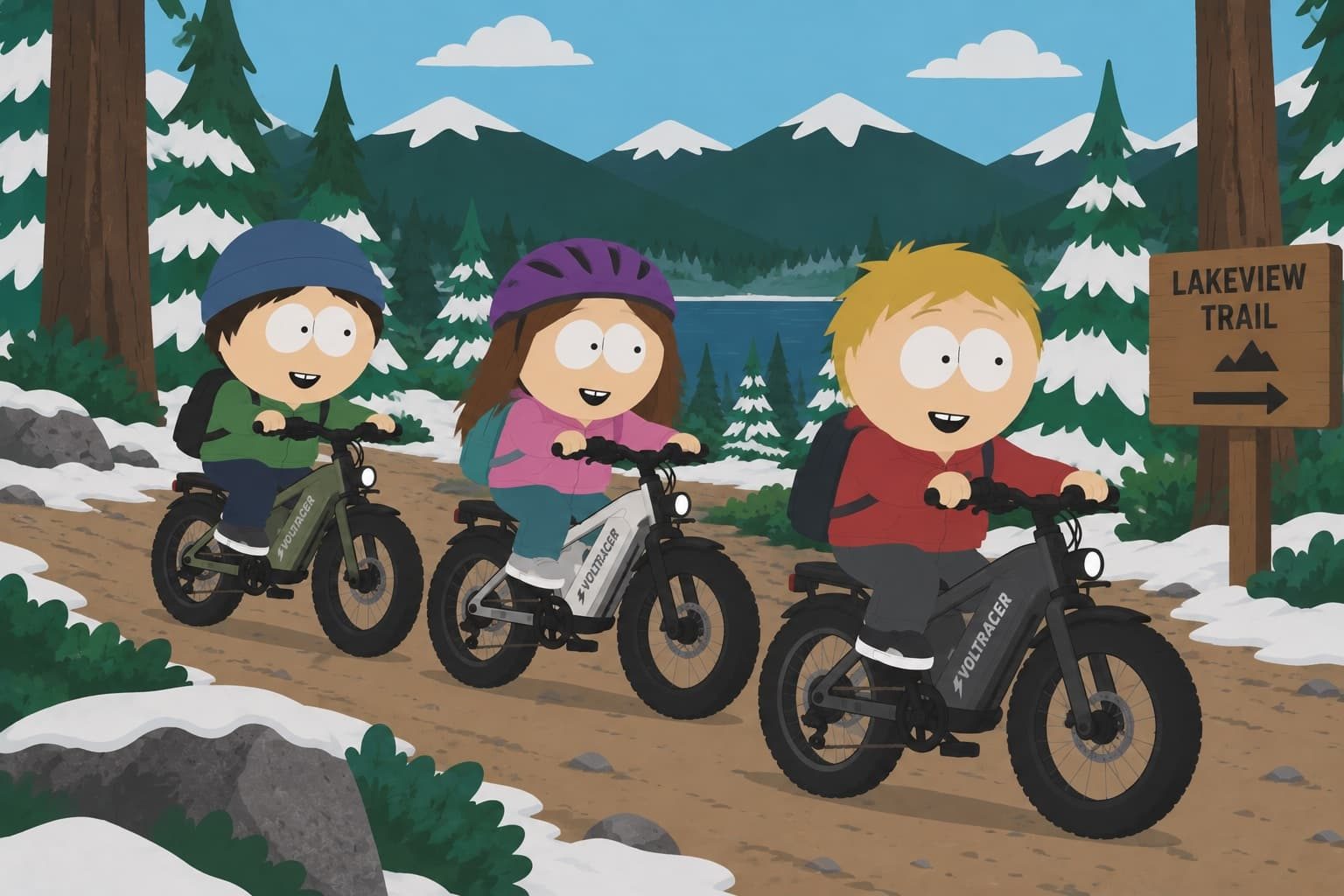
And then everybody bans e-bikes
Eventually, Kenny tries to explain to the spandex cyclists’ biker gang that most e-bike riders aren’t hooligans. He and his friends ride responsibly. He wants the adults to understand what e-bikes give kids like him. He wants to explain to them the independence, the camaraderie of shared experiences, the ability to exist in a third place without bothering anyone.
Then his bike explodes.
Again, not because of its battery – because Randy’s spandex bike gang planted a bomb on it.
But that distinction quickly disappears.
Kenny’s death becomes the social proof that e-bikes are dangerous, and the entire town rallies around banning them. Police confiscate every e-bike in town, loading them in the back of lifted pickup trucks to haul the bikes away while the kids are left slowly trudging back to school on foot.
It’s ridiculous, but it’s yet another sharp piece of satire in the episode, where one spectacular incident becomes representative of an entire category of transportation. The behavior of the worst riders becomes representative of every rider. And instead of targeting dangerous behavior, inappropriate vehicles, or unsafe equipment, the easiest political solution is simply getting rid of the thing everyone has decided is the problem.
Of course, South Park isn’t an e-bike policy documentary. It’s South Park. Everything is intentionally pushed well beyond reality. But underneath the explosions and absurdity, the episode gets something surprisingly important right.
There are legitimate problems surrounding today’s e-bike boom. Kids riding high-powered machines irresponsibly is one of them. Vehicles being marketed as e-bikes despite operating outside established electric bicycle classifications is another. Battery safety deserves serious attention, too.
But none of those problems means that e-bikes themselves are inherently the problem.
For millions of riders – including plenty of teenagers – they’re simply bicycles that let people travel farther, climb hills more easily, and experience a degree of transportation independence they might not otherwise have.
So yes, South Park spent 22 minutes making fun of e-bikes. Yet somehow, by the end, it also made a pretty compelling case for them.
[Note: All images in this article are generic AI-generated to keep us from getting sued over copyright law. Apparently, if I ride my pedal bike instead of my e-bike for 5 km, I can work off the environmental impact of those four AI image generations. I’ll be back in 20 minutes.]


FTC: We use income earning auto affiliate links. More.



Comments