
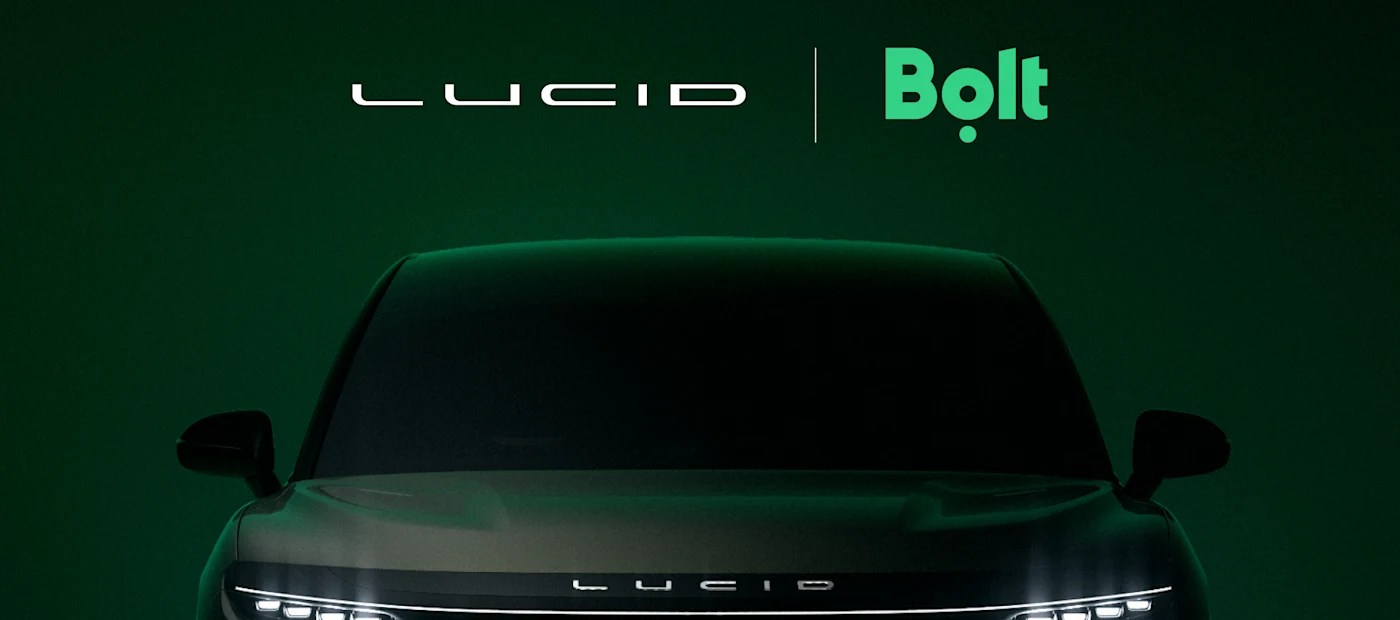
Lucid and Bolt announced a partnership today to build and deploy autonomous vehicles across Europe, with the ride-hailing platform aiming to put at least 25,000 self-driving Lucid EVs on its network.
It’s the second big autonomous-fleet deal Lucid has signed in just over a year. And it rides on a vehicle platform the company delayed six weeks ago.
What the deal covers
Bolt is Europe’s largest shared-mobility platform, with more than 200 million customers, 4.5 million drivers and couriers, and operations in over 50 countries and 850 cities. The company says the 25,000 vehicles are “a major step” toward a bigger goal: 100,000 autonomous vehicles on its platform by 2035.
The cars will be built on Lucid’s upcoming Midsize platform and designed for SAE Level 4 autonomy. The two companies plan to co-develop an “ADS-ready” vehicle from the product stage, and it’s expected to use NVIDIA Hyperion, a production-ready reference architecture that bundles high-performance compute with a standard sensor suite.
Bolt is taking the operator role. Its dedicated unit, Bolt Autonomous Driving Solutions, will define the vehicle, software, and safety requirements, build the fleet infrastructure and city partnerships, and it intends to own and operate the fleet itself. On Lucid’s side, the work runs through the newly created Lucid Technologies, which pulls the company’s AI, driver-assistance, and autonomy efforts under one roof.
“Shared autonomous mobility offers the perfect opportunity to extend our unique technology beyond consumer vehicles,” Lucid CEO Silvio Napoli said in the announcement. Bolt founder and CEO Markus Villig framed it as a systems problem, saying autonomous driving in Europe “requires data, software, vehicles, and operations to work as one system built for European roads and regulation.”
Lucid’s second robotaxi bet in a year
This isn’t Lucid’s first swing at autonomous fleets. In July 2025, Uber committed to deploying 20,000 Lucid Gravity robotaxis in the US, running Nuro’s Driver system, alongside a $300 million investment. Uber has since built its stake in Lucid up to roughly 11.5%, part of a wider push to own alternatives to Waymo.
The Bolt deal is a different shape. It’s Europe instead of the US, the Midsize platform instead of the Gravity SUV, and NVIDIA Hyperion instead of Nuro. On paper, Lucid now has commitments for 45,000 autonomous vehicles across two continents.
But look at what Lucid is actually supplying in both deals: the vehicle. Not the software that drives it. Hyperion is compute and sensors, not a self-driving system, and the announcement says the partners will still “work with autonomous-driving technology partners” to make Level 4 work. So the hard part, the part that turns a Lucid into a robotaxi, is still an open question.
The platform isn’t built yet
In the case of this Bolt deal in Europe, there’s a bigger catch. The Midsize platform these 25,000 vehicles depend on doesn’t exist yet, and Lucid just pushed it back.
On August 4, in its Q2 “operational reset,” Lucid delayed the Midsize program. That reset has defined Lucid’s year. Napoli became permanent CEO on June 1, the company cut 18% of its workforce — about 1,500 jobs — later in June, withdrew its 2026 production guidance, and delivered just 3,953 vehicles in the second quarter.
Neither company gave a deployment date for the Bolt fleet. Bolt’s 100,000-vehicle target is a decade out, in 2035.
Electrek’s Take
Bolt is a real platform with real scale, and 850 cities’ worth of operating data is exactly the kind of asset a serious autonomy operator needs. This isn’t a vaporware startup announcement.
But two things jump out. Lucid keeps announcing enormous autonomous-fleet numbers while it’s laying people off, pulling its own guidance, and delaying the exact product these fleets are supposed to be built on. First 20,000 with Uber, now 25,000 with Bolt, from a company that made fewer than 4,000 cars last quarter. And in every one of these deals, Lucid is the hardware vendor. The autonomy comes from someone else.
So even though these are significant demand drivers, demand will only come once these companies have solved autonomy at scale, and that has yet to happen.
If you’re eyeing an EV, powering it with home solar can cut your driving costs to nearly zero. With electricity rates up almost 10% last year and expected to keep climbing, going solar is one of the best ways to protect yourself against rising costs. And with lease and PPA options, you can do it with zero upfront cost and start saving immediately. If you want to find the best deal, check out EnergySage. It’s a free service with hundreds of pre-vetted installers competing for your business, so you save 20 to 30% compared to going it alone. No sales calls until you pick an installer. Get your free quotes here.


FTC: We use income earning auto affiliate links. More.




Comments