
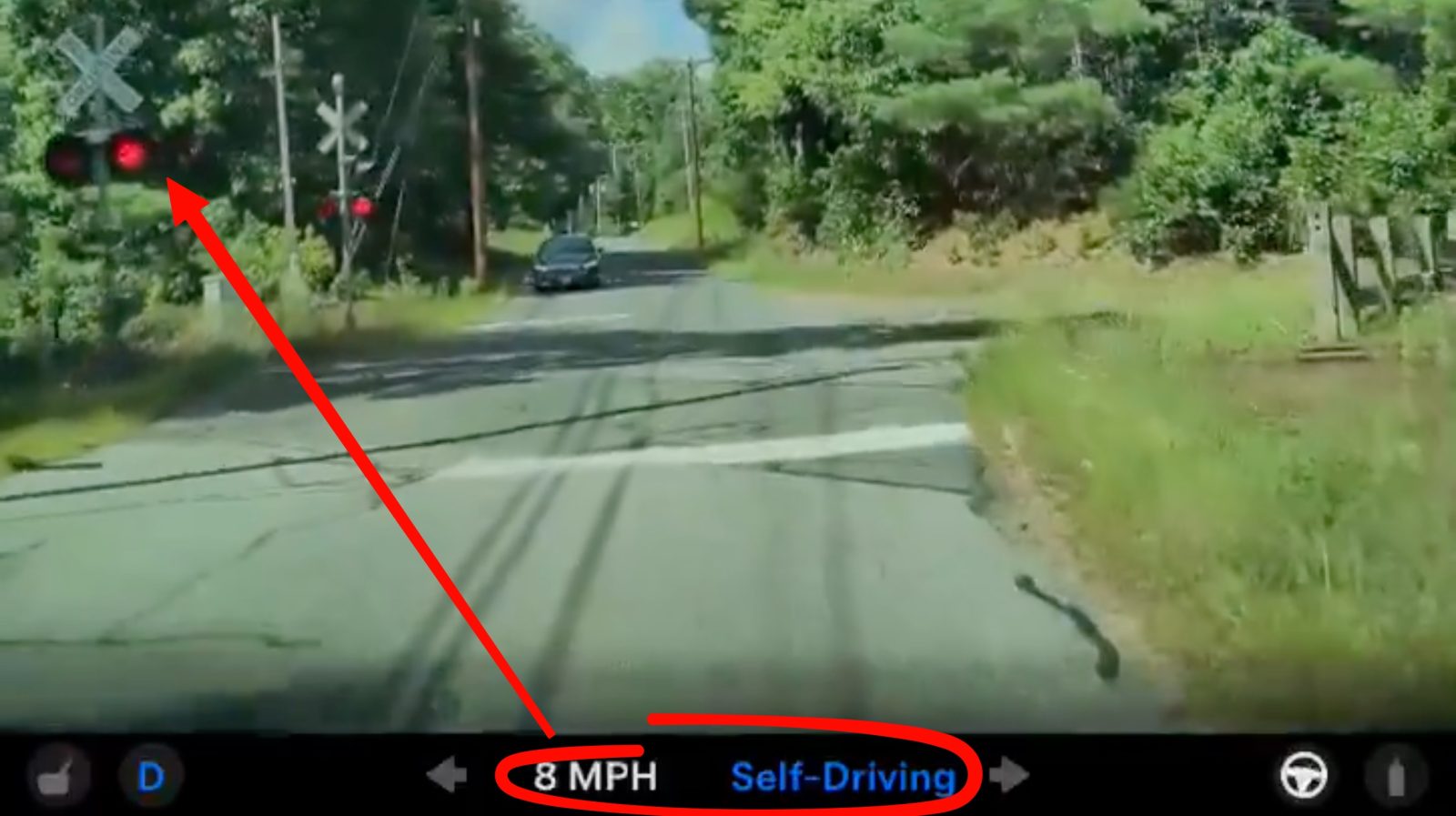
A Tesla running the latest version of “Full Self-Driving” failed to stop at an active railroad crossing this week and nearly drove straight into a passing train, according to the driver and as evidenced in dashcam footage.
The kicker: it was running FSD v14.3.7, the newest build Tesla has released — and it’s at least the third time this year that Electrek has documented FSD trying to drive a Tesla into a train.
FSD kept going as the train horns blared
Lei Xing, a well-known auto journalist and co-host of the China EVs & More podcast, shared dashcam video of the incident on X Tuesday.
“Would have been ran over by the [train] had I not braked,” he wrote. “The rail road crossing lights were flashing and the train horns were pretty loud.”
The video shows the Tesla approaching the crossing at 9 mph with the “Self-Driving” indicator active. The crossing signals were flashing and the train was audible and visible, but the car only slowed down before attempting to cross right when the train was coming. Lei braked manually to avoid ending up on the tracks.
When asked directly which software version the car was running, Lei confirmed it was 14.3.7 — Tesla’s most recent FSD release, currently rolling out to AI4 vehicles.
That detail matters. Tesla rolled out FSD v14.3 earlier this year with release notes that specifically claimed improved handling for “rare and unusual objects extending, hanging, or leaning into the vehicle path” — the kind of language that should cover a lowered gate or a moving train. Seven point-releases later, the car still drove toward one.
This keeps happening
Railroad crossings have become one of the most consistent and dangerous failure modes for Tesla’s driver-assistance system.
In March, we reported on a Tesla on FSD that drove straight through lowered railroad crossing barriers in West Covina, California, making no attempt to brake until after impact.
A month later, a Texas owner shared footage of his Tesla crashing through a railroad gate seconds before an oncoming train — he had to floor the accelerator to clear the tracks, and the crossing arm struck his window on the way through. And back in 2025, a Tesla in “self-driving mode” in Pennsylvania was actually struck by a train after turning onto the tracks.
NBC News, which first surfaced the pattern, documented more than 40 accounts of Tesla vehicles failing at railroad crossings.
Regulators are already watching
The failures have drawn government attention. NHTSA opened an investigation into FSD in October 2025 after 58 reported crashes, covering incidents where the system ran red lights and drove into oncoming traffic.
That probe has since expanded to cover roughly 2.9 million FSD-equipped vehicles, one step short of a formal recall demand. Senators Ed Markey and Richard Blumenthal separately pushed the agency to specifically investigate the railroad crossing failures, calling them a “disturbing safety risk.”
Tesla continues to market the system as “Full Self-Driving” while its own manual states the driver must remain fully attentive and ready to take over at any moment.
Electrek’s Take
Top comment by Anthony Womack
As I read this, it made me think of a question that I personally never thought about before. Does none of the autonomous driving systems listen for sounds? IE, train horns, ambulance sirens etc?
Seems like an issue. If it is trying to "act like a human", that is one of the ways we know those things are coming.
I actually asked Xing which version he was running because, frankly, I thought Tesla had addressed this. It hadn’t. This is the newest FSD software available, and it still can’t reliably recognize the single most obvious “do not proceed” signal on the road: flashing lights, gates, and a train.
Driving into a train is about the worst-case outcome there is, and handling railroad crossings is hardly a rare scenario that an autonomous system needs to handle.
If you really believe Elon when he says again that unsupervised self-driving is coming to consumer vehicles this year, you really need to reevaluate.
As electricity rates keep climbing, going solar is one of the smartest ways to lock in your energy costs and protect against rising bills. EnergySage makes it easy to compare quality local installers, get transparent pricing, and find the best deal on solar for your home. It’s free to use, and you won’t get sales calls until you select an installer and share your phone number. Your personalized solar quotes are easy to compare online and you’ll get access to unbiased Energy Advisers to help you every step of the way. Get your free quotes here.


FTC: We use income earning auto affiliate links. More.





Comments