

Tesla has started building its next-generation Megapack 3 grid battery, with the first units rolling off the line at the company’s new Megafactory in Brookshire, Texas.
The plant went from groundbreaking to production in 16 months and is designed to build 50 GWh of Megapack 3 a year. That’s the version Tesla says packs roughly 28% more energy into the same footprint as the Megapack it replaces.
Tesla confirmed the production start on Wednesday through its Megapack account, noting the Brookshire facility has “a designed capacity of 50 GWh/year dedicated to Megapack 3.” It’s the physical follow-through on the Megapack 3 and Megablock reveal from last September, when Tesla laid out the specs but hadn’t yet shipped a unit.
So here’s what actually changed between Megapack 3 and the versions before it.
What’s different about Megapack 3
A single Megapack 3 holds about 5 MWh, up from 3.9 MWh on the Megapack 2 XL. That’s roughly 28% more storage in a box that takes up the same ground.
Tesla gets there mainly by using bigger cells. Megapack 3 moves to a larger 2.8-liter cell format, which lets Tesla cram more capacity into each cabinet without growing the enclosure.
The other big change is plumbing. Tesla says Megapack 3 cuts thermal-system connection points by 78% versus the previous generation. Fewer connections means fewer places for a liquid-cooled battery to leak or fail, and less labor to assemble and service. Not glamorous. But at grid scale, reliability and install time are the whole game.
For context, the Megapack has been climbing this curve for years. It launched in 2019 at around 3 MWh, then Tesla squeezed it up to 3.9 MWh with the 2 XL in 2022. Megapack 3 is the biggest single jump yet.
The real shift is the Megablock
A Megablock bundles up to four Megapack 3 units (about 20 MWh) with the transformer and switchgear already integrated at the factory. On older Megapacks, a lot of that medium-voltage wiring happened in the field, one of the slowest and most expensive parts of building a battery farm.
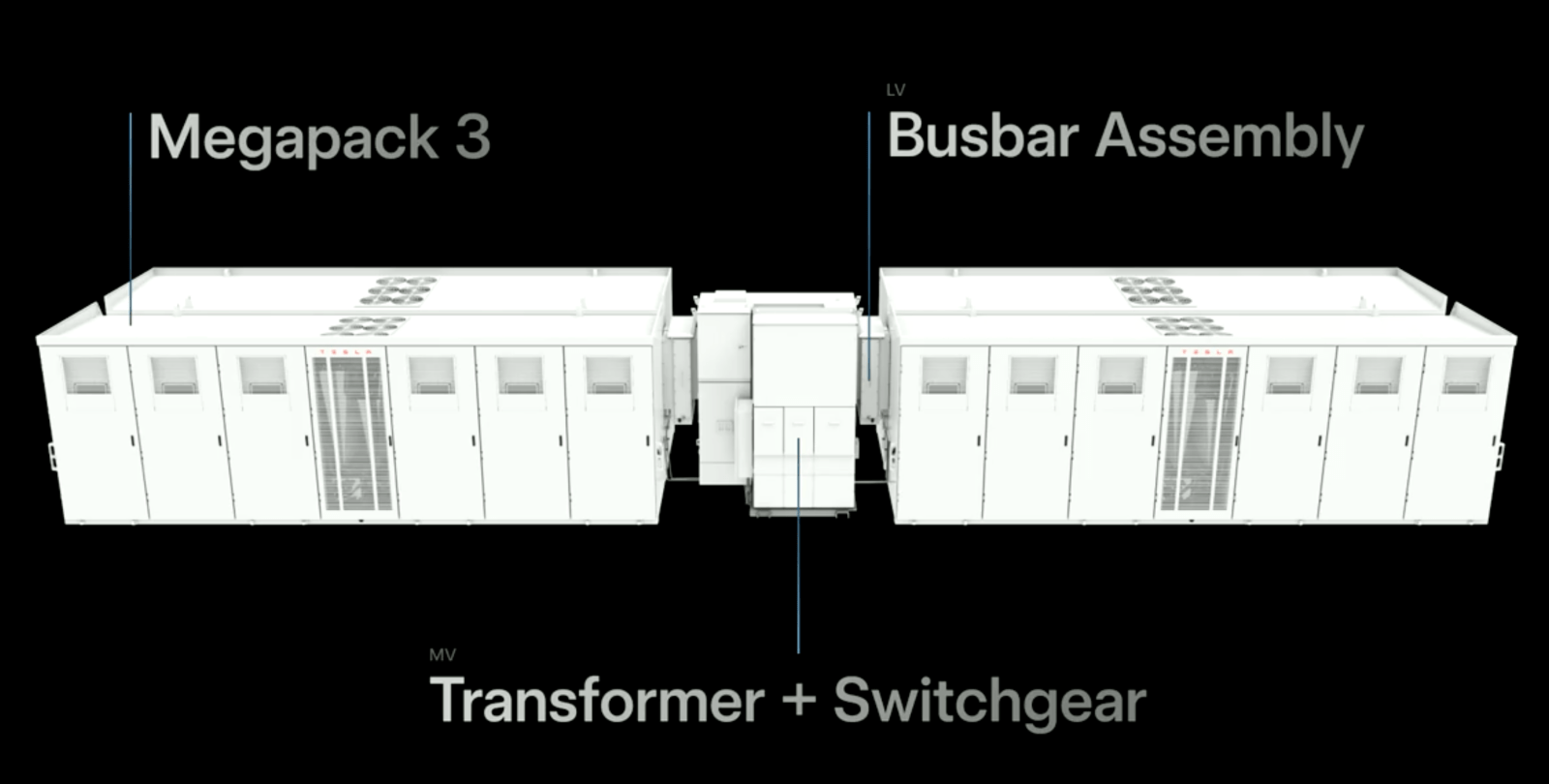
By moving that work indoors, Tesla says it can hit 248 MWh per acre and deploy 1 GWh in 20 business days, with installation running about 23% faster than the current approach. The pitch is simple: fewer trucks and electricians on site, and faster interconnection.
Tesla just signed a $5 billion, 25 GWh Megapack deal with NatPower in Europe, and data-center operators are buying storage as fast as Tesla can build it. A denser unit that goes up faster is exactly what those customers are asking for.
Why the new factory matters
Brookshire is Tesla’s answer to a supply problem. The company’s Lathrop, California Megafactory and its Shanghai plant have been running flat out, and Tesla announced this third Megafactory specifically to add capacity as competition from CATL, Fluence, and BYD heats up.
At 50 GWh a year dedicated to Megapack 3, Brookshire could quickly become Tesla’s largest energy storage manufacturing facility, beating Lathrop’s full output on its own. And building it in 16 months is fast for a facility this size.
Electrek’s Take
It’s impressive how quickly Tesla can get a new factory to production.
Top comment by Prana686
Curious to see how this will impact their costs and profits per MWh.
The chart I've kept on this for the past few years has Q2-26 as the lowest revenue/MWh yet at $232,500 along with the lowest profit/MWh by a wide margin at $47,400 compared to next lowest of $70,100 back in Q4-24
Lowest cost/MWh they've shown was Q1-26 at $165,500 and was up about 12% Q2-26 for $185,100 on this latest earnings
Very curious to see how these numbers evolve with both the new factory and the new pack design. Must say though, BESS is a tough game to win when your cell supplier also builds a competing product...
However, the spec that matters most with Megapack 3 isn’t the 5 MWh. It’s the Megablock. Grid batteries don’t fail to get built because the cells aren’t good enough — they stall on interconnection, permitting, and the slow, expensive work of wiring gear in a field. Moving that into the factory is the kind of unglamorous manufacturing win that actually moves deployment numbers, and it’s the same playbook Tesla ran on the Supercharger and that turned out more than alright.
The open question is cells. Tesla needs a lot of large-format cells to fill a 50 GWh factory, and a chunk of that still depends on suppliers and on how the current US tariff picture shakes out for imported LFP.
Tesla has already started reporting lower gross margins on its energy business due to high tariffs on LFP cells, and its own production isn’t coming close to 50 GWh.
If you’re adding a home battery or solar to lock in your own energy costs, the same math that makes grid storage attractive works on your roof. With electricity rates up almost 10% last year and expected to keep climbing, going solar is one of the best ways to protect yourself against rising costs. And with lease and PPA options, you can do it with zero upfront cost and start saving immediately. If you want to find the best deal, check out EnergySage. It’s a free service with hundreds of pre-vetted installers competing for your business, so you save 20 to 30% compared to going it alone. No sales calls until you pick an installer. Get your free quotes here.


FTC: We use income earning auto affiliate links. More.





Comments