
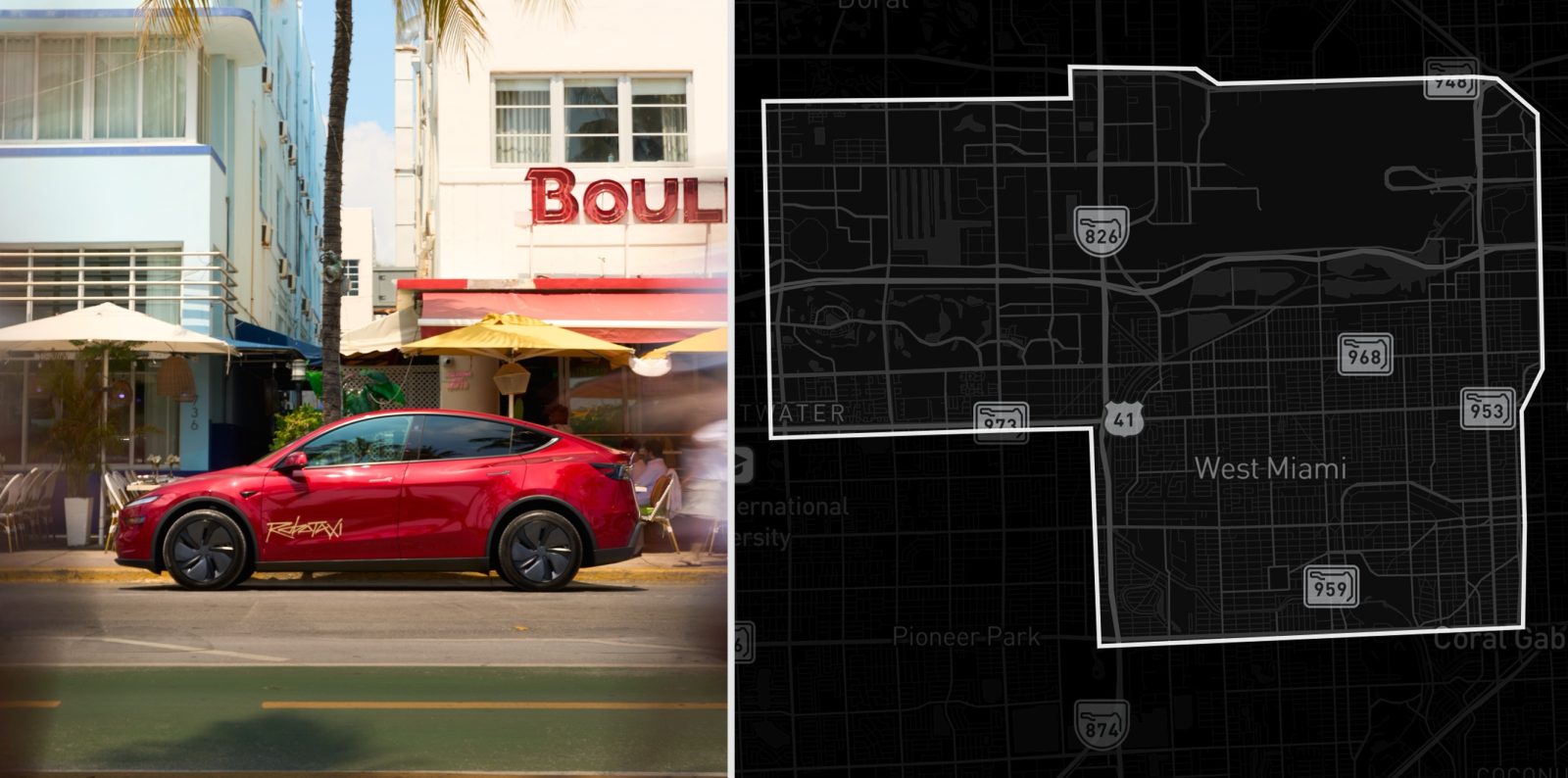
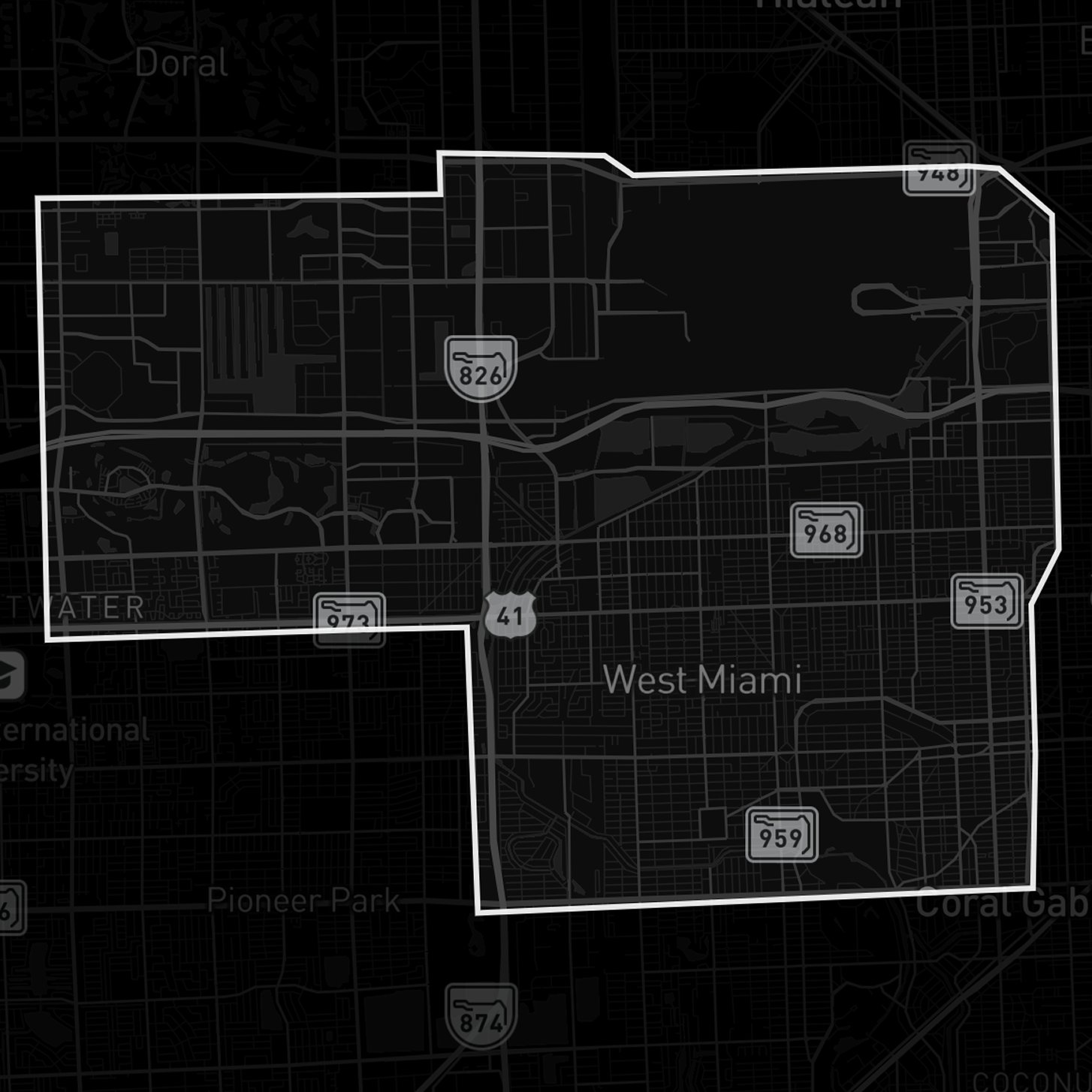
Tesla has mapped out a Robotaxi service area in Miami, publishing a geofence that covers only a small slice of the metro — mostly West Miami and a strip stretching toward Doral and Sweetwater.
It’s the latest city Tesla has drawn a box around, but the announcement lands with a thud when you consider what’s happened in Texas over the past year.
A geofence, not a launch
Tesla’s Robotaxi account shared the Miami map, showing a coverage zone bounded roughly by SR-826 (the Palmetto) to the north, US-41 to the south, and a handful of state roads on the edges. It leaves out the vast majority of Miami-Dade — no downtown Miami, no Miami Beach, no airport, and only a corner of Coral Gables.
Miami has been on Tesla’s list for a while. The company named it among five new US cities targeted for the first half of 2026, alongside Phoenix, Orlando, Tampa, and Las Vegas. That timeline has since quietly softened from a firm “1H 2026” to a vaguer “preparations underway.”
Drawing a service area on a map is the easy part. Tesla has done it repeatedly — in Austin, then Dallas and Houston, each launched with tiny geofences and a supervisor sitting in the car.
The Texas problem Tesla still hasn’t solved
Tesla launched Robotaxi in Austin in June 2025. A year later, the service is still tiny.
City officials peg Tesla’s Austin fleet at roughly 50 vehicles, and the unsupervised portion — the cars actually running without a Tesla employee behind the wheel — is far smaller. Recent data shows Tesla’s unsupervised fleet has been shrinking, not growing, sliding from a peak of about 25 cumulative vehicles down toward roughly 14 active cars.
Tesla eventually expanded its map to cover the entire Austin metro — but with only about 20 vehicles running, the bigger box changed little for riders. Wait times routinely stretched past 15 minutes, and in more than a quarter of checks, no cars were available at all.
The reason Tesla isn’t scaling isn’t a mystery, and it isn’t a mapping problem. It’s safety, and Musk has said so himself.
On Tesla’s Q1 2026 earnings call, Musk told investors that safety validation is the limiting factor for Robotaxi expansion, and that Tesla is holding back until improvements arrive in a rewritten FSD v15. Tesla has reported a string of crashes to NHTSA in Austin, and independent analysis has pointed to a crash rate roughly four times worse than the average human driver.
Electrek’s Take
Top comment by taverngeek
The problem for Tesla is that Musk has misstated the engineering problem of FSD needing to be as good as human drivers so he has decided FSD can rely upon cameras like a driver relies upon their eyes. But the definition of negligence is what a reasonable person would do. So, for the inevitable FSD accidents then the victim's lawyers would argue that a reasonable person would include lidar because the data is so much better at showing what is where than mere cameras. It would be a bad argument for Tesla's lawyers to claim that lidar isn't that good when the competition relies upon it and there are plenty of academic papers on how lidar is better than cameras.
My prediction is that eventually Tesla will say that the NHSTA requirement of new vehicles by 2029 needing Automatic Emergency Braking systems effectively requires lidar so then Tesla starts using lidar and FSD autonomous driving finally works as well as the competition. Though, it leaves Tesla having broken Musk's promise that existing vehicles have all the hardware needed to become revenue producing robotaxis.
I get why Tesla keeps publishing these maps — every new city is a headline, and every headline props up the autonomy narrative that carries so much of Tesla’s valuation. But a service area is just a polygon on a map. It tells you nothing about whether Tesla can actually operate driverless cars safely and at scale inside it.
The evidence from Texas says it can’t — not yet. A full year after the Austin launch, Tesla is running a handful of cars, the unsupervised fleet is shrinking rather than growing, and Musk himself has admitted the company is waiting on FSD v15 before it dares to scale. And it’s not like we haven’t heard that before so I’m not putting much weight on it.
So Miami joins the list. Until Tesla solves the safety problem that’s keeping its fleet small in the city where it’s had a full year to figure it out, drawing a box around West Miami means very little. Expanding the map is not the same as expanding the service — and Tesla keeps doing the first while struggling with the second. When Tesla can put more than a couple dozen genuinely driverless cars on the road in a single city, that will be the story. A new geofence isn’t.
If you’re a Tesla owner, powering your EV with home solar is one of the smartest ways to lock in low fuel costs. With electricity rates climbing nearly 10% last year, home solar protects you against future rate increases. And with lease and PPA options, you can go solar with zero upfront cost and start saving immediately. If you want to find the best deal, check out EnergySage. It’s a free service with hundreds of pre-vetted installers competing for your business, so you save 20 to 30% compared to going it alone. No sales calls until you pick an installer. Get your free quotes here.


FTC: We use income earning auto affiliate links. More.


Comments