
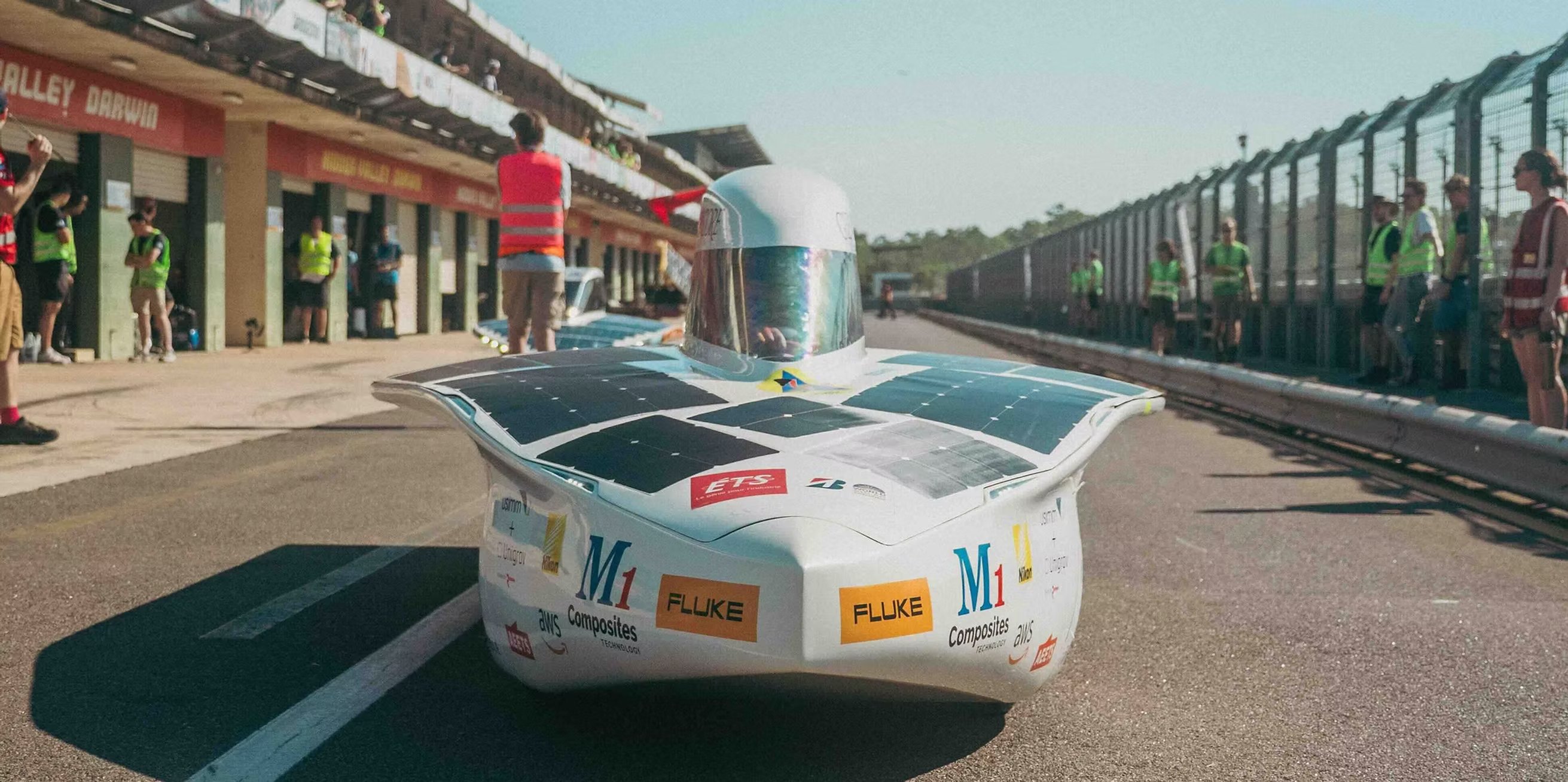
This July, the 2026 Electrek Formula Sun Grand Prix (FSGP) and American Solar Challenge (ASC) head north to Minnesota. Meanwhile, I caught up with one of the teams making the trip, and they’ve been racing solar cars longer than almost anyone. Éclipse, out of École de technologie supérieure (ÉTS) in Montreal, has been building them for over 33 years, since 1992. Hence the big 92 you’ll spot on the car.
The team’s captain, Yohann Gourmelen, sat down with me to talk about their new car (Éclipse 12), some rule changes shaking up this year’s race, and how they build nearly an entire solar car in-house.
A team that builds almost everything in-house
ÉTS is a renowned engineering-only college, and it is one of Éclipse’s biggest strengths. The team works out of what Yohann says is one of the most advanced student club workshops at any university in North America. “We get visits from universities all over the world every week trying to see how it’s done here,” he told me.
They build almost everything themselves. The printed circuit boards, the battery packs, the fabrication, all of it happens in-house. It drives down cost, cuts lead times, and gives the team full control over what they’re putting on the car.
Because most students arrive with a technical degree already in hand, they show up knowing how to machine parts, wire electronics, or run a shop floor. “If you design it, you’re gonna build it,” Yohann said. “There’s no shipping a part off to the other side of the world and waiting for a DHL box to show up.” The team has the unique ability to draw something out and then make it the same day.
And they’re trying to bring even more under their own roof.
For the next car, they want to encapsulate their own solar cells, something only a handful of teams in the world even attempt. They’ve been developing it with a local company that basically treats Éclipse as its R&D arm.
The new and improved Éclipse 12
The last time I saw the team was at Bowling Green in 2024, where Éclipse 11 ran its final race. That car was a four-wheel catamaran, with two fairings on the sides, a tunnel down the middle, and the driver off to one side. It was the tried-and-true layout teams had leaned on for years.
Éclipse 12 is something entirely new, I’m told. The new car is what Yohann calls the bullet car, a three-wheel tadpole with two wheels up front and a single driven wheel in the back. The driver now sits in the middle. It’s a massive change to the suspension, the chassis, and the aero shell, and it looks almost nothing like the last two cars.
There’s real logic to it. Dropping a wheel means dropping the weight of a whole suspension assembly, and a symmetrical car is easier to build since you can design one side and mirror it.
The three-wheel layout is more popular at the World Solar Challenge, with its arrow-straight stretches through the Australian Outback.
North American teams usually stick with four wheels because they hold their balance better around the track during the Formula Sun Grand Prix pre-qualifier and on public roads during the American Solar Challenge main event.
Regardless, I have every confidence that Éclipse will still succeed with its smaller three-wheeled vehicle at this year’s events. ÉTS wasn’t at last year’s FSGP because Éclipse 12 was racing for the first time in Australia for the 2025 World Solar Challenge.
Then there’s the array cooling, which is the kind of detail you only notice if you know to look. Back in 2024, the car had cutouts under the solar array to vent heat. They worked, but Yohann wasn’t impressed by how the heat was building up, especially when it was visible on a thermal camera.
On Éclipse 12, the team made the whole array section thinner, swapped in better conductive materials, and added far more cutouts. “It’s really more spider-webby of a part than we had in 2024,” Yohann said. The new panels run cooler and more evenly, which matters more than it sounds. On a solar car, the energy you don’t lose to heat is energy you get to spend on speed/distance.
On paper, the two cars barely look related. Éclipse 12 comes in around 45 kg lighter than the car it replaced, roughly 100 pounds, carries half as much solar array, and runs slightly more efficient panels, all while holding the same top speed.
| Spec | Éclipse 11 (2023) | Éclipse 12 (2025) |
| Vehicle mass | 205 kg | 160 kg |
| Solar array | 4 m² silicon | 6 m² silicon |
| Panel efficiency | 25.1% | 25.5% |
| Max speed | 120 km/h (75 mph) | 120 km/h (75 mph) |
| Battery | 20 kg Li-ion, 5 kWh | 13 kg Li-ion, 3 kWh |
Those battery numbers are the team’s World Solar Challenge spec, where the energy cap is tighter. They run a larger pack for the Electrek American Solar Challenge.
Bigger arrays, smaller batteries
This year, there’s some rule changes.
Since 2019, teams were capped at four square meters of solar panels. Then the World Solar Challenge in Australia moved its race from October to August, which is closer to the end of their winter. That means shorter days, weaker sun, and less overall energy. To make up for it, organizers bumped the array limit up to six square meters and shrank the battery. The American Solar Challenge followed suit.
For the teams, that’s a big deal. “It’s 50% more energy we get to spend,” Yohann said. A four square meter array might pull around 1,000 watts under a clean noon sun. Six gets you closer to 1,500.
The battery went the other way, and the way it’s measured changed too, switching from a weight cap to an energy cap. For Australia that meant a drop of 30 to 40%, which made strategy a lot harder. The American Solar Challenge kept its packs a little larger at 5.25 kWh, so Éclipse will actually swap in a bigger battery for July.
Yohann expects the fast teams to spend most of the race pinned to the 65 mph (104.6 km/h) speed limit.
Save the date!
Éclipse comes into this one with a strong recent run. Éclipse 11 won in its class at the 2024 Electrek FSGP and took second at that year’s ASC, and Éclipse 12 placed 9th at the World Solar Challenge in Australia last fall. The team also picked up the Eberle-Selwood Championship Arrow Cup for the 2024-2025 season.
ICYMI, I also recently interviewed the Delft Solar Team flying in from the Netherlands to talk about their world champion solar car.
The 2026 Electrek FSGP runs July 21 through July 23 at Brainerd International Raceway, where 46 teams will race to compete and to prequalify for the cross-country American Solar Challenge on July 25 out of the Twin Cities.
Both events are open to the public and free to attend! Hope to see you there.
You can find more details and the full list of schools competing on the official event website.


FTC: We use income earning auto affiliate links. More.

Comments