
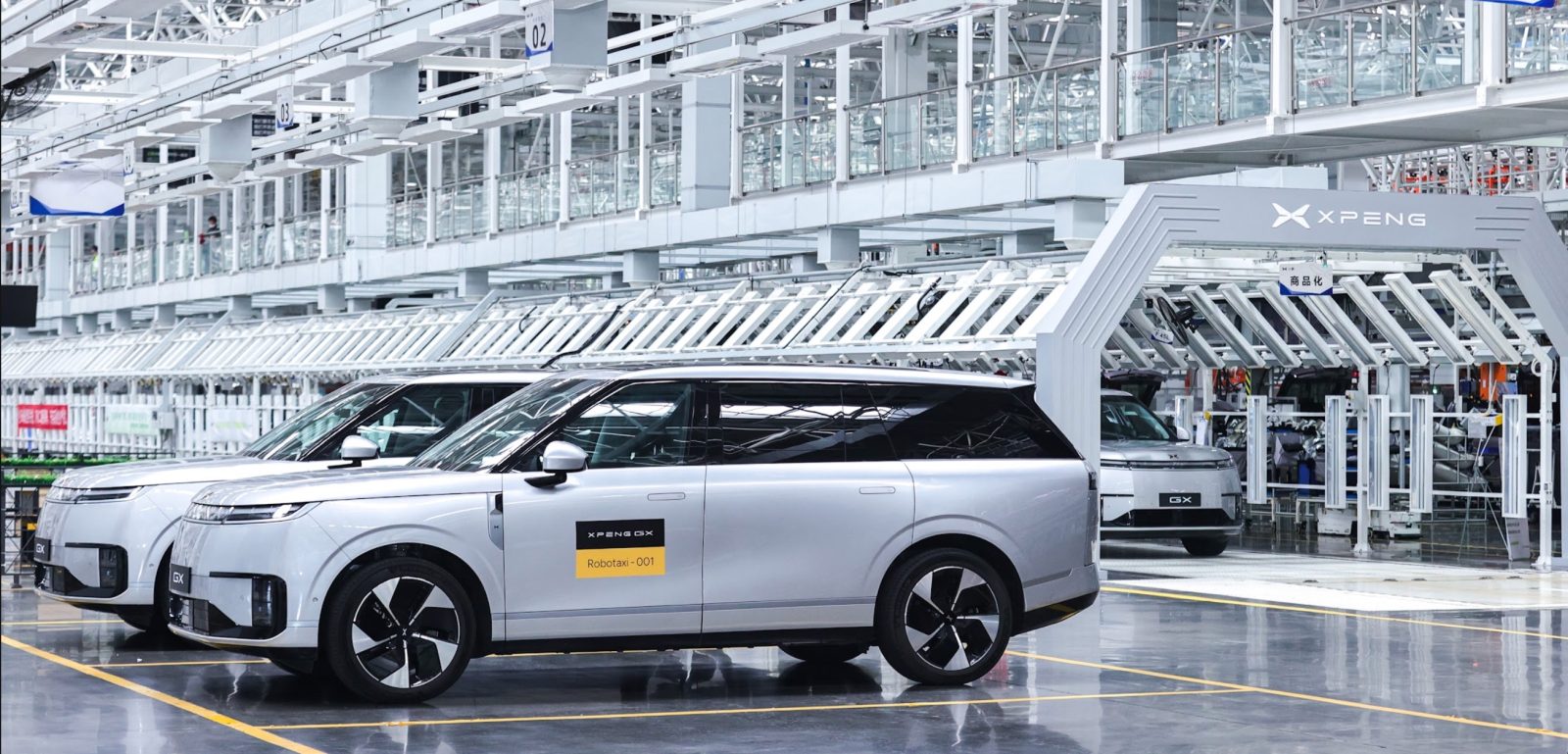
XPeng (NYSE: XPEV) announced today that it has rolled the first mass-produced unit of its robotaxi off the production line in Guangzhou. The milestone makes XPeng the first automaker in China to achieve mass production of a robotaxi built entirely through full-stack, in-house development.
The purpose-built vehicle, engineered to L4 autonomous driving standards, is powered by four of XPeng’s self-developed Turing AI chips delivering 3,000 TOPS of computing power — and it doesn’t use any LiDAR.
Same GX platform, different mission
It’s important to understand what this robotaxi is — and isn’t. The vehicle is built on the same XPeng GX platform that underpins XPeng’s $58,000 consumer flagship SUV, which launched last month at Auto China 2026. Both share the same core hardware: four in-house Turing AI chips at 3,000 TOPS, the VLA 2.0 autonomous driving system, Bosch steer-by-wire, and the aviation-grade six-layer safety redundancy architecture.
But the robotaxi version is configured specifically for ride-hailing. Where the consumer GX is a six-seat AWD luxury SUV with 750 km of range that a buyer drives themselves, the robotaxi strips out the consumer-oriented layout and replaces it with a passenger-first cabin: privacy glass, gravity seats, rear entertainment screens, and voice-controlled cabin settings. XPeng has announced plans for three robotaxi variants — a 5-seater, 6-seater, and 7-seater.
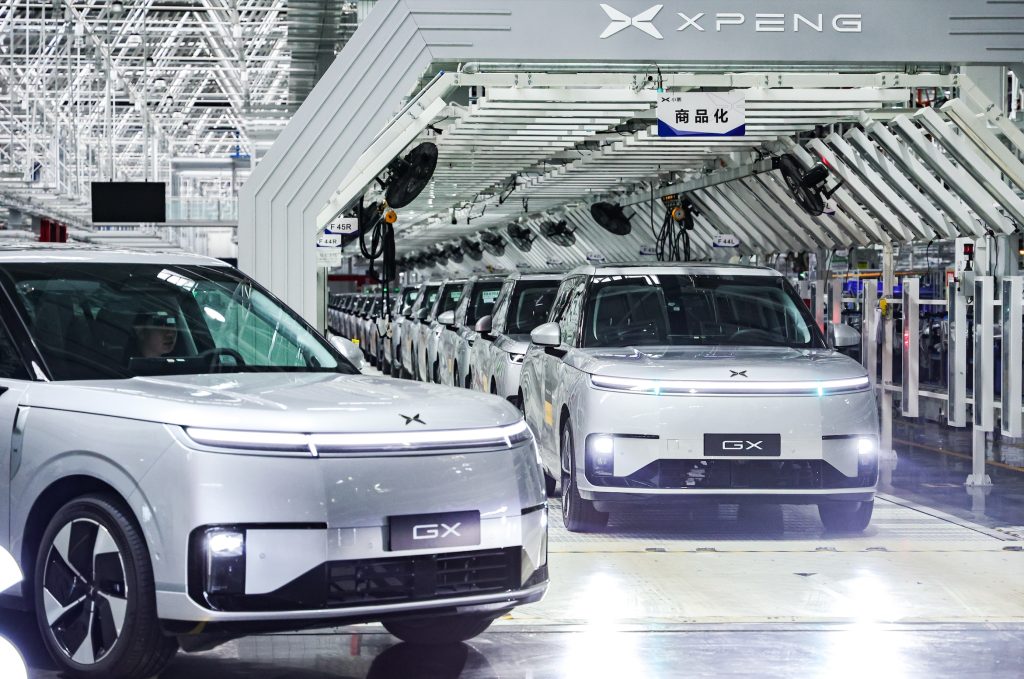
This is a fundamentally different approach from Tesla’s Cybercab or Geely’s newly unveiled EVA Cab, both of which are purpose-built robotaxis designed from the ground up without a steering wheel or driver controls. XPeng’s bet is that a shared platform between consumer vehicles and robotaxis reduces costs and speeds development — you validate the hardware in millions of consumer cars while configuring the same platform for autonomous ride-hailing.
Pure vision, no LiDAR, no HD maps
The robotaxi relies on what XPeng calls a “pure vision solution.” There are no LiDAR sensors and no high-definition maps — instead, the system runs entirely on XPeng’s VLA 2.0 end-to-end AI model.
VLA 2.0 eliminates the language-translation step found in traditional vision-language-action architectures, compressing system response latency to under 80 milliseconds. XPeng claims the model offers 12x faster inference than the previous generation and roughly 5x better performance than competitors on takeover rates, driving smoothness, and scenario coverage.
I tested Xpeng’s level 2 VLA 2.0 for consumer vehicles in China last month and I was impressed:
The road to commercial operations
XPeng has been building toward this moment methodically. In January 2026, the company secured a road testing permit for L4 autonomous vehicles in Guangzhou. In March, it established a dedicated robotaxi business unit to oversee product development, testing, and commercialization.
The timeline from here is aggressive but defined: XPeng plans to begin pilot robotaxi operations in the second half of 2026 to validate the technology, user acceptance, and its business model. The company aims to achieve fully autonomous operations — no on-site safety officer — by early 2027.
On the ecosystem front, XPeng will open its robotaxi SDK to third-party developers, with Amap (Alibaba’s mapping platform) already signed on as its first global ecosystem partner.
Where XPeng fits in the global robotaxi race
The robotaxi sector is in the middle of a critical transition from technical validation to commercial scale, and XPeng is entering a crowded field.
In the US, Tesla launched its robotaxi service in Austin in June 2025 with human safety monitors and began integrating unsupervised vehicles in January 2026. Tesla has since begun Cybercab production at Giga Texas and expanded its service to Dallas and Houston. Waymo, meanwhile, continues to operate the most mature commercial robotaxi service, with hundreds of thousands of weekly rides across multiple US cities.
In China, Baidu’s Apollo Go hit 250,000 weekly robotaxi rides by late 2025 — closing in on Waymo’s numbers — and operates across more than 20 cities. Pony.ai and WeRide each run fleets of over 1,000 vehicles.
In China specifically, Geely just unveiled the EVA Cab at the same Auto China 2026 show — a purpose-built robotaxi with no driver seat, dual Nvidia Drive Thor-U chips at 1,400 TOPS, 43 sensors including LiDAR, and a 2027 deployment plan through CaoCao Mobility’s existing 60-city ride-hailing network. The EVA Cab takes the opposite architectural approach from XPeng: a dedicated robotaxi chassis with no provision for human controls, similar to Waymo’s vehicles and Tesla’s Cybercab.
What differentiates XPeng is the full-stack approach combined with platform sharing. While Baidu and Pony.ai are primarily software and fleet operators working with third-party vehicles, and Geely chose Nvidia’s chips for the EVA Cab, XPeng designs the chips, the AI model, the vehicle platform, and the manufacturing all in-house. XPeng’s 3,000 TOPS from four Turing chips also offers roughly 2x the compute headroom of Geely’s Nvidia-based stack. That vertical integration could give it a significant cost advantage as the industry scales.
The challenge is that XPeng is late to actual L4 road operations, but it has real-world experience with L2 in its consumer vehicles. Baidu has years of real-world ride data, Tesla’s Austin service already has unsupervised vehicles on public roads, and Geely has CaoCao Mobility’s existing fleet infrastructure ready to absorb its robotaxis. XPeng’s pilot operations haven’t started yet.
Electrek’s Take
This is a significant milestone, but let’s be clear about what it is and isn’t. Rolling the first unit off a production line is not the same as running a commercial robotaxi service. XPeng still needs to validate the technology in real-world pilot operations, build rider trust, and prove out the economics — none of which has happened yet.
Top comment by Steve Zodiac
A large vehicle with room for 5-7 people and luggage? That can't be right, surely an oversized two seater is the answer to all robotaxi needs.
That said, the full-stack approach is genuinely compelling. The fact that XPeng developed the Turing chips, the VLA 2.0 AI model, the GX vehicle platform, and the manufacturing process all in-house puts it in rare company globally. Tesla is the obvious comparison on the vertical integration front.
The pure vision approach — no LiDAR, no HD maps — mirrors Tesla’s strategy, but XPeng’s VLA 2.0 model takes a different architectural path. The sub-80ms latency claim is impressive if it holds up in practice.
We think the real test comes in the second half of 2026 when pilot operations begin. The technology can look great on a production line, but robotaxi businesses are made or broken by the millions of edge cases encountered on real city streets. XPeng’s goal of removing safety officers by early 2027 is ambitious, and we’ll be watching closely to see if the timeline holds.
If you’re looking to reduce your transportation energy costs, pairing an EV with home solar is one of the smartest financial moves you can make. With electricity rates climbing nearly 10% last year, home solar protects you against future rate increases. And with lease and PPA options, you can go solar with zero upfront cost and start saving immediately. If you want to find the best deal, check out EnergySage. It’s a free service with hundreds of pre-vetted installers competing for your business, so you save 20 to 30% compared to going it alone. No sales calls until you pick an installer. Get your free quotes here.


FTC: We use income earning auto affiliate links. More.




Comments