
Xpeng’s flying car division Aridge invited media to tour its massive new factory in Guangzhou, and it’s clear the Chinese automaker is pouring serious resources into making manned electric aircraft a commercial reality.
I saw about 20 aircraft at various stages of production inside the plant — from bare carbon fiber bodies to completed units in quality checks — as Aridge validates its manufacturing process ahead of planned deliveries later this year.
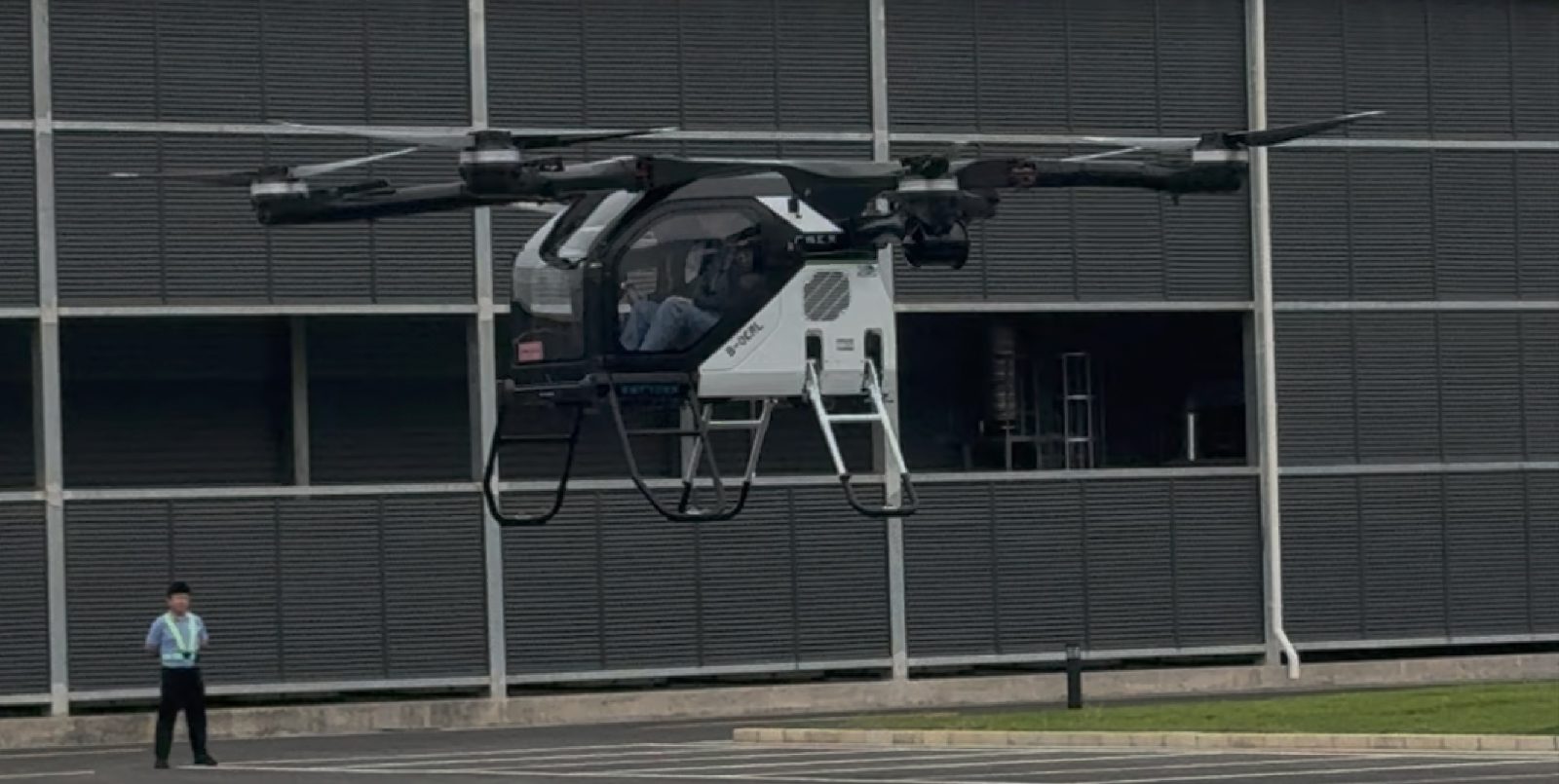
The company didn’t allow us to film or photograph the production floor, which was a bit frustrating, but they did let us witness a quick test flight outside the facility.
The aircraft took off, hovered, and landed — controlled by a single joystick and looking remarkably polished compared to the prototype I saw up close last year.
Inside Aridge’s flying car factory
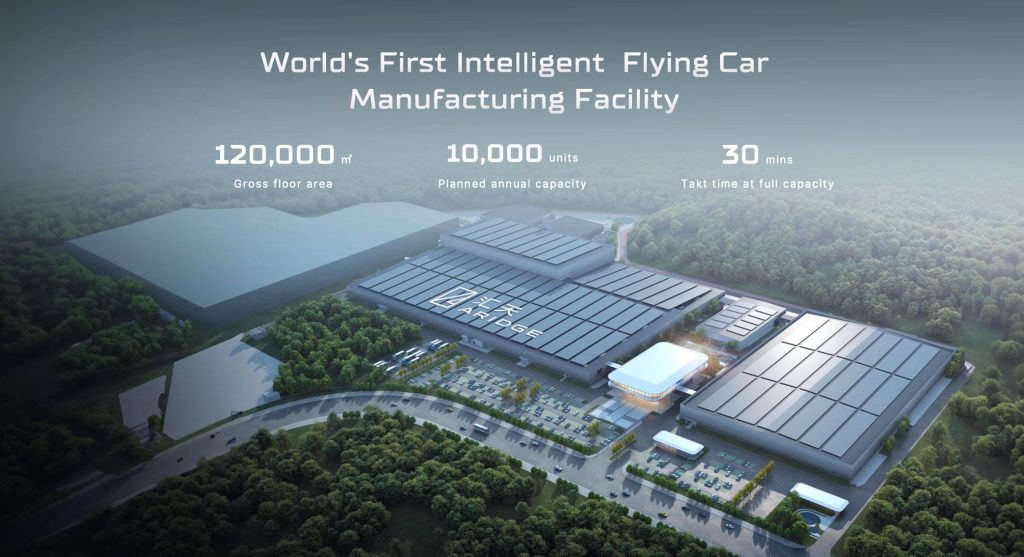
Aridge’s Guangzhou facility is a 120,000-square-meter (1.3 million sq ft) plant that the company calls “the world’s first modern assembly line for flying cars.” It is designed for an initial capacity of 10,000 units per year at a 30-minute takt time.
The factory is clearly not complete yet — sections are still being fitted out and workstations are being configured — but it’s undeniably a real production facility with real aircraft moving through it. It’s more than the render above.
During the tour, I counted roughly a dozen carbon fiber bodies at various stages of assembly being actively worked on as the team sets up its production stations. Another eight units appeared to be in final quality checks or fully completed. Workers were putting the final touches on carbon fiber processes — a critical step given that over 42% of the airframe uses lightweight aviation-grade composites.
The improvement from prototype to production-intent units is dramatic. I got close to an early prototype last year and it was rough — nothing you’d want to put a customer in. The units coming off this line look like finished products. Xpeng has clearly invested heavily in refining the fit and finish.
What Aridge is actually building
The system Xpeng calls the “Land Aircraft Carrier” is a two-part modular package: a six-wheeled, three-axle ground vehicle that serves as the transport and charging station, and a detachable two-seat eVTOL aircraft that sits in the back and deploys autonomously.
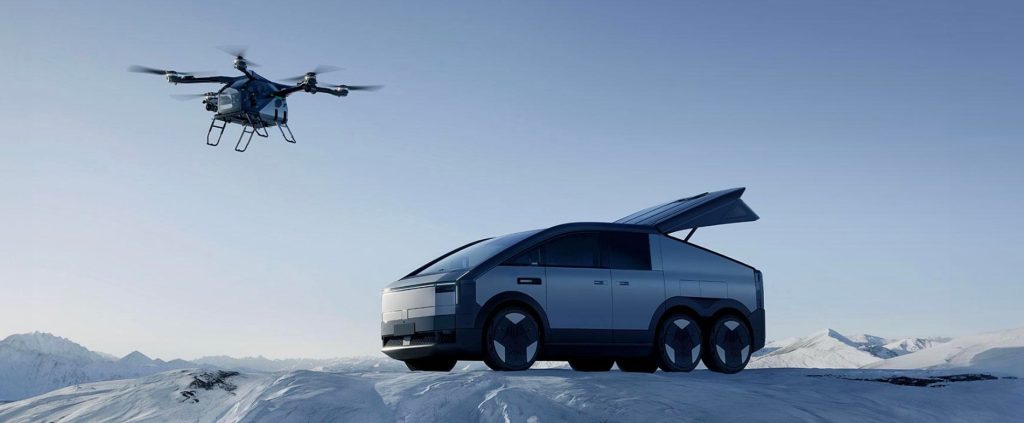
The ground vehicle is built on an 800-volt extended-range electric (EREV) platform with over 1,000 km of total range. The air module is a six-rotor all-electric aircraft with a carbon fiber fuselage and dual-ducted rotors. It packs roughly 50 kWh of battery capacity into a compact airframe weighing around 700 kg — small enough to fit in the back of the large van.
The battery energy density exceeds 255 Wh/kg, and the ground vehicle can recharge the aircraft from 30% to 80% in just 18 minutes, supporting five to six complete flights before the mothership itself needs a top-up.
Flight controls use a four-axis single-joystick system, and Aridge claims most people can reach basic flight proficiency within about 10 minutes. The aircraft tops out at roughly 90 km/h (56 mph).
The entire package — ground vehicle and aircraft — is priced around 2 million yuan (~$300,000). Aridge has accumulated approximately 7,000 pre-orders and is targeting customer deliveries toward the end of 2026. The subsidiary raised $200 million in March and Xpeng has announced plans to take Aridge public.
For context, aviation battery supplier CALB started mass production of batteries specifically for Xpeng’s flying cars in March, another sign that the supply chain is materializing.
Electrek’s Take
If you’ve been following my reporting on personal electric aircraft — which companies love to call “flying cars” — you know I’m not exactly hyped by the concept. But walking through this factory changed my perspective on at least one thing: Xpeng is dead serious about this, and the engineering is genuinely impressive.
Top comment by Erik
When I think of a flying car I envision the DeLorean from Back To The Future 2. This is just a small electric helicopter. Still impressive, but these companies should stop calling it a car.
Fitting 50 kWh of batteries into a roughly 700 kg aircraft that can fold up into the back of a van is no small feat. The propulsion systems, hyper-efficient electric motors, simple single-joystick flight controls, and all the avionics packed into a ~$300,000 package that includes the ground vehicle — it’s wild when you see it all together on a production floor rather than as renders on a screen.
But I still struggle to see a massive market here. The most obvious use case right now appears to be leisurely scenic flights in national parks and resort areas, which is exactly what Xpeng seems to be targeting initially. That’s a real market, but it’s a niche one.
This is not the Jetsons flying-car future that some people were hoping for. You’re not going to commute to work in this thing. Regulatory hurdles for urban air mobility remain enormous, and the flight time and range are inherently limited by battery physics.
That said, this technology has to start somewhere. The electric motors, battery density, flight control software, and carbon fiber manufacturing processes Aridge is developing will only improve from here. And if there’s one thing I’ve learned covering EVs for a decade, it’s that dismissing a technology because its first commercial application seems niche is a mistake. Where this goes from here is anyone’s guess — but at least Xpeng is actually building the thing.


FTC: We use income earning auto affiliate links. More.



Comments