
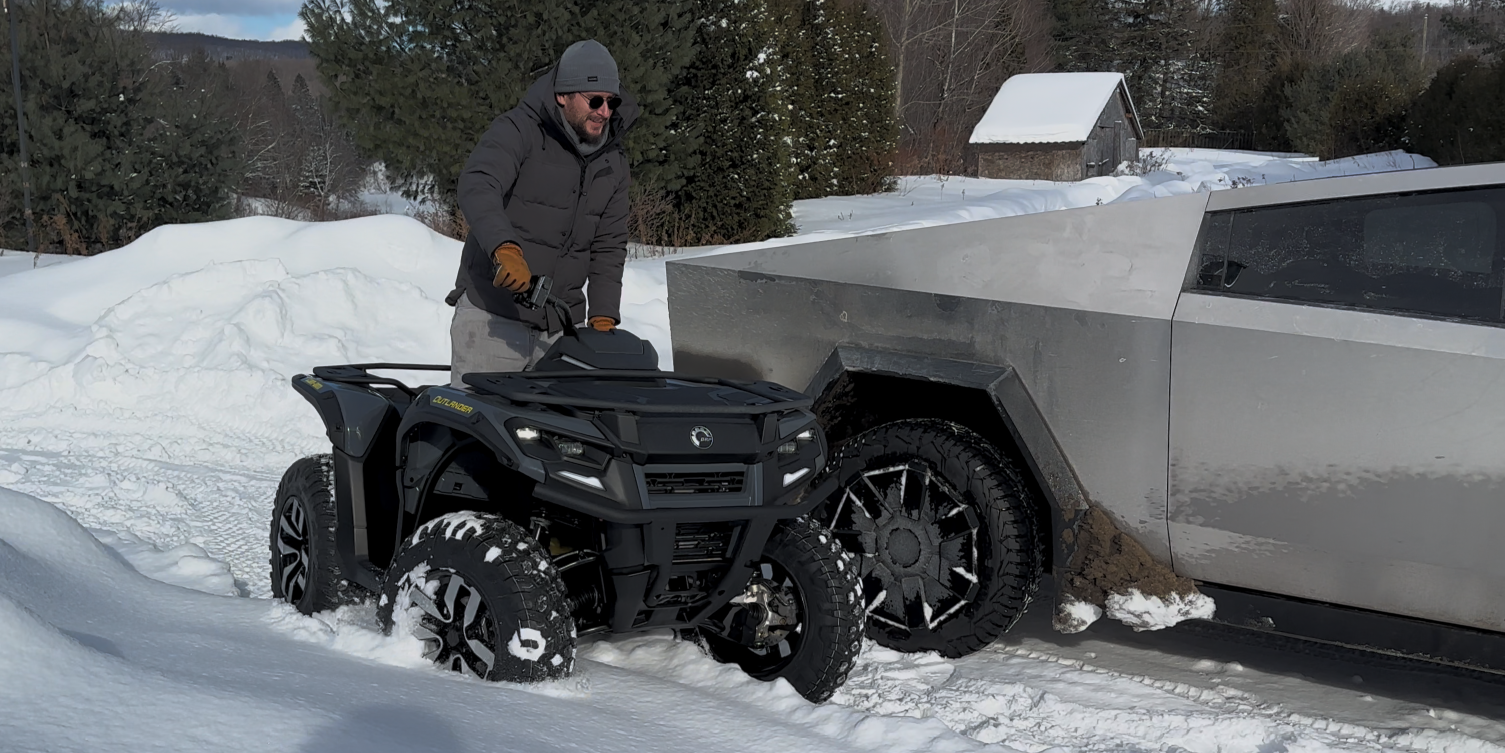
For the first time, a full‑size ATV goes electric without shrinking expectations. The Can‑Am Outlander Electric delivers real utility, real capability, and a strong signal that the future of off‑road work will be battery-powered, it’s a matter of time.
Edit: I previously wrongly reported the Can Am Outlander Electric max speed to be 60kph (37mph). This information was taken from the International User Manual, and European regulations are different.
The North American Version is good for up to 80kph (50mph)!
Introduction
The Can Am Outlander Electric is one of the very few available electric ATV on the North American Market. Available since mid-2025, Electrek had a first look at it back in September 2025 (Can-am Outlander Electric first drive: ATVs are better with a battery | Electrek)
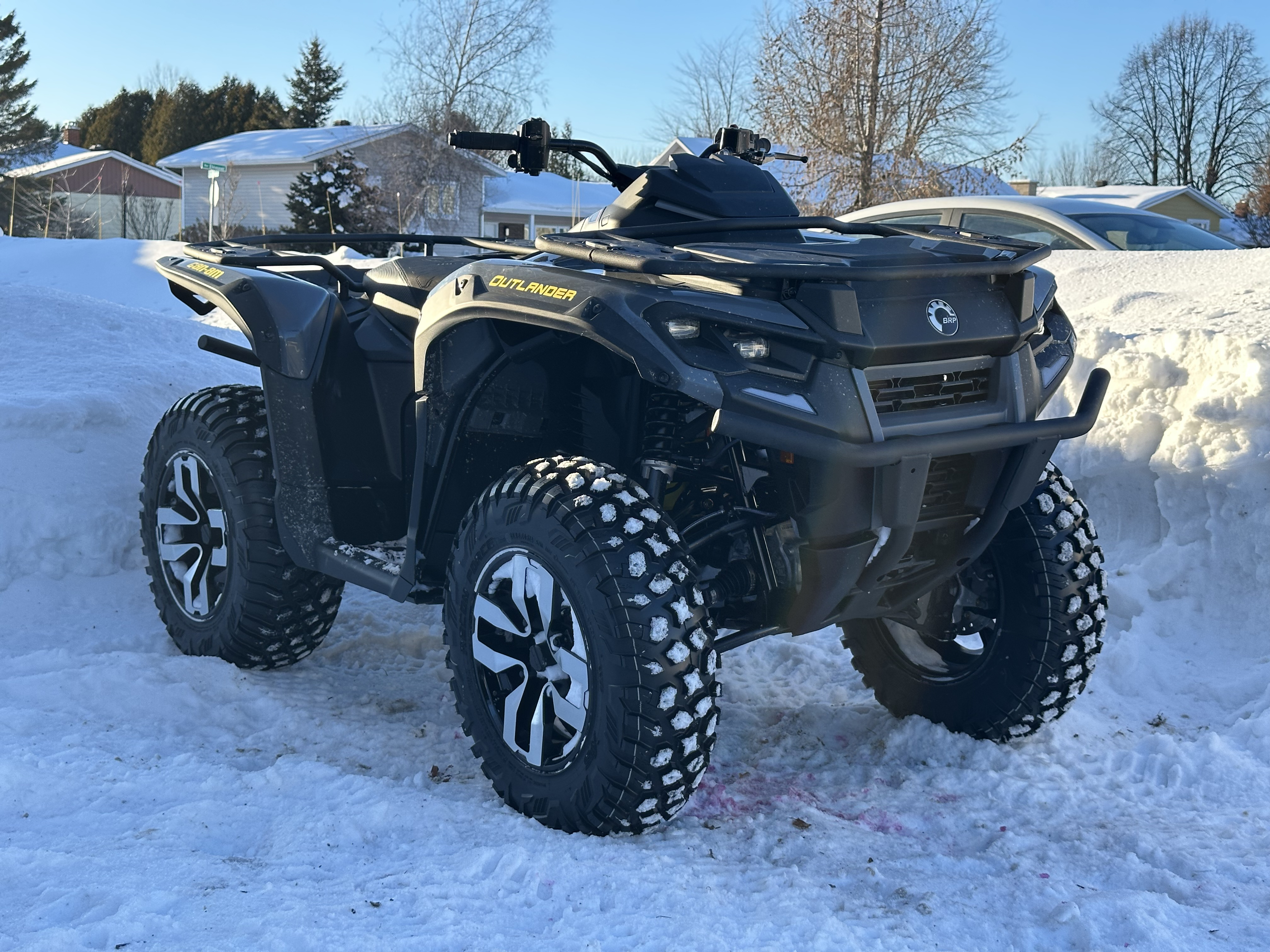
Here are some of the specs
- 47HP
- 53 lb-ft of torque
- 2WD/4WD on demand with Visco-Lok front differential
- 8.9kWh, liquid thermally regulated battery
- 80km (50mi) of range
- 50km (31mi) of Utility range
- 80kph (50mph) Top speed
- 5 years (20 000km / 12 427mi) Battery Warranty
- 1 year Motor warranty
- 26in tires
- Dry Weight 885lbs (Outlander) / 925lbs (Outlander MAX)
- Towing 1830 lbs
How did it score ?
Since it’s an off-road vehicle, not all scoring categories apply to it, so I removed those and scaled the weights accordingly to obtain a score out of 100. Here is the score:
- Engineering: 7 / 10
- Electric Performance & Charging: 14.4 / 20
- Ergonomics, Cabin & Storage: 13 / 17
- Driving Experience: 7.5 / 13
- Extra/Fun Factor: 4 / 5
- Value: 7 / 10
- Fitness for Purpose: 4.5 / 5
- Safety: 4 / 5
Total : 61.4 / 85 –> 72.2%
Details about these scores are discussed later in the article.
Living with it the Outlander Electric
The first thing any driver will notice is the complete lack of noise. Can Am did an excellent job silencing every quirky sound from the suspension through the use of high-quality bushings, and even worked on the powertrain tuning so it is completely silent at low speed. It is common knowledge nowadays that EV powertrains are quiet, but actually, on a naked vehicle like an ATV or a Motorcycle, you can usually hear the high frequency switching of the electrical phases, coming from the motor drive. On this vehicle, though, there is so little noise from it that you can barely hear it, even without a helmet. I’m impressed.
Can Am also did a very good job tuning the throttle response of the powertrain, resulting in an excellent control of the vehicle. Points added for the ability to tune the Regen from Low/Medium/High, with strong enough regen to allow true one-thumb driving.
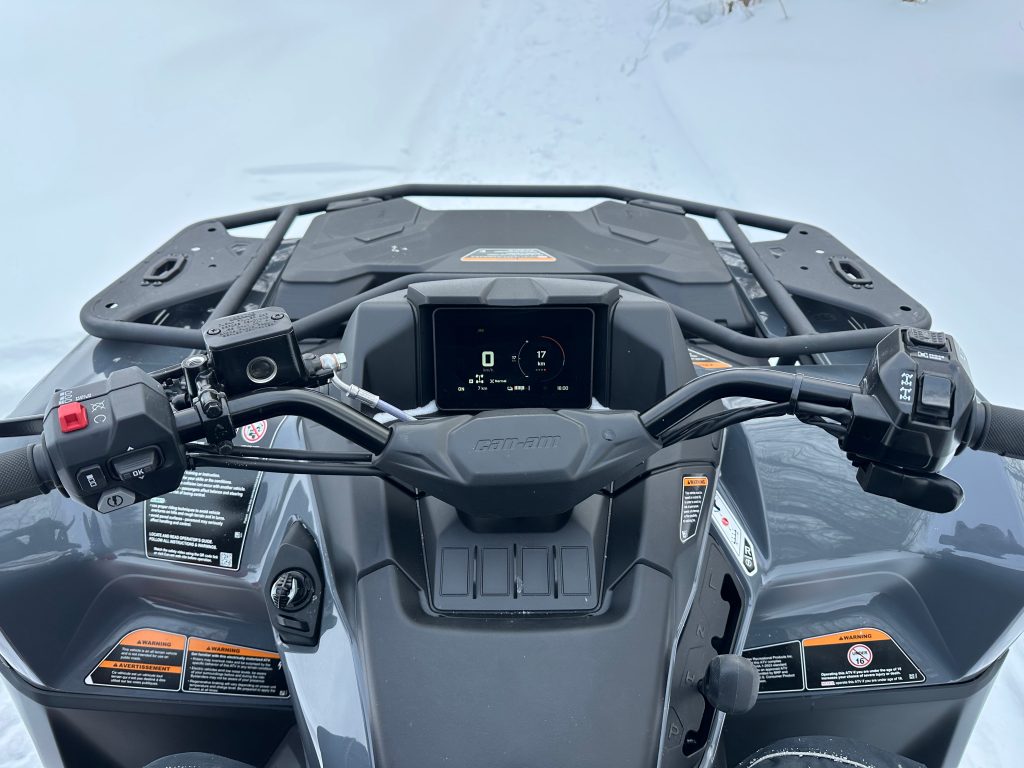
Every other aspect of the vehicle is equivalent to the gas-powered Outlander, with the same 2WD/4WD ability, steering assist, LINQ system for the accessories, and infotainment screen, albeit in 5”.
Speaking of the screen, I would have liked a bigger indication of the remaining battery State of Charge as well as the ability to show the remaining percentage instead of just 10 bars and the range guess-o-meter.
Since this vehicle is mostly aimed for working and not trail riding, more on that later, showing precisely the remaining range is of limited usefulness since the farmer doesn’t necessarily know the distance he does in a day, but does want to know how much battery energy a given task consumes, so he can plan ahead.
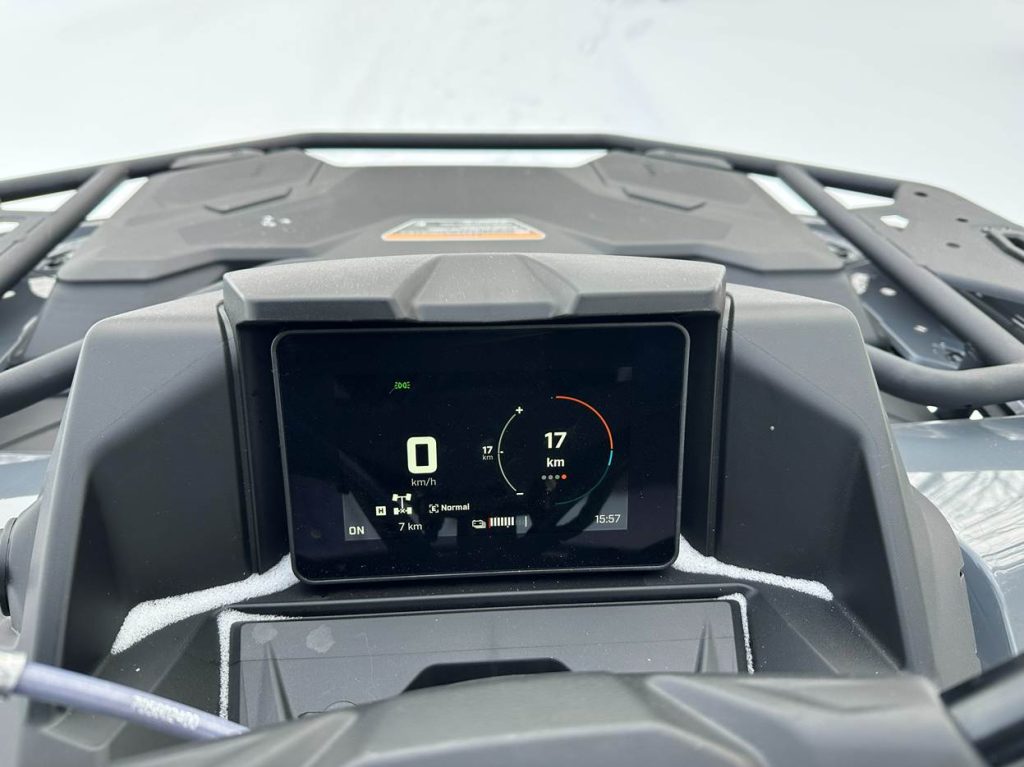
Likewise, navigating through the screen isn’t intuitive, and some data is lacking, like the average energy efficiency, the regen mode selected, and the charging power when plugged in.
Speaking of charging, it is to be noted that plugging the vehicle when the battery is cold, will delay the charging as the thermal system will work to heat the battery to an acceptable temperature for initiating charging. However, the user can easily miss the message on the screen indicating the battery is warming up, resulting in confusion about whether charging is working, since nothing else will be shown on the screen except the State of Charge. After warming up, when the battery is charging, the remaining charging time to the set charging limit will be shown.
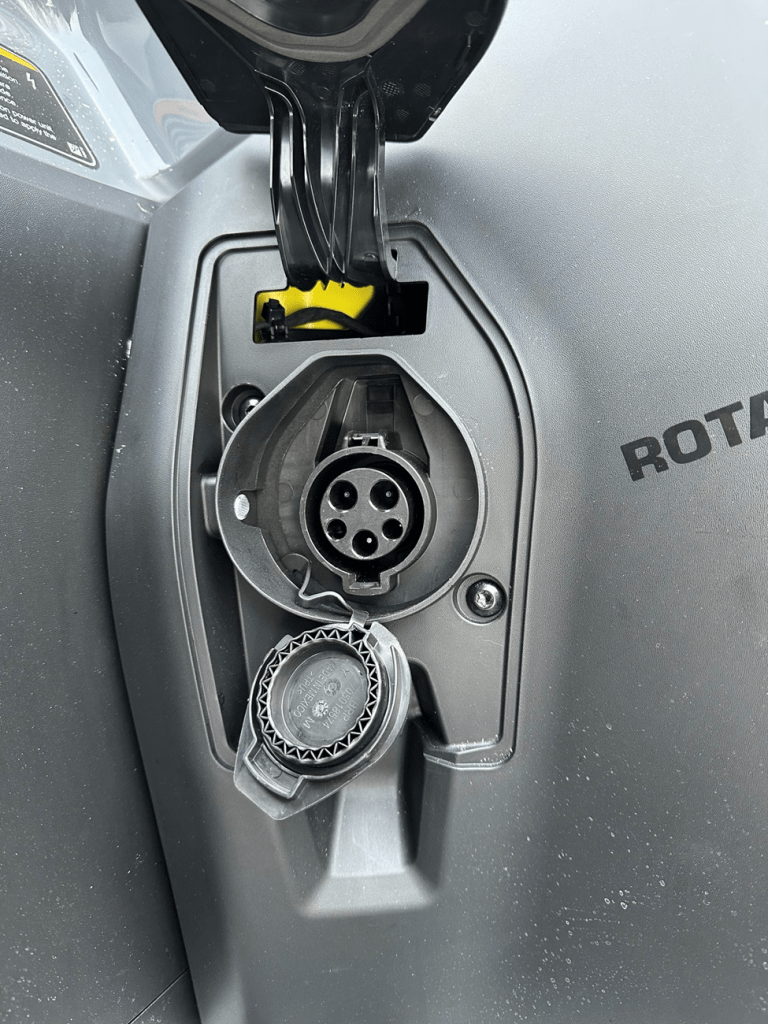
Staying on the topic of charging, the Can Am Outlander Electric 2026 uses a J1772 inlet connector located just above the left footwell, accessible via a manual door and a secondary rubber seal for added waterproofing. This connector allows for the onboard charger to draw as much as 6.6kW of power, resulting in a full charge from empty in about 1.5h.
I would have liked the inlet to be located higher on the side, with a door opening toward the bottom or side rather than the top (like the Can Am Pulse, which shares the same powertrain), or directly on the top of the vehicle, which would not require the user to crouch in order to plug in.
Driving it is really enjoyable; the lack of noise and the tight reaction of the powertrain are an awesome mix. With a top speed of 80kph (50mph), (I reached 63km/h), it’s not the fastest ATV on the market; however, for the aimed market, it is quite good.
Combined with the 1830lbs of towing and the two-speed transmission (High and low gear), the off-road capabilities of the Can-Am Outlander Electric are fantastic.
To be noted, the tires did an amazing job in the snow and traction was really good in my testing, and we are told they are made for lowering the rolling resistance, which is impressive. For comparison, they are much better in the snow than the ITP MudLite II I run on my personal ATV!
Range is somewhat limited, and even more in freezing cold, -15 to -20°C (5 to -4F), as I achieved 31km (19mi) of real-world range. This seems low; however, it is important to understand that driving in the snow, even on a hard surface, is way more difficult than driving on dirt or gravel. In more typical conditions, I’m then guessing a real world range of about 65km (40mi). For comparison, my old Raptor 350 (not the same category of ATV, I know) was getting 90km (56mi) out of the gas tank in the summer, and only 50km(31mi) in the winter.
For the targeted market of workers in farms, national parks or outfitters, these ranges will be enough for a majority of use cases. Actually, Can Am themselves did a survey resulting in the majority of the targeted market driving for less than 29km (18mi) a day on their ATV.
What is limiting the range is the use of the exact same 8.9kWh battery as the Can Am Pulse and Origin motorcycles. You can clearly see the battery was tilted on its side and fitted in the frame of the Outlander. It’s a pretty tight packaging.
The motor is fitted at the back of the vehicle, right between the wheels, and directly connected to a two speed gearbox (HI and LO) with an output shaft for the front differential, which can be electronically connected or disconnected allowing the 4WD on demand system.
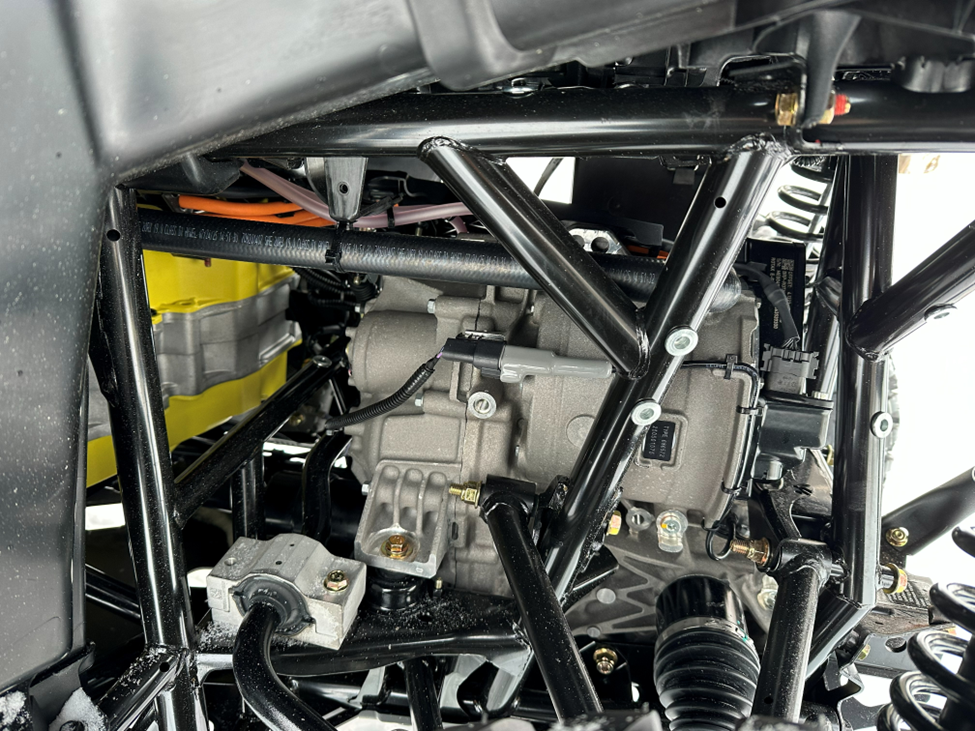
This Front wheel drive output shaft goes the length of the vehicle, passing right below the battery.

Another way to have 4WD would be to use a Dual motor configuration, like we’re seeing on cars, allowing for the removal of this output shaft and increasing the available volume for the battery, maybe allowing for 2x 8.9kWh side by side? I hope Can Am will think about it, that would be a pretty decent ATV for trail riding, moreover, if DCFC were then supported!
Final thoughts
Overall, this is a very solid utility ATV: comfortable, powerful, and completely noise- and emission-free.
For my typical use case, range would not be an issue, leaving me with an excellent powertrain and a low‑maintenance vehicle that’s easy on both my lungs and my hearing.
If you’re looking for a utility electric ATV to work on your property, look no further!
If I had done that with a gas-powered ATV, my wife and daughter would have been sickened by the emissions. (Yes, I did that as a kid behind a gas-powered ATV, and I can still remember the smell!)
It’s designed first and foremost as a work tool, and who better to confirm that than my farmer friends, who run a small grass‑fed cattle operation and ordered their own Outlander Electric after I gave them a quick test ride.
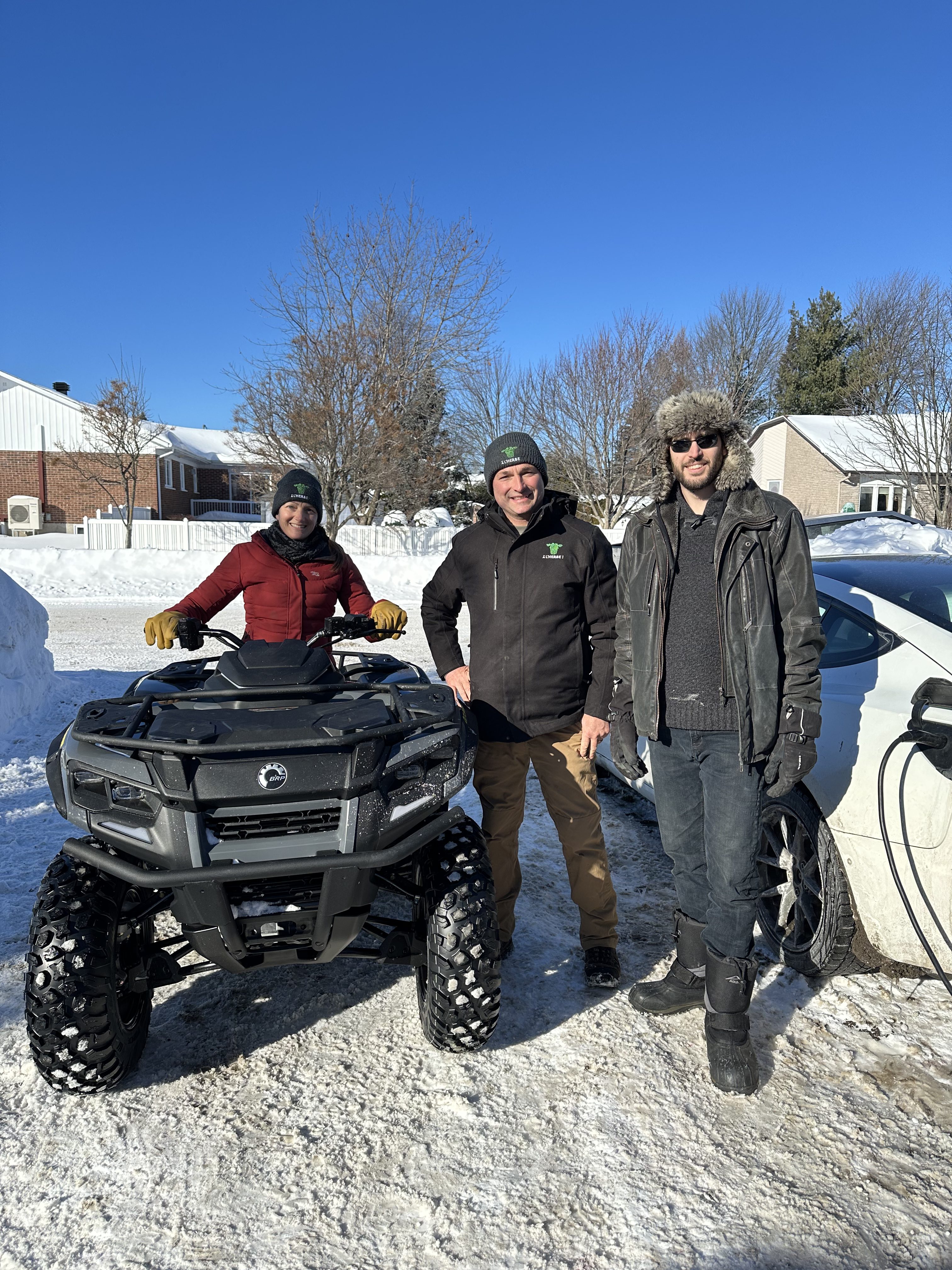
You don’t get a better endorsement than that.
Scoring details
Engineering: 7 / 10
The Outlander Electric has an excellent powertrain with a motor and gearbox integrated in one efficient and very silent package. The response to the user input is perfect, with enough sensitivity and control. On the battery side, things are looking great with a liquid-cooled 350V Li-ion, of most probably NMC cells (I could get a confirmation on that, but given the size of the pack and the energy density, that’s what makes most sense).
However, the lack of any type of V2X capabilities, moreover, for a utility vehicle, is a bummer.
Electric Performance & Charging: 14.4 / 20
Efficiency in my testing was surprisingly good, taking into account the snowy conditions and harsh cold (-20°C / 4F), for such a heavy ATV at 885lbs. The weight is on par with the gasoline version of the Outlander, though. Range is disappointing for trail riding, but more than enough for the targeted market and not that far off from a smaller gasoline ATV. Like I mentioned earlier, my old Raptor 350 was good for a maximum of 90km, in the ideal condition. People are often surprised to realize we often don’t get that far with an ATV, and a range of ~80km in summer trail riding conditions, coupled with fast enough charging, would be great.
The Outlander electric is on the low side of this range; again, it doesn’t matter for the targeted market, and doesn’t allow DCFC, which explains this score.
Ergonomics, Cabin & Storage: 13 / 17
Seat comfort and driving position are pretty good; it shows that it’s not Can-Am’s first ATV. Storage is also good, with an added storage compartment in lieu of the gas tank, and under the front rack. The vehicle is also available with an optional rear case, fitted on the rear rack, like every other Outlander.
The only weak point of the ergonomics is the UI. The screen doesn’t show all the data I’d like, and navigating between the menus isn’t very intuitive, as shown in the video earlier.
Driving Experience: 7.5 / 13
The driving experience is good, even if the score doesn’t reflect that. Actually, we evaluate in this section the ease of road-tripping, or in that case go for a day of trail riding.
Obviously, with a somewhat limited range and no access to DCFC, that’s a big hit in the score. But don’t be mistaken, I had a lot of fun driving this one. Control and throttle sensitivity are perfect, regardless of the mode used (Work, Normal, Sport), and the Steering Assist that can be tuned to your liking (Min, Med, Max) is a nice touch and feels really good to use.
As more electric ATVs/off-road vehicles become available, we might adjust this score to better reflect that this is more of a work vehicle. But you can still have some fun with it between work tasks.
Extra/Fun Factor: 4 / 5
It’s an ATV, Electric with instant torque, of course, the Fun Factor will be high!
Value: 7 / 10
It’s not the most expensive ATV on the market starting at 12 999$ (17 799$ CAD) but since the usage is limited to working on your field, it’s not a vehicle for the mass market.
Fitness for Purpose: 4.5 / 5
I already spoke way too much about the target market for this vehicle, and I’m convinced it is the best for it. tough, silent, powerful, easy to use and control, efficient, with good traction and a high towing capability, that’s a work horse.
Safety: 4 / 5
The Outlander Electric is well balanced and offer a couple of safety features like the automatic turn-off and making noise (annoyingly) when backing up.
It is not a wild animal for you to control, but rather your trusty workhorse that responds perfectly to your command. It adds to the safety of using it.
Electrek’s take
We were waiting a long time for a manufacturer to finally bring a true electric ATV to the market, and this is a great beginning. Keep going, Can Am, you’re on the right trail!
The Outlander Electric is the only full-size electric ATV on the market that you can purchase today through your local Can-Am dealership.
This is a great product, aimed at a niche market for utility ATVs, and it meets its needs really well.
Top comment by Mrvc
I like the idea of it. Especially as gas is such a headache to store. You don't burn all that much fuel running an ATV around your property but still will always keep gas on hand. But this seems a lot like those artic cat diesel atvs they brought out maybe 20 years ago. Same idea you have diesel on your farm or ranch for everything why not for your ATV. They didn't do so well because they were underpowered and expensive. This might suffer from that too. On paper it's a decent tool for the job. It just has some big flaws in range power and charging speed without factoring in price. This is where I think the battery tool people could really get into the market with their swappable batteries many have already brought out dirt bikes and other little two wheelers. An all wheel drive ATV with the same battery as some of your equipment much like the electric mowers could be a real winner.
Price is probably the best part. It's not great but it's where can-am is on their mid range 15 years ago where their top of range was. I can seem muni use for these. Probably some at least relatively well to do ranchers and maybe some farmers that have solar arrays and maybe an electric vehicle or two already. With that kind of range I don't think many outfitters unless there is a specific reason like some kind of gas ban where they are. I'm not sure outfitters really go can-am in the first place as they are top of the range they tend to go mid tier or lower.
I hope another model, aimed at a broader market, will be unveiled soon, based on the excellent recipe Can-Am already has: an excellent powertrain, a proven frame and suspension system, a wide range of third-party accessories, and clever engineering.
This next model could improve on range and also add some useful features like V2X capabilities, fast charging for those wanting to do road trip and slightly higher max speed.
This one is perfect for farmers, outfitters, national parks, and municipalities, though. Can Am did a really great job with the power delivery of the powertrain and the ease of control combined to the comfort of the vehicle makes it suitable for effortless tasks at work!



FTC: We use income earning auto affiliate links. More.


Comments