
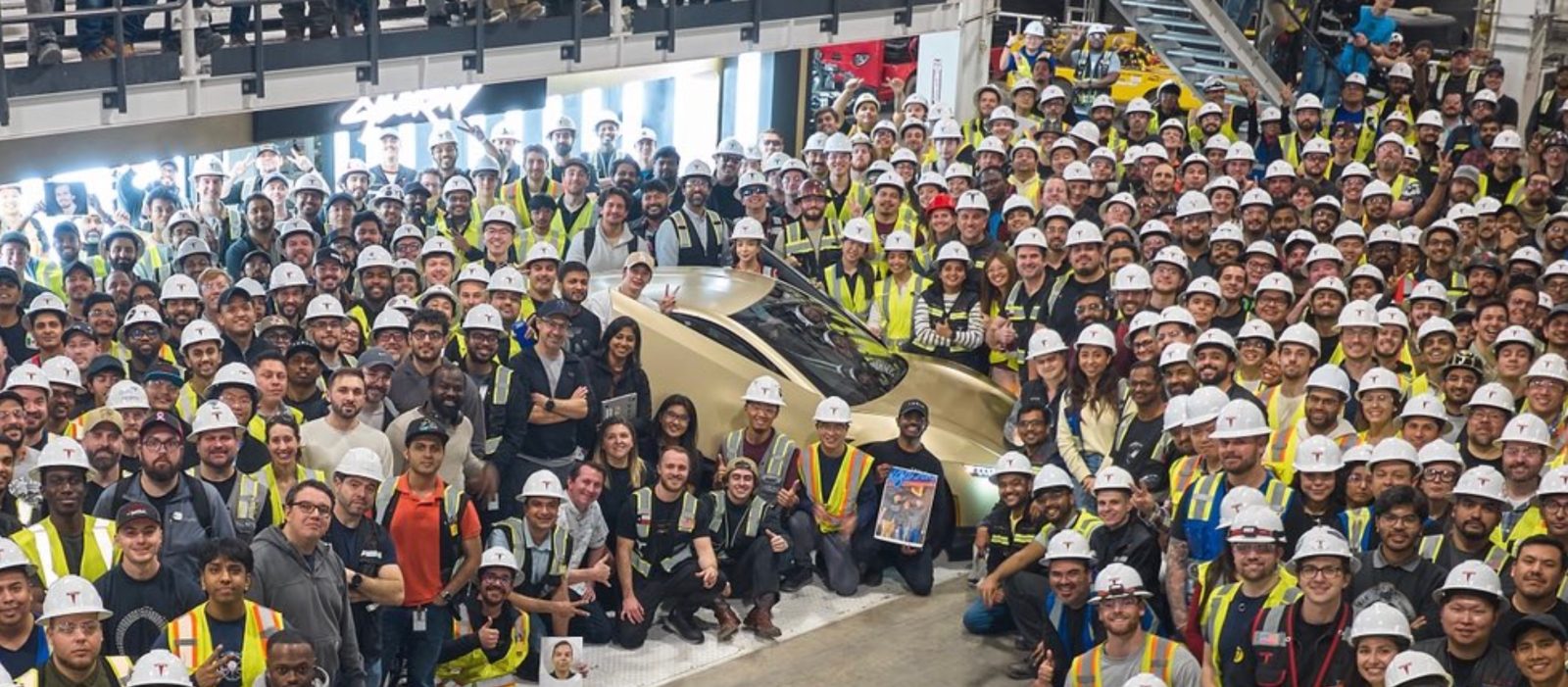
Tesla shared today that the first Cybercab production unit has rolled off the assembly line at Gigafactory Texas. The vehicle has no steering wheel and no pedals. It is entirely dependent on autonomous driving software that, based on every available data point, Tesla has not solved — and is nowhere close to solving.
Even the name “Cybercab” is not set in stone.
The announcement comes on a day after we published our latest robotaxi status check showing that Tesla’s “Robotaxi” program in Austin is crashing at nearly four times the rate of human drivers, operates at just 19% availability, and has roughly 40 vehicles on the road eight months after launch.
Tesla announced today that it produced its first Cybercab off its production line at Gigafactory Texas:
While this is the first production unit, continuous production is not expected to start until April.
The data doesn’t support the product
Tesla’s robotaxi pilot in Austin, which uses Model Y vehicles equipped with the same “autonomous driving” technology as Cybercab, has accumulated roughly 14 crashes across an estimated 800,000 cumulative miles, working out to one crash every 57,000 miles. By Tesla’s own benchmark of one crash per 229,000 miles for human drivers, its “Robotaxi” fleet is crashing nearly four times more often than the average person behind the wheel, and virtually every one of those miles was driven with a trained safety monitor in the vehicle.
The latest status check of Tesla’s robotaxi program paints an even bleaker picture. Over a 48-hour tracking period, the Austin service was available just 19% of operating hours. Eight months after launch, Tesla operates in only two cities, Austin and San Francisco, with roughly 200 vehicles total, most of those vehicles being in San Francisco, with drivers in the driver’s seat, despite Musk claiming “well over 500” on the Q4 2025 earnings call.
Perhaps most damning: Tesla’s supposedly “unsupervised” rides turned out to be anything but. Video evidence showed the vehicles being closely followed by black Tesla trailing cars with safety monitors inside. Tesla didn’t remove the safety monitors, it just moved them to a different vehicle.
One enthusiast took 58 rides over a week before finally getting a single genuinely unsupervised one. Then, the unsupervised rides vanished entirely a week after the pre-earnings announcement.
To this day, only a few riders per week report rides with no supervisors or trailing cars.
Musk’s own goalpost: 10 billion miles
In January, Musk himself admitted that Tesla needs roughly 10 billion miles of data to achieve “safe unsupervised self-driving.” Based on current fleet growth and FSD engagement rates, Tesla is projected to cross that threshold around July 2026. But collecting the data is only step one, Tesla still needs massive training runs, validation testing, and debugging of millions of edge cases, meaning the software likely won’t be ready for another year beyond that milestone.
Tesla has also delayed its next-gen AI5 chip to mid-2027, meaning the Cybercab will launch on the current-generation AI4 hardware.
And yet, the first production unit of a vehicle that depends entirely on this unsolved software just rolled off the line today.
Tesla has a pattern of premature hardware bets based on autonomy
The company has a well-documented history of removing features in the name of a self-driving future that wasn’t ready, and then quietly walking those decisions back.
In 2021, Tesla removed radar from Model 3 and Model Y vehicles, overruling its own engineers who warned against the move. The result was an uptick in crashes, near misses, and phantom braking incidents. In 2022, Tesla removed all ultrasonic sensors from its vehicles before its camera-based replacements were ready, shipping cars without Park Assist, Autopark, Summon, or Smart Summon for months.
Then there was the yoke steering wheel, introduced on the Model S and X in 2021 as a nod to Tesla’s autonomous future, Musk argued that stalks and a round wheel weren’t necessary on a car that would soon drive itself. He refused to offer a round alternative. Two years later, Tesla broke and started offering the round wheel again, eventually making it the default and charging a $250 premium for the yoke instead. The company even offered a $700 retrofit for owners stuck with the yoke.
The turn signal stalk followed the same arc. Tesla deleted the stalk from the Model 3 Highland in 2023, replacing it with capacitive buttons on the steering wheel. The decision was so unpopular that driving schools banned the car and it dinged Tesla’s near-perfect safety rating in Europe. By 2025, Tesla’s head of vehicle engineering Lars Moravy admitted the company had “deleted too much.” Tesla brought the stalk back on the Model Y Juniper refresh and started selling $595 retrofit kits to fix the problem it created, literally charging customers hundreds of dollars for a part it never should have removed.
Every one of these reversals involved Tesla making a hardware bet on an autonomous future that wasn’t ready. With the Cybercab, Tesla is making the most extreme version of this bet yet — and this time, there’s no retrofit that can fix it.
Electrek’s Take
The Cybercab is a two-passenger vehicle with butterfly doors, no steering wheel, and no pedals. It has a 35 kWh battery with 200 miles of range and inductive charging. Musk has described its manufacturing process as closer to consumer electronics than car manufacturing, with a target cycle time of one unit every 10 seconds.
The vehicle is designed to cost under $30,000 and operate exclusively as an autonomous taxi. There is no fallback. If the software doesn’t work, the vehicle literally cannot be driven.
Top comment by Philip234
When ANY company with a real autonomous vehicle rolls out a service, they send their vehicles, with no people in them, to drive around a city doing validation runs. We see empty Waymos ("ghost riders") driving around all the time where I live preparing for their launch. You will know Tesla has an actual robotaxi when you see that. Not just one or two, but triple-digit empty taxis cruising the streets.
Tesla’s own chairwoman, Robyn Denholm, signaled that the Cybercab might need a steering wheel after all, but Musk quickly shut that down. Cybercab prototypes were spotted testing with steering wheels in Austin late last year. Tesla has also yet to secure the “Cybercab” trademark, the company just received a 30-day extension to oppose a squatter’s claim, pushing the deadline to March 14, less than a month before the stated production date.
This is one of the most reckless product decisions in automotive history. Tesla is no longer talking about building a vehicle that cannot function unless software that doesn’t exist yet is perfected — it’s actually doing it. The first Cybercab just rolled off the line. It has no steering wheel. It has no pedals. If FSD isn’t solved, this vehicle is a $30,000 paperweight on wheels.
We’ve been covering Tesla’s self-driving promises for nearly a decade. Musk promised a cross-country autonomous drive in 2017. He promised one million robotaxis on the road by 2020. He promised “Full Self-Driving” would be solved “next year” virtually every year since. And now, with his own admission that Tesla needs 10 billion miles of data, with a crash rate four times worse than human drivers, with “unsupervised” rides that required trailing safety cars, he’s greenlighting production of a vehicle that bets everything on the technology being ready.
We’ve also watched this company remove radar, remove ultrasonic sensors, remove turn signal stalks, and force a yoke steering wheel on customers, all in the name of an autonomous future that wasn’t and isn’t ready. Most of those decisions were eventually reversed, sometimes at the customer’s expense. The Cybercab is the ultimate version of this pattern: a vehicle designed entirely around solved autonomy, produced before autonomy is solved. The difference is that when Tesla removed a turn signal stalk too early, it could sell a $595 retrofit. When it builds thousands of vehicles with no steering wheel and the software doesn’t work, there is no retrofit.


FTC: We use income earning auto affiliate links. More.


Comments