
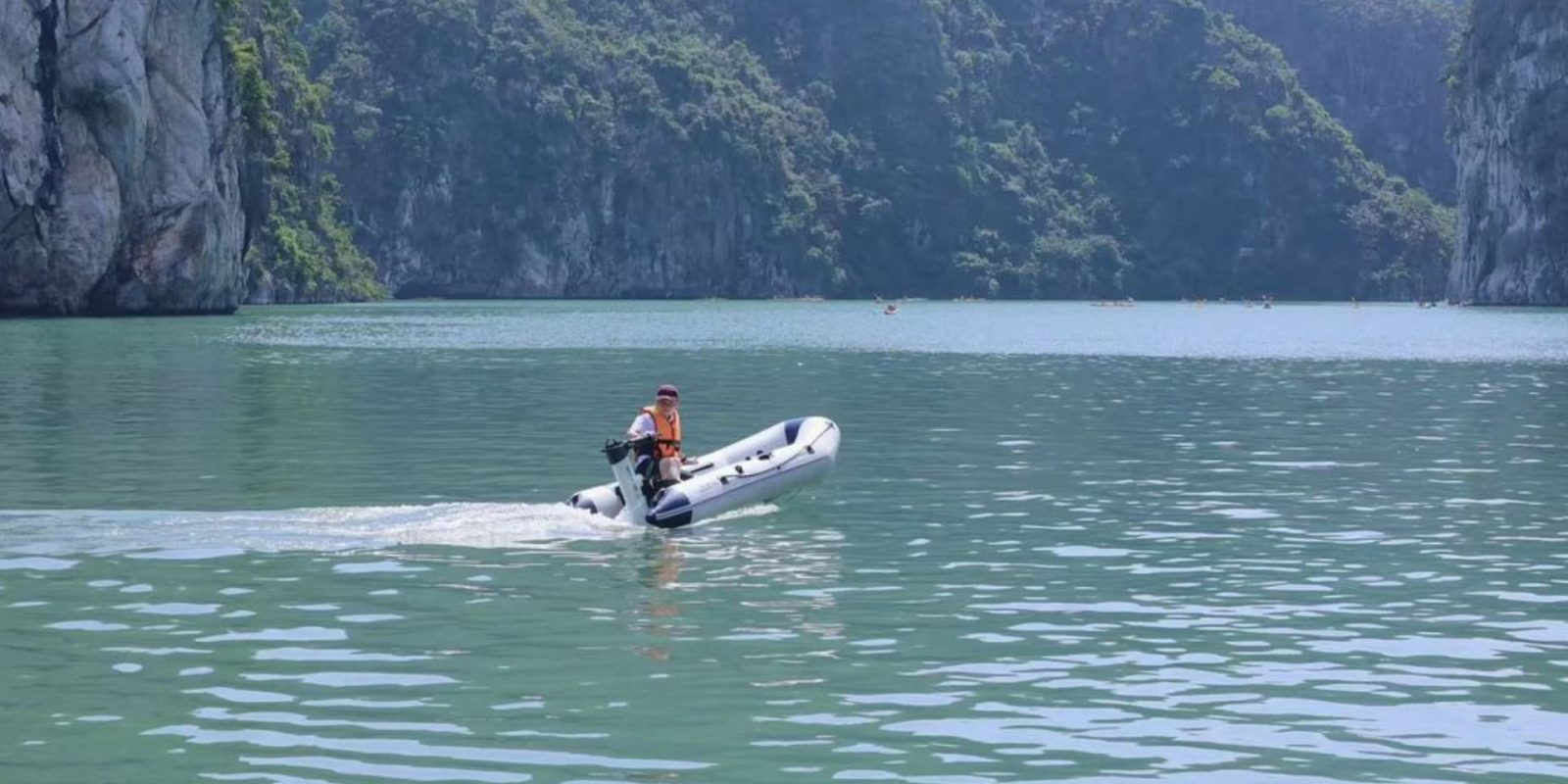
Electric outboards have long been pitched as the cleaner, quieter alternative to gas motors. But according to Blade, ideology alone isn’t enough to convince boaters to switch. The numbers actually have to work, or folks won’t be able to make the switch.
That’s the thinking behind the company’s new Blade Halo Series, a lineup of compact electric outboards designed around a very specific economic target. Blade says electric propulsion only starts to make sense for small boats when battery costs fall below about $300 per kilowatt-hour. Above that point, compromises in runtime, power, or price pile up quickly. Below it, electric can finally compete with petrol in ways that matter to everyday users.
Rather than chasing big headline power numbers, Blade focused on usable runtimes. Both the Halo 3 and Halo 6 outboards use a 1.7 kWh integrated battery, while the larger Halo 10 steps up to a 5 kWh pack. The goal, the company says, is repeatable real-world use instead of just short bursts of impressive but impractical output.
Battery economics remain the hardest part of the equation. While lithium-ion cells themselves may cost under $100 per kWh, fully assembled battery packs with protections, housings, and marine-specific requirements push costs much higher. Blade says shipping, waterproofing, and low-volume production make competitive pricing especially difficult in the marine world, and that its advantage comes from aggressive supply-chain optimization rather than technical shortcuts.
“We’ve kept cost low by design by pulling every supply chain rope we can find” says director Bruce Anson, highlighting Blade’s focus on balancing performance, usability, and affordability. He adds “Blade has been able to price outboards and batteries in a way that the industry will struggle to stay competitive with.”
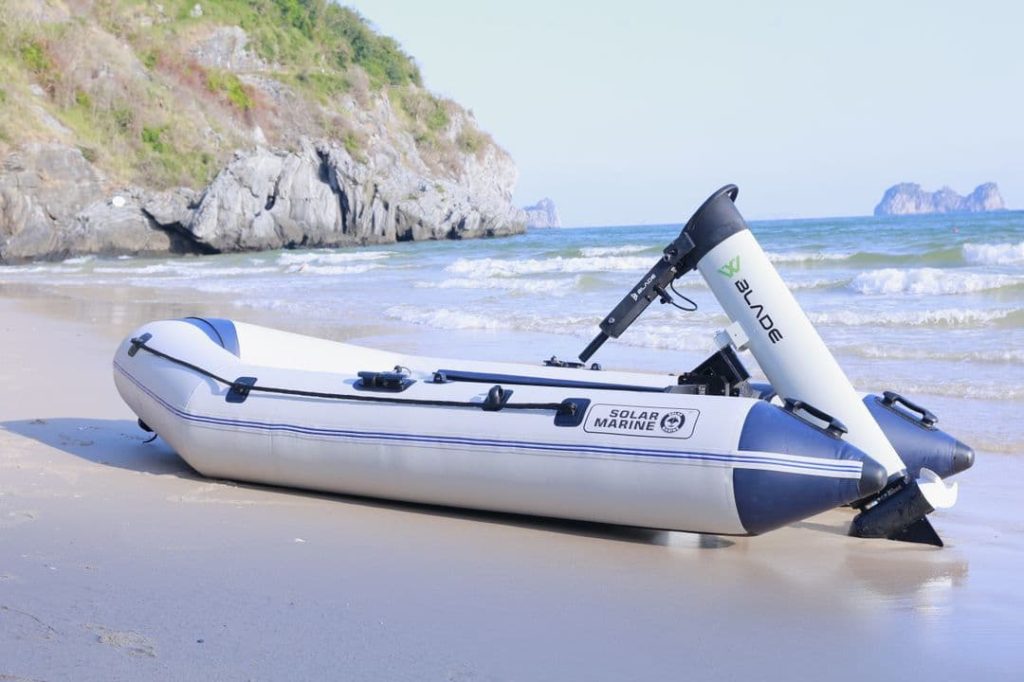
The 2026 Halo Series includes three models named after their equivalent horsepower: the Halo 3 (1.2 kW), Halo 6 (3 kW), and Halo 10 (6 kW). Each uses a custom-designed motor and electronics system tuned for efficiency and durability. Connectivity is also a major focus, with Bluetooth smartphone control, built-in 4G LTE, and NMEA2000 support for integration with chartplotters. Haptic feedback via sound and vibration provides alerts without forcing riders to constantly watch a screen.
Blade has been in production since 2025 and expects deliveries of the 2026 models to begin in April in both Europe and the US. The lineup will also be publicly displayed at Boot Düsseldorf later this month.
Top comment by Actually Thoughtful
it is not about ideology. Just common sense. Anyone who enjoys the open water has a vested interest in not trashing said waters with toxic fossil fuels. But sure, lower costs are good too. A canopy with solar panels would change things dramatically, too.
European pricing (excluding VAT) starts at €1,700 (approximately US $1,970) for the Halo 3, rising to €2,400 (approximately US $2,800) for the Halo 10. Blade’s bet is simple: if electric outboards are going to win, it won’t only be because they’re greener. It’ll be because they also make financial sense.
Electrek’s Take
These aren’t exactly huge motors or batteries, but that’s the point. These are meant for smaller boats that cruise along efficiently, and that’s a perfect use case for light electric outboards. We’ve seen before how even modest batteries can provide nearly 24 hours of boating when used efficiently.
My own electric boat could have made use of one of these, and that would have made my upgrades a lot simpler when I went about adding more power to it.
I’m excited to see these types of solutions becoming both more common and more cost-effective.


FTC: We use income earning auto affiliate links. More.


Comments