
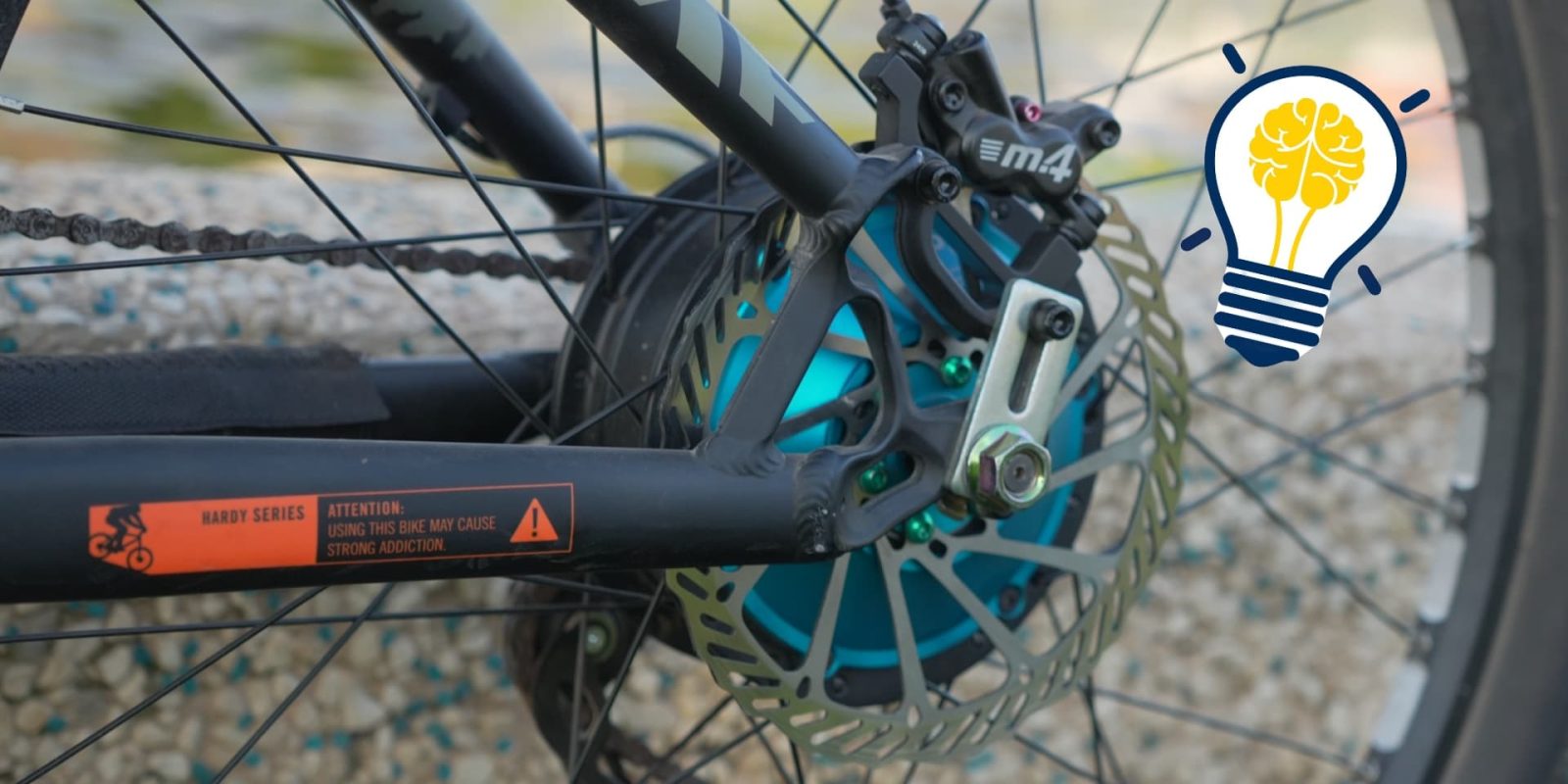
If you’ve covered e-bikes as long as I have, you’ll know two things about them: they’re an awesome way to get around, and the basic technology behind an e-bike motor hasn’t radically changed in a long, long time. However, based on the new e-bike motor design I just tested from a powertrain technology company called CHARGE, the e-bike world may be about to get turned on its head. These guys discovered that nearly any e-bike hub motor can perform regenerative braking, but everyone has just been building them wrong this whole time.
I know that sounds crazy, but stick with me. Because I’ve seen this in action, and it’s legit.
So here’s the background: The most common motor style for an electric bike is a hub motor (a motor in the center of the wheel), and we’ve all known for a long time that e-bikes generally can’t do regenerative braking. Well, they can, except that it requires a heavy and lower efficiency direct drive hub motor, something that we haven’t seen employed on any major retail e-bike in years. These days, everyone uses smaller geared motors that allow the wheel to freewheel like a typical bicycle wheel, making an e-bike coast like a pedal bike yet still have the power of an electric drivetrain.
The problem is that the freewheeling nature of a typical geared e-bike motor means regenerative braking is impossible; there’s just no way to backdrive the motor and turn it into a generator since it doesn’t turn when the bike isn’t being powered (i.e. coasting or braking). You’d need a controllable clutch to do that, and while there have been designs for such a thing, no one has ever succeeded in doing it in a simple enough or cost-effective way that it could reach production.
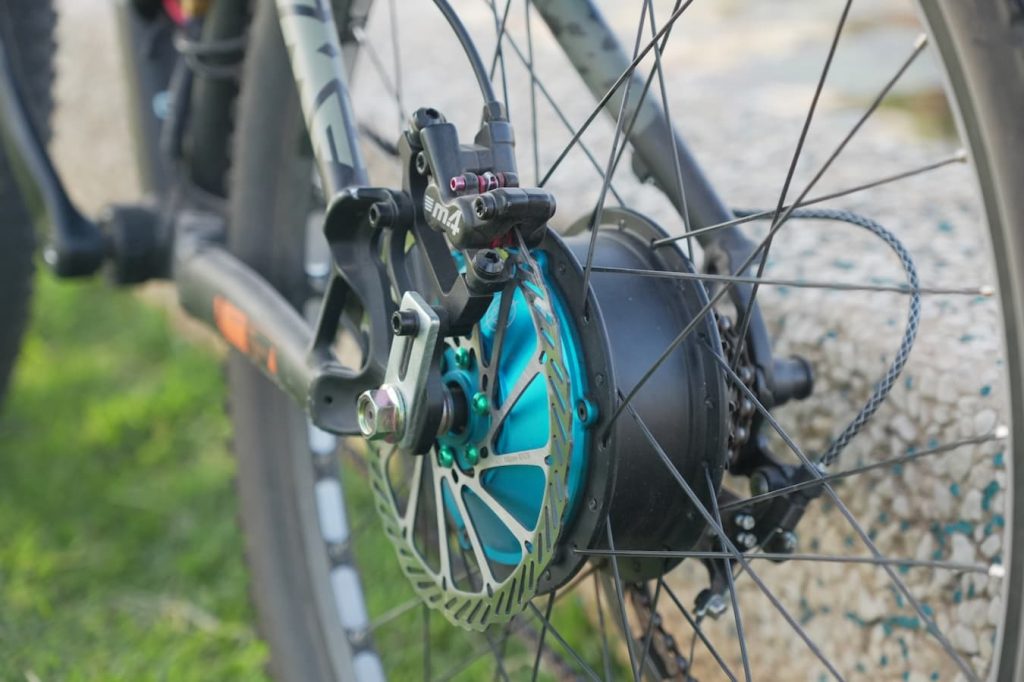
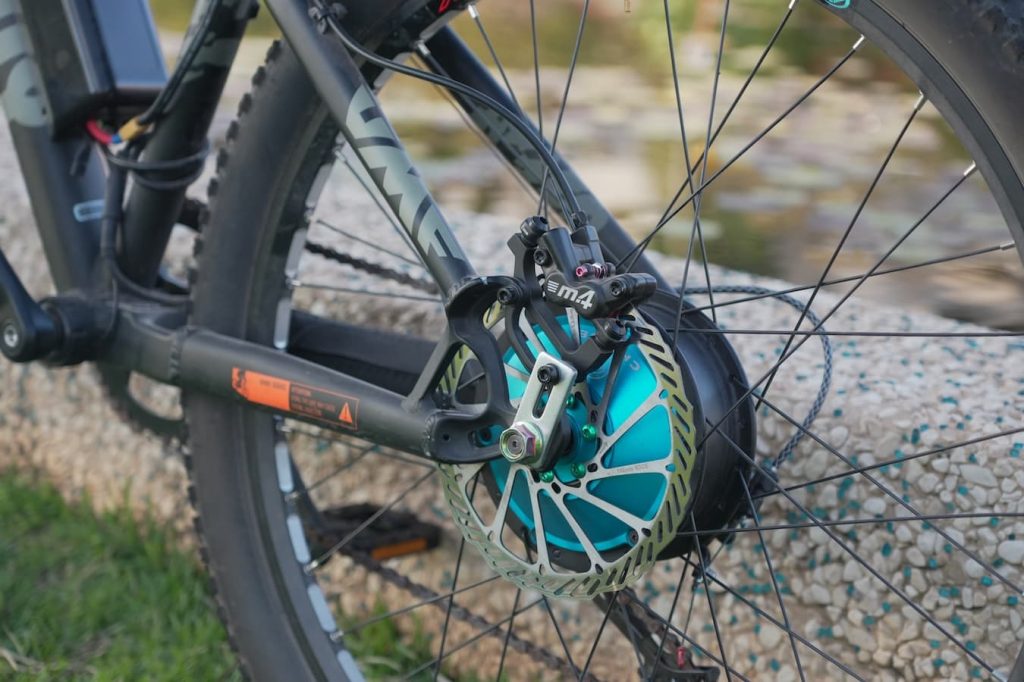
But the clever guys at CHARGE discovered that it doesn’t have to be that way, at least not if you simply tweak the motor design. Instead of mounting the disc rotor to the motor’s shell, which has been the go-to method for decades, they mounted the disc rotor to the carrier plate that holds the planet gears in the motor’s internal gearbox. It requires a slightly different shell for the motor – one that lets a mount connect the disc rotor to the gears’ carrier plate – but that’s the only difference, and it’s an easy one to produce. It just requires tweaking the motor assembly line. After that, the entire braking system is the same.
So the user still pulls the brake lever on the handlebar as usual, and the brake pads still grip that disc rotor. But the difference is that as the pads bite down on the disc rotor, the motor is forced to turn, which is what creates the braking force. In essence, the disc rotor now doubles as the user-operable clutch that has always been missing. That means the motor can switch into generator mode, essentially becoming a brake as it loads the motor and converts rotational energy back into electrical energy to charge the battery. The controller and motor continuously communicate with each other, increasing or decreasing braking power according to how hard the user pulls the brake lever.
The amount of slip of the disc rotor in the brake is basically the clutch that controls how much regenerative braking power is applied. That’s the second clever trick here. Since the rotor is connected to the planetary gears instead of the motor shell, the motor knows how fast the disc brake rotor is spinning, because it’s the same speed that the planetary gears are spinning. When the disc brake rotor begins to slow down or stop – essentially brake lock up – the motor knows that the user wants to brake harder, and so in turn it draws more power by applying more regenerative braking, which prevents the disc brake rotor from locking up and keeps it spinning slowly. It’s constantly monitoring rotation speed to ensure the braking power matches what the user is doing with their own hand pull on the lever (i.e. the brake pads on the rotor). And it’s doing so with the existing motor speed sensors already built into every hub motor – no extra sensors required.
But since the brake pads are just applying a small force to the rotor and not actually using friction to create much heat and cause significant braking, they experience very minimal wear and likely won’t need replacing. They’re simply lightly squeezing the rotor as a way for the motor and thus the controller to experience braking input from the hand lever. Nearly all the braking power is actually coming from the motor itself, which is acting as a generator to generate electricity. Or at least, that’s true most of the time. There’s another neat trick where when the battery is full and thus can’t use regen to charge it anymore, the controller can automatically lock or nearly lock the disc rotor speed by stalling the motor, which means more friction is generated by the brake pads. That’s a rare case though, that only happens upon braking when the battery is in a fully-charged state (e.g., at the beginning of a ride).
Conceptually, it can be a bit hard to wrap your head around. And honestly, seeing it in real life doesn’t exactly hammer the mechanics home, either.
But since I got to test it myself, why not take a look at the trippy way the disc rotor moves – and doesn’t move – during the test ride experience. See it in the short clip below! Or check out CHARGE’s own slow motion video that brakes it down even more (get it?).
If you want an even deeper dive that gets into the technicals of the engineering, Justin from Grin Technologies met up with the CHARGE guys and made a great deep dive explanation video here.
Having ridden it myself, I can tell you that this setup feels exactly the same as normal braking with physical disc brakes. The harder I squeeze the right brake lever, which controls the rear brake caliper, the more braking power I get from the rear wheel.
If no one had told me that something was different back there in the braking system, I might not have even noticed it. Perhaps the only giveaway is that you don’t get the same amount of brake noise like you might get from a squeaky disc rotor under hard braking. And if you happen to turn around and look at your rear wheel riding (which is a tricky thing to do, in general), you’ll notice a strange sight which is that when you are riding along, your wheel is turning but the disc brake rotor is actually still. It’s trippy, and it’s the only giveaway that something isn’t quite normal back there.
Top comment by Dave Brower
Approve! Regen has been a vital part of e-transportation for quite a while and the absence of an effective way to do it on bikes is a real annoyance to the engineer in me.
The craziest part of this is that the CHARGE engineer who first came up with the solution, Alon Goldman, had never actually ridden an electric bike before coming up with this invention. He simply heard of the problem and started thinking about how he could solve it. And perhaps that was the secret that allowed him to approach motor design in a way that no one had thought of in over two decades. After learning about the problem – that e-bike motors couldn’t perform regenerative braking due to the freewheeling design of geared hub motors – he started thinking outside of the box, or rather inside of the wheel, and he realized the solution was simple. It just meant changing the way we have connected disc brake rotors to the wheel since the dawn of the first hub motor. Everything else could stay the same.
And that opens the door to finally bringing regenerative braking to basically any e-bike, or at least the majority of e-bikes on the road today, which are using geared hub motors. It requires the motor to be slightly adjusted mechanically so the disc is mounted differently, and to use CHARGE innovative controller to modulate the regenerative braking, but that’s it. It’s no longer an impossibility or even much of a hurdle. The solution is just sitting there on the table waiting to be implemented. And you better believe that the first e-bike company to jump on it is going to have a major advantage on their hands, both functionally and from a marketing perspective.
That brings us to one final question here, which is about the nature of regenerative braking itself. Regen is common in just about every electric vehicle out there except for e-bikes. We’ve long accepted that for e-bikes, the tradeoff of having a freewheeling motor to coast like a normal pedal bike is worth giving up regen, but that hasn’t numbed the desire for everyone. The benefits to other vehicles are the same to e-bikes. Brake pads last longer, batteries go farther, and we simply don’t waste the energy we worked hard to produce (or to charge up, if we haven’t been pedaling ourselves). The amount of energy we’re talking about isn’t huge on average, often between 5-10% of the total used for a trip, depending on the terrain and load (or up to 20-30% on long downhill sections, which could result in considerable increases in range). But even on average flat city riding, that still means riders can go 5-10% further, which isn’t nothing. And for many, the reduced wear and tear and lower maintenance are big benefits on their own.
So will we be watching this technology roll out on any new e-bikes soon? It sounds like the hardware and software are ready, but now it’s time to see if the market is ready to adopt it. We’ll be keeping a close eye on it, that’s for sure!


FTC: We use income earning auto affiliate links. More.

Comments