
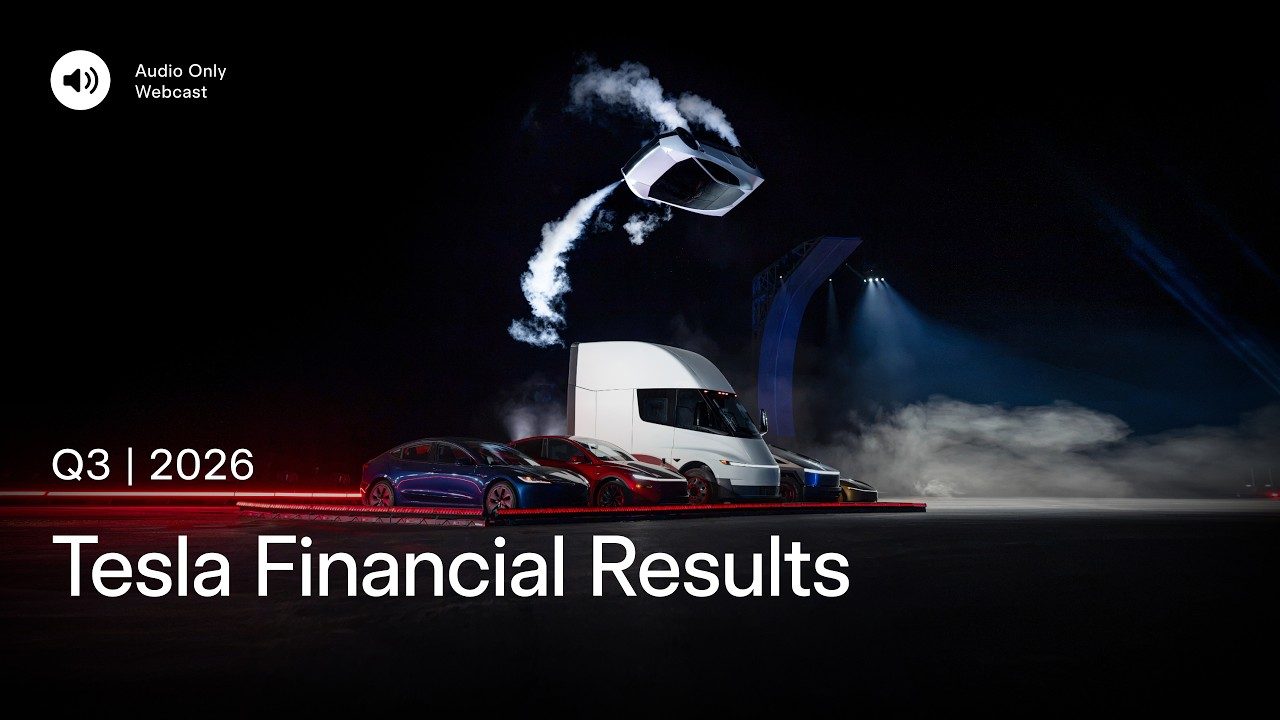
Tesla (TSLA) released its financial results and shareholders’ letter for the third quarter (Q3) 2026 after market close today. We’re updating this post with all the details from the financial results, shareholders’ letter, and the conference call later tonight.
The earnings call with management is scheduled for 5:30 p.m. ET.
Tesla Q3 2026 earnings expectations
Wall Street came into the report expecting a flat quarter. The FactSet consensus, as displayed on Estimize, called for $28.06 billion in revenue, essentially unchanged from the $28.1 billion Tesla posted in Q3 2025 and a bit below the $28.24 billion it reported last quarter.
Profit expectations were lower. Analysts were looking for non-GAAP earnings of $0.45 per share, down 10% from $0.50 a year ago. The Estimize crowd was slightly more bullish at $28.36 billion and $0.48.
We already had the volume numbers. Tesla delivered 486,532 vehicles in Q3, down 2.1% year-over-year but well ahead of the 461,974 consensus, while producing only 464,391. It also deployed 13.7 GWh of energy storage, up from 12.5 GWh a year ago but short of the roughly 15.9 GWh analysts expected. For the full setup, see our Q3 2026 earnings preview.
So the question was never volume. It was whether Tesla could stop the profit slide after Q2, when operating margin fell to 1.4% and EPS missed the consensus by 20 cents.
Tesla Q3 2026 financial results
After the market closed today, Tesla released its financial results for the third quarter and reported $28.05 billion in revenue, flat from a year ago and in line with the $28.06 billion Wall Street expected. Non-GAAP earnings came in at $0.48 per share, beating the $0.45 consensus but down 4% from $0.50 a year ago.
It’s a better quarter than Q2, but the trend hasn’t changed. Margins recovered, with auto gross margin excluding credits back above 18%, yet operating income still fell 56% year-over-year as spending on AI and Optimus grew faster than gross profit. On a GAAP basis, net income dropped 43% to $787 million, or $0.22 per share.
Total gross margin was 19.6%, up 160 basis points from 18.0% a year ago and well above the 16.8% Tesla posted in Q2. Operating income fell 56% to $718 million, for an operating margin of 2.6%, compared with 5.8% a year ago and 1.4% last quarter.
Operating expenses came in at $4.78 billion, up 39% year-over-year. Research and development alone jumped 69% to $2.76 billion as Tesla spends on what it now calls “Super Intelligence” (SI), Optimus, and the Cybercab. Stock-based compensation, which includes the 2025 CEO pay package, hit $1.17 billion, up from $663 million a year ago.
Capital spending was $4.73 billion, more than double the $2.25 billion of a year ago, and free cash flow came in at $1.53 billion, compared with $3.99 billion a year ago and negative $1.09 billion in Q2. Tesla ended the quarter with $45.4 billion in cash and investments. GAAP net income included a $288 million unrealized gain on Tesla’s bitcoin holdings, partly offset by a $142 million unrealized loss on its SpaceX equity investment.
That puts Tesla’s capex at $13.01 billion through the first nine months of 2026, only about half of the “more than $25 billion” management guided for the year. To hit that number, Tesla would need to spend roughly $12 billion in Q4 alone, more than double its biggest quarter so far. The Q3 letter doesn’t update the guidance, and capex actually fell sequentially from $5.79 billion in Q2. So either Q4 spending explodes, or the 2026 plan is quietly slipping into 2027. The lower spending also flatters this quarter’s positive free cash flow.
| Metric | Q3 2026 | Q2 2026 | Q3 2025 | Consensus |
|---|---|---|---|---|
| Revenue | $28.05B | $28.24B | $28.1B | ~$28.06B |
| Total gross margin | 19.6% | 16.8% | 18.0% | — |
| Operating income | $718M | $398M | $1,624M | — |
| Operating margin | 2.6% | 1.4% | 5.8% | — |
| Non-GAAP EPS | $0.48 | $0.33 | $0.50 | ~$0.45 |
| GAAP net income | $0.79B | $1.11B | $1.37B | — |
| Free cash flow | $1.53B | –$1.09B | $3.99B | — |
| Capex | $4.73B | $5.79B | $2.25B | — |
| Regulatory credits | $113M | $146M | $417M | — |
| Energy storage deployed | 13.7 GWh | 13.5 GWh | 12.5 GWh | ~15.9 GWh |
Tesla’s auto margin without credits
The number we watch first is automotive gross margin excluding regulatory credits, now that the credit market has mostly dried up. It came in at 18.1% this quarter, up from 16.3% in Q2 and 15.4% a year ago, though still below the 19.2% of Q1, when Tesla got help from warranty and tariff one-time benefits. Tesla credits a better regional and product mix and more FSD subscription revenue, partly offset by lower average selling prices.
Regulatory credits brought in just $113 million, down 73% from $417 million a year ago and below the $146 million in Q2. That line isn’t coming back now that automakers no longer pay federal fuel-economy penalties.
Energy was the weak spot on revenue. Energy generation and storage revenue fell 16% to $2.88 billion, which Tesla partly blames on tariff-related customer refunds, even though deployments rose 10% to 13.7 GWh. The segment’s gross margin jumped to 33% from 20% in Q2, but energy gross profit still slipped to $954 million from $1.07 billion a year ago.
Services and other was the bright spot. Revenue grew 33% to $4.61 billion, and Tesla says gross profit hit a record $734 million on charging, insurance and parts sales.
Tesla blames batteries, not demand
Tesla says “battery availability continued to be the limiting factor in increasing auto volumes in the quarter,” and that it ended Q3 with “the largest backlog for our passenger vehicles in four years.”
That’s a new explanation for flat sales. Deliveries were still down 2% year-over-year, “other models” (Cybertruck, Semi, Model S and X) fell 48%, and Tesla delivered 22,141 more cars than it built, bringing inventory down to 11 days of supply from 15 in Q2. But average selling prices fell again, which isn’t usually what a supply-constrained automaker does.
On autonomy, Tesla says active FSD subscriptions reached 1.74 million, up 67%, though that count includes upfront purchases, as defined in Musk’s 2025 pay package. Its Robotaxi service reached nearly 2 million cumulative unsupervised miles by the end of the quarter, a month after Cybercab joined the Austin fleet.
Tesla Q3 2026 shareholder deck
Top comment by Tony Martie
After all the years of promises about how they were going to revolutionize and build their own batteries, now batteries are the claimed bottleneck. Great work as usual Tesla.
Tesla’s full Q3 2026 shareholder deck is available on the company’s investor relations site, and management will discuss the results on the earnings call at 5:30 p.m. ET.
More from Tesla’s Q3 2026 earnings
This is a developing story. We’ll add the most important updates from Tesla’s shareholder letter and earnings call here as they come.
- Tesla blames battery supply for flat sales, but its prices keep falling
- Tesla FSD ‘subscriptions’ hit 1.74M, counted the way Musk’s pay package wants
- Tesla energy revenue drops 16% as it refunds customers over tariffs
- Tesla pushes unsupervised FSD to Q2 2027, and only inside Robotaxi zones
You can watch the earnings call here starting at 5:30 PM:
Tesla’s earnings won’t lower your power bill, but going solar will. If you drive a Tesla or any other EV, charging it on home solar is one of the smartest ways to lock in low fuel costs for good. With electricity rates up almost 10% last year and expected to keep climbing, going solar is one of the best ways to protect yourself against rising costs. And with lease and PPA options, you can do it with zero upfront cost and start saving immediately. If you want to find the best deal, check out EnergySage. It’s a free service with hundreds of pre-vetted installers competing for your business, so you save 20 to 30% compared to going it alone. No sales calls until you pick an installer. Get your free quotes here.


FTC: We use income earning auto affiliate links. More.



Comments