
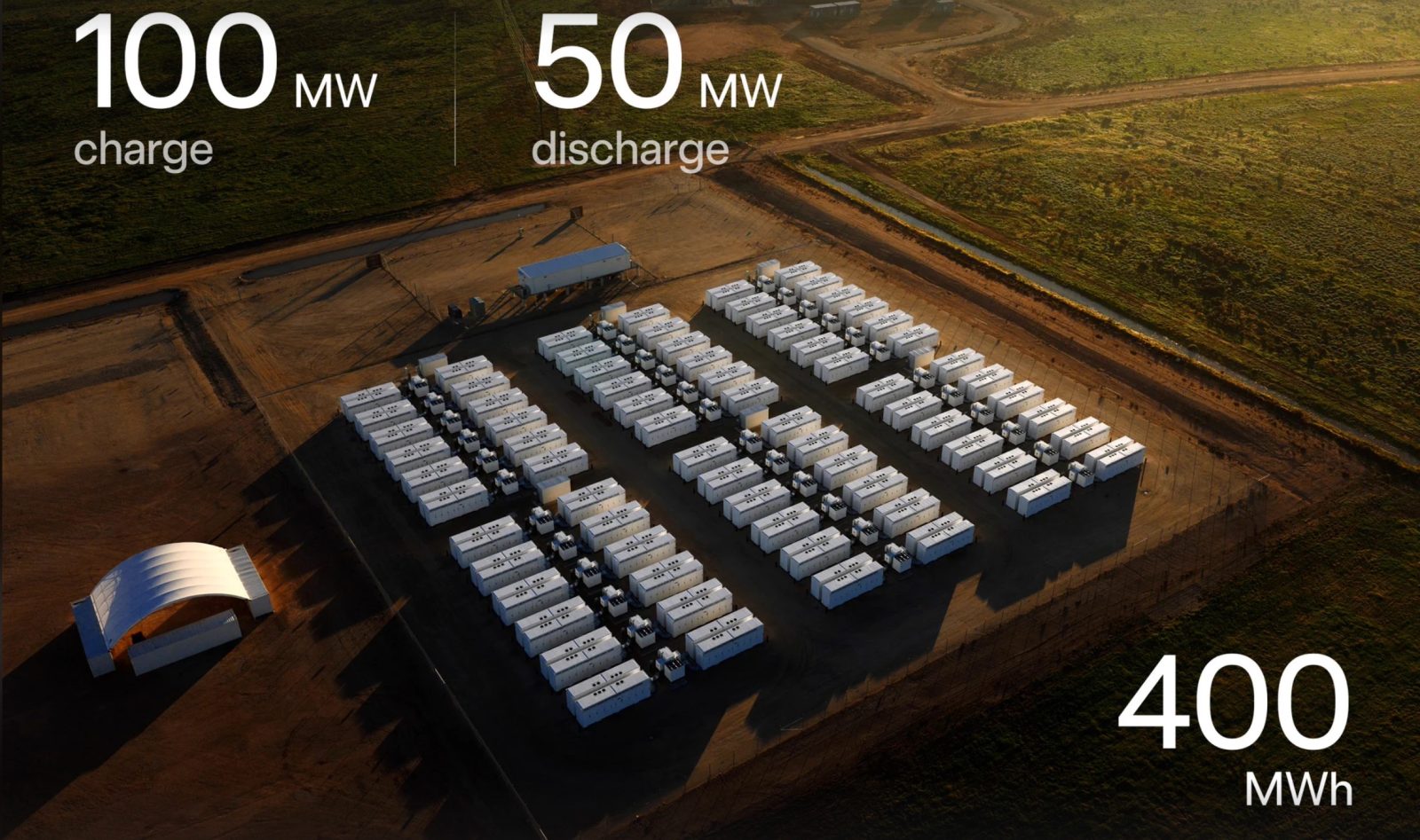
Australia just switched on its longest-duration grid battery, and it runs on 144 Tesla Megapacks.
RWE’s Limondale battery in New South Wales can discharge for a full eight hours — four times longer than the two-hour batteries that dominate the Australian grid. It’s the first project of its kind in the country.
The battery sits at 50 MW / 400 MWh, near Balranald in the state’s south-west, right next to RWE’s existing Limondale solar farm. It’s now registered and operating on the National Electricity Market after getting its final operational sign-off from grid operator AEMO earlier this year.
Charging twice as fast as it discharges
Limondale is built to charge at roughly 100 MW but discharge at only 50 MW. Most grid batteries charge and discharge at the same rate. This one doesn’t.
That asymmetry is the whole point. The battery can fill up in about four hours — soaking up the midday solar glut when NSW is drowning in cheap renewable power — then stretch that energy back out over eight hours to cover the evening peak and into the night. Charge fast, discharge slow.
It’s a neat answer to the “duck curve” problem that every solar-heavy grid runs into: too much power at noon, not enough at 7 PM. Pairing the battery directly with a solar farm makes the arbitrage even cleaner.
Why 8-hour storage is the new frontier
Australia has plenty of big batteries. What it hasn’t had is long ones.
The first wave of grid storage, including Tesla’s landmark Hornsdale project, was built for fast response and one-to-two hours of duration, great for grid stability, useless for shifting bulk solar into the evening. Four-hour batteries are now becoming the norm. Eight hours is the next step up, and Limondale is the proof of concept.
RWE didn’t build it on spec. Limondale was the only winning bid in NSW’s first long-duration storage tender under the state’s Electricity Infrastructure Roadmap, backed by a Long-Term Energy Service Agreement, essentially a government revenue floor that makes financing a long battery bankable. Two more LTESA-backed 8-hour batteries are moving through the NSW pipeline behind it.
“RWE’s investment decision and signing of supplier contracts for the Limondale BESS project is an exciting step forward,” RWE Renewables Europe & Australia CEO Katja Wünschel said when the project was greenlit. Tesla supplied the Megapacks; Beon Energy Solutions handled the balance of plant.
For Tesla, it’s another flagship win in a market it helped create. The company has been stacking up grid deals worldwide, from a 500 MWh Megapack battery that just went live in Texas to a 1 GWh project in the UK, and its Megapack energy business is now one of its fastest-growing segments.
Electrek’s Take
Two-hour batteries proved storage could stabilize a grid. Eight-hour batteries are what actually let you retire coal, because they can carry solar generation through the entire evening ramp instead of tapping out at dinnertime. That’s the transition Australia is trying to pull off, and it’s why the asymmetric charge/discharge design matters more than it looks. Building a battery that inhales cheap midday solar and exhales it slowly all night is exactly the shape of storage a renewables-heavy grid needs.
Now, we just need a lot more of them.
Home batteries are quietly changing the economics of residential energy the same way grid batteries are reshaping the wholesale market, and pairing one with rooftop solar is the best way to squeeze the most value out of both. With electricity rates up almost 10% last year and expected to keep climbing, going solar is one of the best ways to protect yourself against rising costs. And with lease and PPA options, you can do it with zero upfront cost and start saving immediately. If you want to find the best deal, check out EnergySage. It’s a free service with hundreds of pre-vetted installers competing for your business, so you save 20 to 30% compared to going it alone. No sales calls until you pick an installer. Get your free quotes here.


FTC: We use income earning auto affiliate links. More.



Comments