
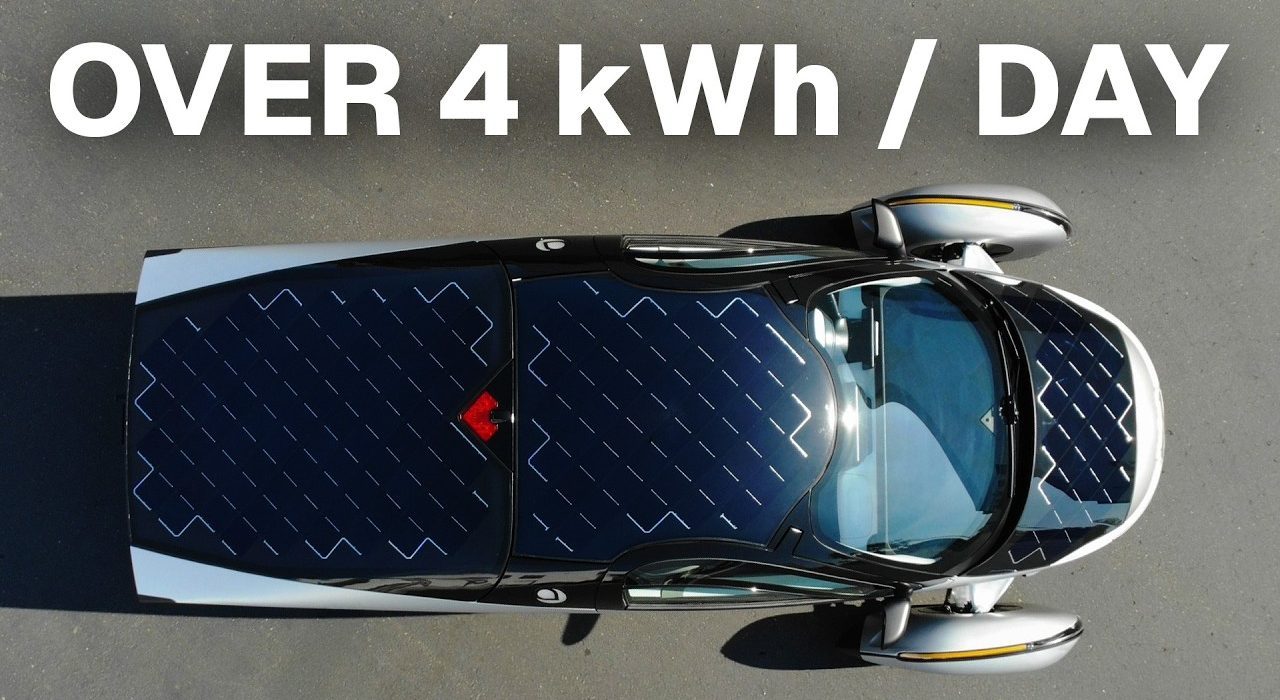
Aptera’s solar electric vehicle can pull more than 4 kWh of usable energy out of the sun in a single day, and now an independent testing house has put its name on the number.
TÜV Rheinland, the 150-year-old German testing and certification firm, ran three days of on-site solar measurements at Aptera’s Carlsbad, California headquarters and confirmed the car generated 4.23 to 4.75 kWh per day, enough for roughly 42 to 47 miles of driving on sunlight alone.
Solar-car range claims have a bad track record. They are generally powered by AC fans and not much more.
Aptera (Nasdaq: SEV) has been quoting daily solar figures for years that could actually result in useful range thanks to its super-efficient vehicle.
Now it is bringing in a third party to prove it. TÜV Rheinland showed up with its own calibrated instruments and measured the energy actually reaching the battery, after conversion losses — not the raw output printed on a panel spec sheet.
What TÜV Rheinland actually measured
Dr. Giorgio Bardizza, a solar expert from TÜV Rheinland, wired data loggers and sensors to the individual solar strings on the car, logging current, voltage, and power for each one across a full day. His team also monitored the high-voltage line feeding the battery pack.
The setup let them verify two things Aptera’s own vehicle already logs: the power coming into the solar charge controller through its MPPT channels, and the power coming back out after the boost to the pack’s 400-volt level. In plain terms, they confirmed the solar number the car shows on its display is real.
The hard part is the car itself. A flat rooftop panel is easy to characterize. Aptera’s body is a curved, teardrop shape wrapped in solar cells at every angle, so the output shifts constantly as the sun moves. Hence all the instrumentation.
The three test days were run differently on purpose:
- Day 1: Parked and left completely untouched, hatch closed. 4.23 kWh (~42 miles).
- Day 2: Repositioned once at solar noon, then left for the rest of the day. 4.40 kWh (~44 miles).
- Day 3: Hatch raised to angle more cells at the sun, one reposition. 4.75 kWh (~47 miles). Aptera calls this “solar maxing.”
But the number that matters most is Day 1. Park the car, walk away, and it still cleared Aptera’s 40-mile daily solar target without anyone touching it.
“The most exciting result is the day we simply parked the vehicle in the sun and let it do the work,” said Steve Fambro, Aptera’s co-founder and co-CEO.
Why the parked number is the whole point
Aptera targets 100 watt-hours per mile, which is where the roughly 40-mile figure comes from. That’s about a tenth of what a typical electric SUV burns. That efficiency is the reason solar works here and doesn’t work on heavier vehicles. Fisker, Toyota, and others have bolted panels onto cars for years and gotten back a rounding error. Lightyear went bankrupt trying to build a solar car; Sono Motors killed its Sion.
For a US commuter averaging around 30 miles a day, 40-plus miles of free solar range means the car could go weeks without ever being plugged in. That’s the pitch Aptera has been making since the CEO showed the car outproducing his home solar array in April, and it’s the pitch a TÜV Rheinland report now backs.
“When American innovation turns sunlight into miles, independent testing helps turn that promise into confidence,” said Jonathan Kotrba, VP of Products at TÜV Rheinland.
Aptera’s full report is available to download. The company, which completed its first vehicle off the validation assembly line in March, is targeting its first 40 production vehicles in the fourth quarter of 2026 through its Launch Design manufacturing partnership.
Electrek’s Take
Top comment by cuhulin1
The Aptera target is the product of two things: (1) the amount of power it generates every day; and (2) the number of miles it gets per kWh. Using the now verified numbers for generation along with Aptera's statements about its power efficiency, you would get significantly more than you daily commute (both ways) by parking it outside all the time, assuming you would be parking in places that get significant sun.
This is a strong result, and I like that they used different scenarios because, let’s be honest, if you need to move and orient the vehicle toward the sun to get meaningful energy out of the solar system, it’s going to be a lot less useful.
Obviously, your mileage may, and will, vary. But if you can get 3-4 kWh every day from just parking in the sun, it’s not bad if the vehicle using it can do it at 100 Wh per mile.
There’s still a lot to be done for Aptera to be succesful, but it does seem like they have figured out the solar part of the equation.
If you’re buying an EV, powering it with home solar can cut your charging costs to nearly zero. With electricity rates up almost 10% last year and expected to keep climbing, going solar is one of the best ways to protect yourself against rising costs. And with lease and PPA options, you can do it with zero upfront cost and start saving immediately. If you want to find the best deal, check out EnergySage. It’s a free service with hundreds of pre-vetted installers competing for your business, so you save 20 to 30% compared to going it alone. No sales calls until you pick an installer. Get your free quotes here.


FTC: We use income earning auto affiliate links. More.




Comments