
Tesla owners used to hide the fact that they were abusing Full Self-Driving. Now they film it, add a caption, and post it for the algorithm.
Sleeping at highway speed, gaming with a controller, watching live TV, answering emails on a laptop — a whole genre of “look what my Tesla lets me get away with” content has taken over Instagram, TikTok, and X, and almost every clip in it shows a driver doing something that is flatly illegal in the country where it was filmed.
A content genre built on breaking the law
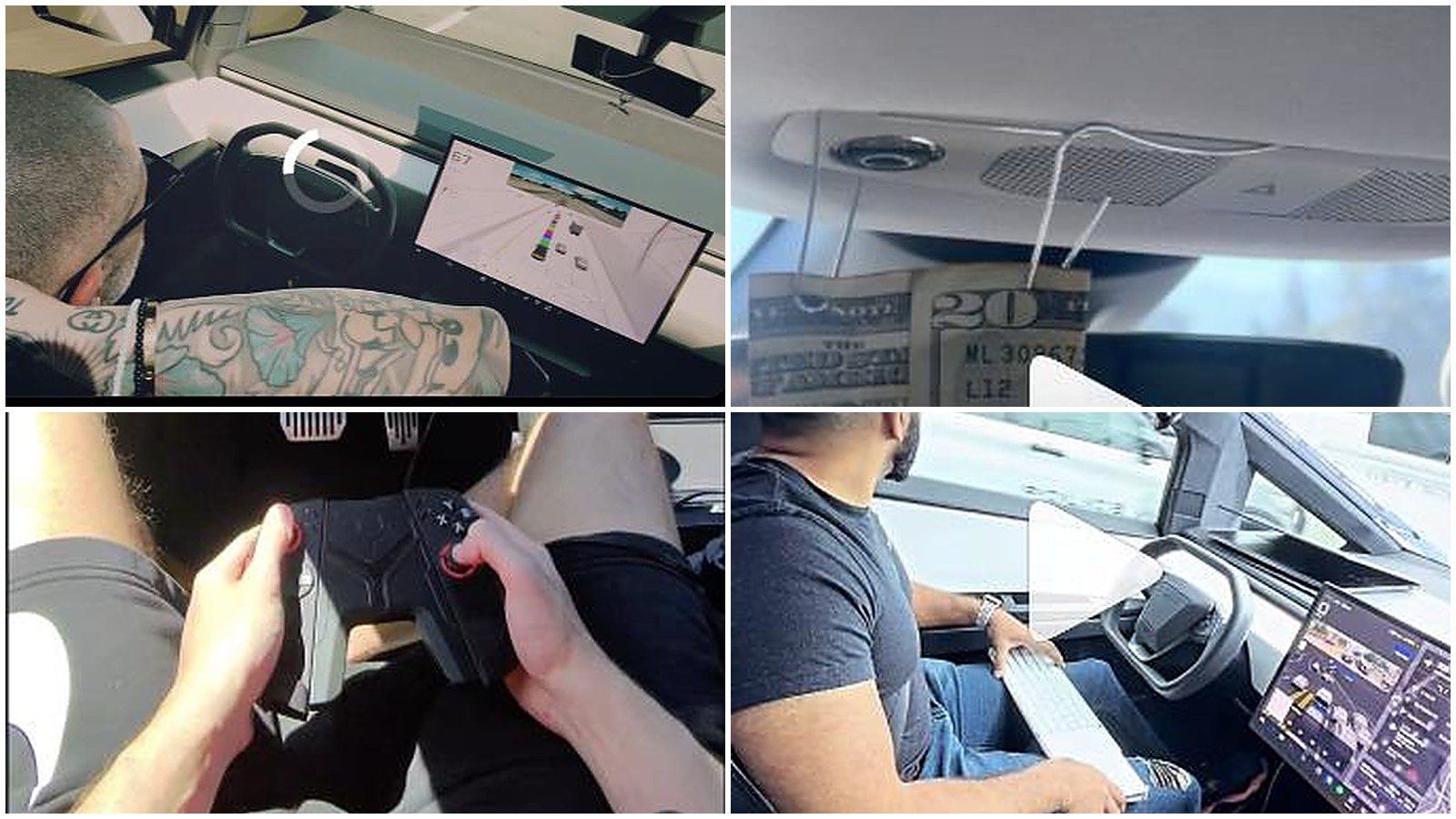
The clearest example making the rounds this week is about as blunt as it gets: a driver slumped over, fully asleep, while his Tesla drives itself down the road with the FSD visualization running on the screen. The caption: “The life of a Tesla owner with FSD”:
It’s not a one-off. Search “Tesla FSD” on any social platform and you’ll find an endless supply of owners treating the driver’s seat as a couch. One creator films himself gaming with a controller all the way to his destination, bragging in the caption that he “beat the eye tracking camera”:
Another shows off streaming live TV on the center screen while the car is in motion — “easier than you think”:
And, inevitably, the productivity-guru version: reclined in the driver’s seat of a Cybertruck, typing away on a laptop while the truck handles the highway, packaged as a hustle tip.
None of these people are doing anything the car will physically stop them from doing for long, and that’s the whole point of the content. The message is always some flavor of “most people have no idea what Teslas can actually do.”
It’s the classic: “you were so focused on whether you could do it that you didn’t think if you should do it.”
There’s now a cottage industry for defeating the safety systems
What has changed isn’t that people misuse driver-assist systems, that’s as old as Autopilot. What’s new is that people beating Tesla’s driver-monitoring are now openly bragging about it.
Tesla’s system is supposed to keep a driver engaged with a mix of steering-wheel torque, and increasingly a cabin-facing camera that tracks the driver’s eyes and issues “strikes” — rack up too many inattention warnings and FSD gets suspended for a week. Tesla has been tightening that camera-based monitoring throughout 2026, even moving toward using the cabin camera to verify the driver’s identity before FSD engages.
Owners’ response has been to defeat it. The oldest trick, a weight on the wheel to fake hands-on-wheel torque, has given way to blinding the camera outright. One popular clip shows a folded $20 bill hung over the cabin camera is enough to make Tesla think Andrew Jackson is driving:
Others are selling the workaround as a product. There are now apps and dongles marketed specifically to unlock video playback while the car is moving — the “video in motion” lockout is one of the few software guardrails Tesla ships, and there’s a tutorial genre dedicated to removing it:
What the law, and Tesla’s own fine print, actually say
Here’s the part the captions leave out: Full Self-Driving is not autonomous, and every one of these owners is legally the driver.
Tesla sells the feature as “FSD (Supervised),” and its own disclaimer is unambiguous: “Currently enabled features require active driver supervision and do not make the vehicle autonomous.” The driver is responsible for the car at all times. Sleeping, gaming, watching a screen, or working on a laptop from the driver’s seat is distracted or careless driving, illegal in every U.S. state and in essentially every jurisdiction where these videos are being filmed. Even Elon Musk conceded last year that texting behind the wheel of a Tesla is “illegal in most states” while promoting software that makes it easier to do.
FSD improving doesn’t change any of that. The legal line isn’t “was the car driving well”, it’s “was a licensed human ready to take over and paying attention.”
Why this is Tesla’s problem, not just the drivers’
It would be easy to write this off as a handful of idiots earning Darwin nominations. But the volume matters.
Social media platforms are being flooded with Tesla drivers brazenly posting video evidence of themselves breaking the law and abusing Tesla FSD. There’s a shift happening.
Tesla has spent a decade marketing these systems in a way that invites exactly this. We’ve documented how Tesla promotes FSD misuse in its own official videos — including footage of a driver making espresso with his hands off the wheel, captioned “Try it yourself” — while simultaneously arguing in court that any crash is the driver’s fault for not supervising. You cannot run both messages at once, and owners have clearly absorbed the first one.
That contradiction is getting expensive. Tesla is facing up to $14.5 billion in lawsuits tied to its driver-assist systems, lost a $243 million verdict over a fatal Autopilot crash, and NHTSA has escalated its FSD probe into an engineering analysis covering 3.2 million vehicles. Meanwhile, Tesla’s own data shows Autopilot and FSD crashes hitting a record 207 in a single month.
Every one of these clout-chasing videos is, functionally, evidence — a self-produced library of owners demonstrating that the car will let them check out entirely, and that the monitoring meant to prevent it is trivial to beat.
Electrek’s Take
The owners filming this stuff are responsible for their own choices. Falling asleep at 70 mph or gaming your way to work isn’t a clever life hack; it’s gambling with other people’s lives on a public road, and doing it for engagement is worse, not better. If the car swerves, and it still does, no caption is going to help them.
Top comment by GoldBone
If these people trust FSD so much as to record themselves not supervising it, would they ever intervene even if they were looking at the road?
In the US alone, Tesla has reported to NHTSA that over 50 people have died in crashes involving Autopilot and FSD. You don’t want to be one of them, or cause one.
And if it does happen, one thing you can be certain of: Tesla will blame you. The automaker named the product “Full Self-Driving,” marketed it with hands-off stunts, shipped driver monitoring weak enough that a folded bill defeats it, and then points to the fine print when someone dies. You don’t get to spend ten years telling people the car drives itself and then act shocked when they believe you.
The fascinating part now is that Tesla doesn’t disavow those videos because they serve a dual purpose for the company. They promote FSD, and they serve as evidence of misuse against the driver for the unavoidable court cases that come after some of these idiots crash and kill or hurt themselves, or, God forbid, someone else.
Whether or not you’d trust your Tesla to drive itself, going electric at home still makes financial sense — and the cheapest way to power an EV is with your own solar panels. With electricity rates climbing nearly 10% last year, home solar locks in low fuel costs and protects you against future rate hikes. If you’re considering going solar, check out EnergySage, a free service that makes it easy to go solar. It has hundreds of pre-vetted installers competing for your business, so you get high-quality solutions and save 20–30% compared to going it alone. It’s free to use, and you won’t get sales calls until you select an installer. Many installers now offer $0-down options like leases and power-purchase agreements (PPAs), so you can go solar with no upfront cost. Get your free quotes here.


FTC: We use income earning auto affiliate links. More.



Comments