
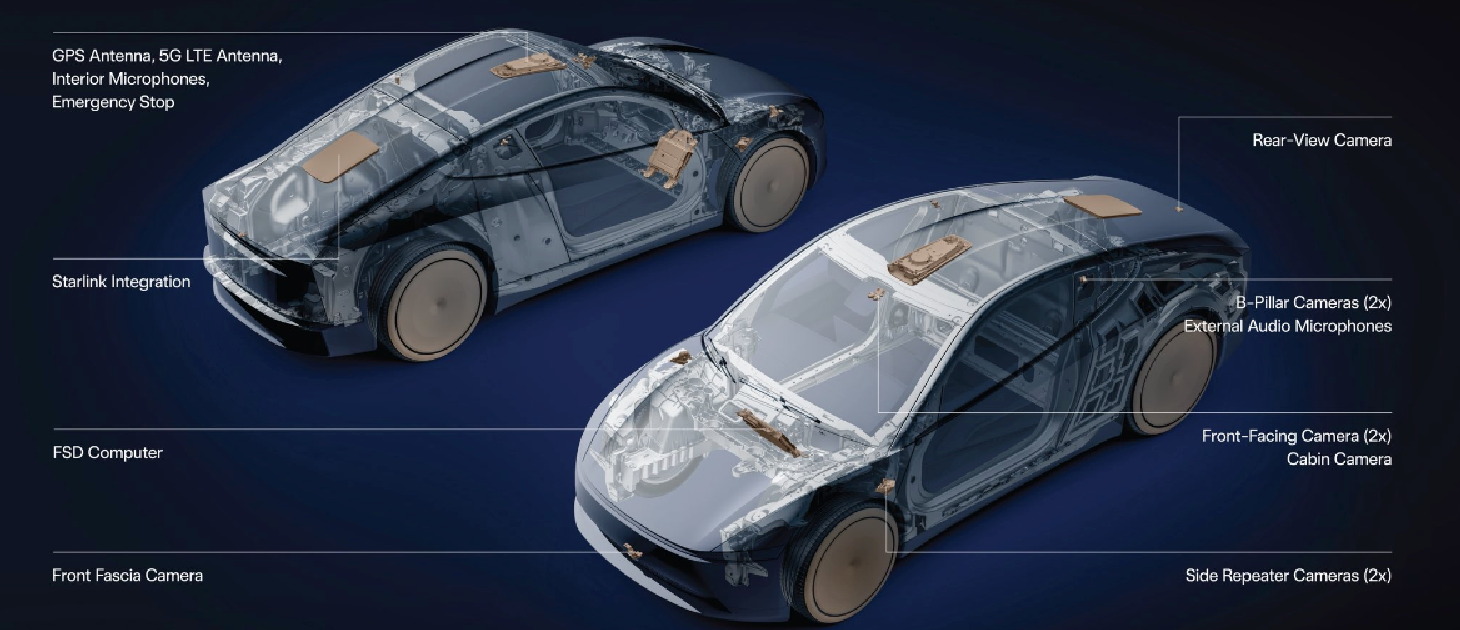
Tesla and Starlink say SpaceX’s satellite internet is now “directly integrated” into the Cybercab, Tesla’s dedicated robotaxi.
The reveal came through a pair of posts on X on Monday, with a cutaway diagram showing a Starlink antenna sitting in the vehicle’s roof. Neither company explained why a car that drives itself on its own computer needs internet from space.
What Tesla actually said
Starlink posted the diagram with the line, “High-speed internet from space for the future of autonomous vehicles.” Tesla’s own post was shorter: “Starlink V5 directly integrated in Cybercab.” The graphic labels a “Starlink Integration” block in the roof, next to the camera and sensor callouts.
That’s the whole announcement. No spec, no timeline, no explanation.
And the timing raises an obvious question. Tesla is building the Cybercab before it can sell it or drive it itself, so “integrated in Cybercab” could mean a production feature or a rendering of a future plan. Tesla didn’t say which.
Tesla’s own cars are built to not need a connection
Here’s the part that makes the “internet from space” framing strange. Tesla’s self-driving system runs entirely on the car’s onboard computer — AI4 hardware in the Cybercab’s case. It perceives, plans, and drives without any data connection. That’s the core of Tesla’s whole approach. Cut the signal and the car keeps driving.
Connectivity does other useful things: live routing and navigation, fleet dispatch, remote support for stuck vehicles, over-the-air updates, and streaming for passengers. All real. None of it is what keeps the car on the road.
For that, satellite connectivity through Starlink could offer more coverage in some dead zones.
But the catch is where the robotaxi actually operates. Tesla’s unsupervised service is limited to small geofenced zones in Austin, Houston, Dallas, and a tiny mapped area in Miami — dense metros that already have strong cellular coverage. Satellite’s advantage is filling gaps in rural and remote areas where cellular thins out. Tesla’s robotaxi is nowhere close to running there.
So in every place a Cybercab would actually drive today, the satellite link solves a problem the car doesn’t have.
The more likely explanation
There’s a simpler read, and it fits a pattern. Musk keeps routing Tesla money and business toward his other companies. Tesla invested $2 billion in xAI, which SpaceX then absorbed in a mega-deal. We’ve laid out how a proposed Tesla-SpaceX tie-up would be Musk’s fourth billion-dollar self-deal.
Top comment by Mrvc
If you own a product / service, you use that product or service. That part isn't surprising. Starlink is in the process of economizing so more terminals also not surprising.
A line sight network in product designed around cities isn't the smartest. Maybe they have a backup cellular modem.
A starlink terminal with a built in cellular modem and plan that covers both could also be a product that would be useful to many.
Bolting a Starlink terminal into every Cybercab is a subscription line for SpaceX, paid for by Tesla’s fleet. That’s a business reason.
Electrek’s Take
A robotaxi with no human aboard that loses its cellular link in a dead zone is a real problem, and a satellite fallback keeps the fleet from going dark. Redundancy for remote operation is a legitimate goal.
But that goal is years away from mattering. Tesla is running a couple dozen cars in a handful of well-covered cities. It hasn’t earned the connectivity problem that Starlink would solve. Announcing a satellite integration now, for a car that isn’t in service and doesn’t need a connection to drive, is solving a problem Tesla doesn’t have yet while handing recurring revenue to another Musk company that does need the cash.
If you’re going all-in on an EV future, powering it at home with solar is the cheapest fuel you’ll ever buy. With electricity rates up almost 10% last year and expected to keep climbing, going solar is one of the best ways to protect yourself against rising costs. And with lease and PPA options, you can do it with zero upfront cost and start saving immediately. If you want to find the best deal, check out EnergySage. It’s a free service with hundreds of pre-vetted installers competing for your business, so you save 20 to 30% compared to going it alone. No sales calls until you pick an installer. Get your free quotes here.


FTC: We use income earning auto affiliate links. More.



Comments