
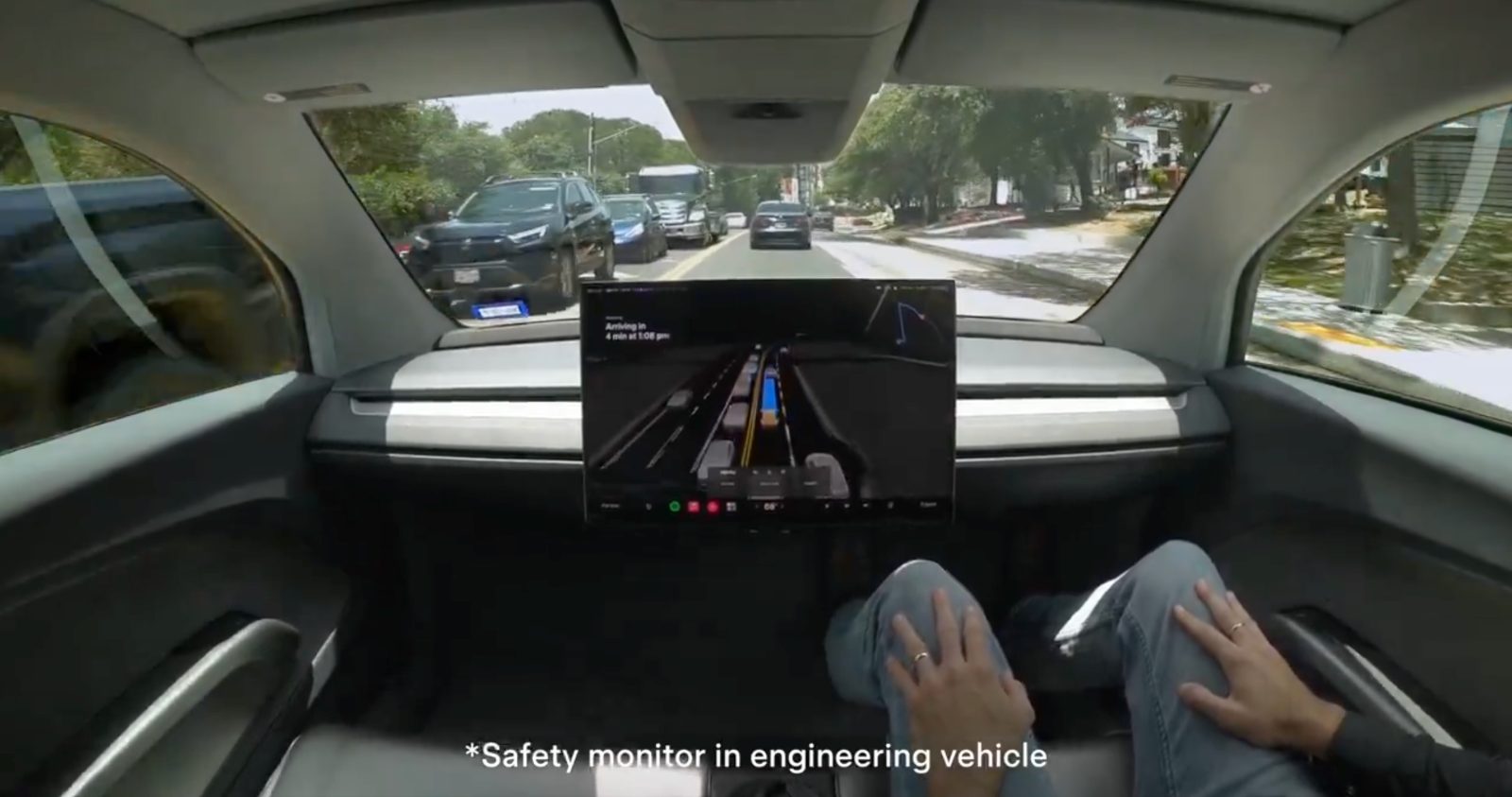
Tesla says it has started engineering tests of its first production Cybercab on public roads in Austin, marking the first time a customer-spec unit of the purpose-built robotaxi has been validated outside the factory.
But a video shared by the company shows the two-seater driving with a supervisor sitting in the front passenger seat — a reminder that the car still isn’t operating on its own in Tesla’s paid service.
What Tesla actually showed
In a post on X early Monday, Tesla announced that “engineering tests of the first production Cybercab have begun in Austin.” The clip shows the vehicle navigating city streets with no one in the driver’s position — which is unavoidable, since the Cybercab is built without a steering wheel or pedals — while a person rides in the passenger seat.
That framing matters. These are “engineering tests,” not driverless customer rides, and a human is still aboard the vehicle during the runs. Tesla describes the person in the front seat as a “safety monitor.”
It’s a meaningful step nonetheless. Tesla rolled its first steering-wheel-less Cybercab off the line at Gigafactory Texas on February 17, then confirmed the start of production during its Q1 earnings call in April. Putting a production-line unit through public-road validation is the next box to check before the car can carry paying passengers.
The robotaxi service still doesn’t run on Cybercabs
Here’s the catch: Tesla’s actual Robotaxi service in Austin has never used the Cybercab. Since launching the public service, Tesla has been running the rides on Model Y SUVs retrofitted with its Full Self-Driving software.
Tesla began the Austin service in June 2025 with an employee in the passenger seat, moved those safety monitors to the driver’s seat in September, and started removing in-car monitors for a portion of rides in January. Even then, reports showed Tesla’s “unsupervised” vehicles being trailed by chase cars with safety monitors inside — the monitor moved to a different vehicle rather than being eliminated.
Today, Tesla only has a handful of vehicles operating without supervisors in Texas.
The Cybercab entering engineering tests is the beginning of a separate, longer process: validating the dedicated hardware platform, not flipping a switch on an existing fleet.
The car itself is no longer a mystery. Tesla’s EPA filing revealed the Cybercab weighs 3,113 lbs with 219 HP and a 48 kWh battery, and at 165 Wh/mi it ranks as the most efficient EV Tesla has ever built. Musk has pitched a sub-$30,000 price, though he has narrowed that to roughly $25,000 on earnings calls.
Waymo is the benchmark
While Tesla tests a production Cybercab with a passenger riding shotgun, Waymo is already operating a fully driverless commercial service at scale.
Waymo is now delivering roughly 500,000 paid driverless rides per week across the US — double its volume from less than a year ago — and is targeting one million weekly rides by the end of 2026. Those vehicles operate with no one in the car at all, backed by remote assistance rather than in-car or trailing human supervisors.
That’s the gap Tesla is trying to close, and the Cybercab is its long-term answer: a vehicle designed from the ground up with no manual controls and a target cost low enough to undercut ride-hailing economics.
Electrek’s Take
Top comment by Ray Finney
Im going to say this because I don't know who is pushing Tesla for this answer. Im hoping that it will get traction if a news org asks. If there are no pedals and steering wheel, what happens when a cybercab can't be driven or operate on its own? Im talking about if a responder needs to get the car off the road? Yes a tow truck will come, but often they turn the steering wheel a certain direction to get it onto a truck. I also see situations where cars just die. I have 2 Teslas so Im aware of how often these situations do or do not happen, but the question needs to be asked. A car that looses power while stopped one can often see bystanders helping owners move cars to the side of the road. That can't be done without pedals and a wheel. I think that in an unexpected immediate power loss or accident roadways will be blocked until tow trucks can clear the cabs in every situation. I say every because I also think the wheels lock and do not roll when there is now power, which is why Tesla's have tow modes. I dont think a rider will have access to that level of the UI. This is also assuming the remote support can't ping the car as well.
This is real progress, and it’s worth saying so plainly: getting a production-intent, controls-free vehicle onto public roads for validation is hard, and Tesla is doing it.
But we should be precise about what this is and isn’t. “Engineering tests” with a human in the passenger seat is not a driverless robotaxi,. The path from “first production unit on public roads” to “fare-collecting driverless Cybercab” runs through a lot of validation miles, regulatory sign-off, and a software stack that still relies on remote and trailing human support today.
The strategic logic is sound — a $25,000–$30,000 vehicle with no steering wheel changes the unit economics of autonomy if Tesla can actually deliver unsupervised driving. The open question is the same one it’s been for two years: not whether Tesla can build the car, but whether the FSD software is ready to run it without a person inside at scale. Considering the Cybercab uses the same system in the Model Ys operating in the Robotaxi network in Texas, there’s nothing particularly exciting about the progress there.
If you’re a Tesla owner or thinking about going electric, powering your EV with home solar is one of the smartest ways to lock in low fuel costs for the long haul. With electricity rates climbing nearly 10% last year, home solar protects you against future rate increases. And with lease and PPA options, you can go solar with zero upfront cost and start saving immediately. If you want to find the best deal, check out EnergySage. It’s a free service with hundreds of pre-vetted installers competing for your business, so you save 20 to 30% compared to going it alone. No sales calls until you pick an installer. Get your free quotes here.


FTC: We use income earning auto affiliate links. More.


Comments