
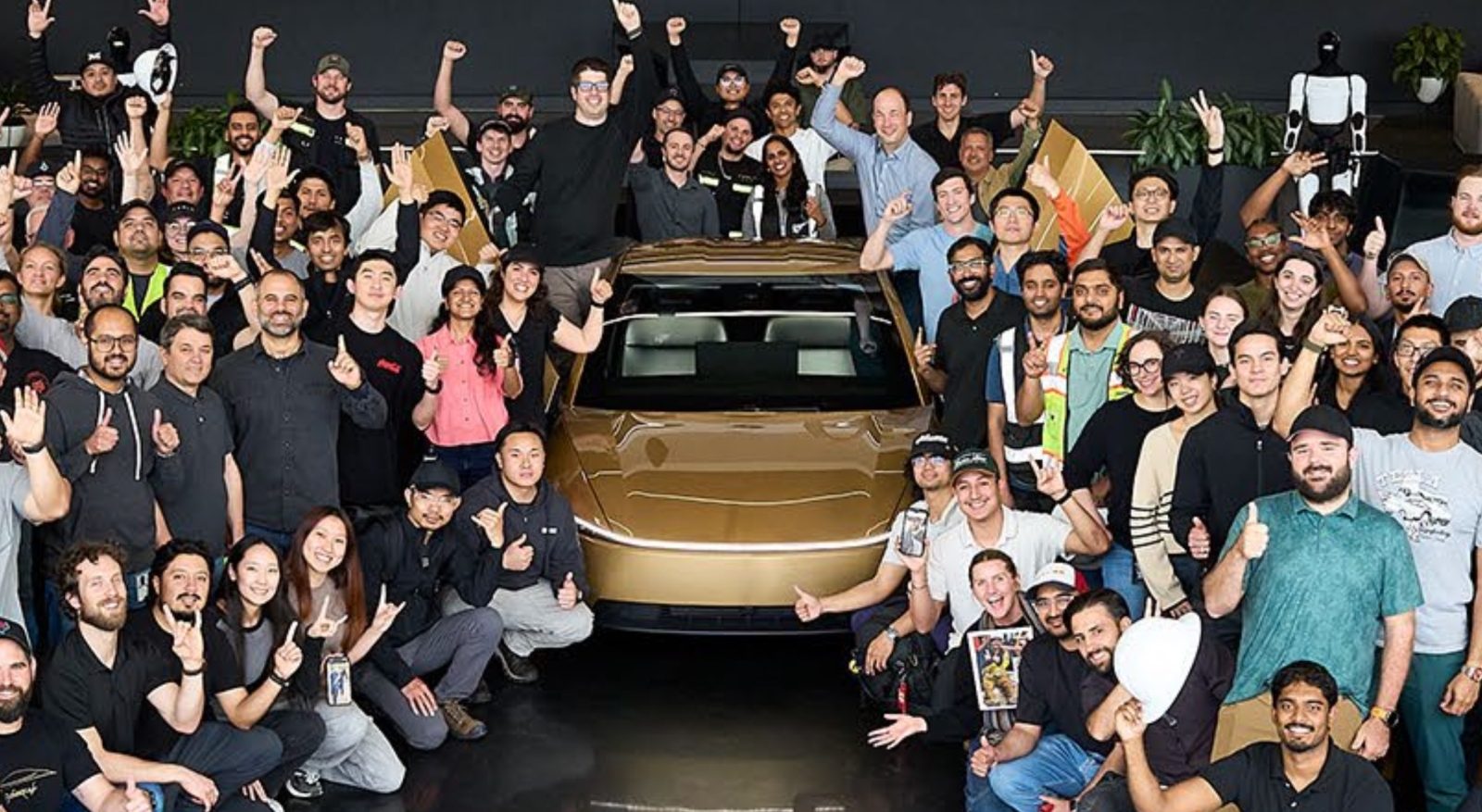
CEO Elon Musk confirmed during Tesla’s Q1 2026 earnings call that Cybercab production has officially begun at Giga Texas.
VP of Vehicle Engineering Lars Moravy confirmed that the Cybercab will not be subject to NHTSA’s 2,500-vehicle annual production cap for autonomous vehicles.
How Tesla bypasses the 2,500-unit cap
The 2,500-vehicle limit comes from NHTSA’s exemption process for vehicles that don’t meet all Federal Motor Vehicle Safety Standards (FMVSS). Companies like Waymo and Cruise have historically needed these exemptions to deploy vehicles with non-standard configurations — and NHTSA caps each exemption at 2,500 units per year.
Tesla took a different route. When asked on X whether the 2,500 cap applies to the Cybercab, Moravy’s answer was a single word: “No.”
The key is that Tesla designed the Cybercab to comply with all existing FMVSS standards on its own — no waiver needed. That’s the same self-certification process used by every Toyota Camry and Ford F-150 sold in the US. Drone footage from Giga Texas has shown Cybercab units already sporting official federal compliance stickers, confirming the vehicle passes safety, bumper, and theft prevention standards without special regulatory treatment.
The practical implication is significant. Congress is currently debating the SELF DRIVE Act, which would raise the autonomous vehicle exemption cap from 2,500 to 90,000 units. But if Tesla’s self-certification holds up, that entire legislative fight is irrelevant to the Cybercab — Tesla can scale production unconstrained by exemption limits.
Production has started, but expect an S-curve
On today’s Q1 2026 earnings call, Musk confirmed that Cybercab production is underway: “We have just started production of Cybercab,” he said, though he immediately tempered expectations.
“Whenever you have a new product with a completely new supply chain, new everything, it’s always a stretched out S-curve,” Musk said. “You should expect that initial production of Cybercab and Semi will be very slow, but then ramping up and going kind of exponential towards the end of the year.”
The first steering-wheel-less Cybercab unit rolled off the line in February, but continuous production only began this month. Tesla has been building both a steering-wheel-less version and a steering-wheel-equipped variant.
Musk framed the Cybercab as Tesla’s long-term volume play, noting that “90% of miles driven are with one or two people” and that “you’d want a vast majority of your production to be Cybercab” over time.
The unsolved problem: autonomous driving
The Cybercab is designed to operate without a driver — but Tesla hasn’t solved unsupervised autonomous driving yet. On the earnings call, Musk said unsupervised Full Self-Driving would reach customer vehicles “probably Q4” of this year, though Tesla’s track record on FSD timelines has been consistently off by years.
Tesla’s current supervised robotaxi fleet crashes at roughly four times the rate of human drivers — one crash per 57,000 miles versus the human benchmark of one crash per 229,000 miles. Musk acknowledged the software still has issues, describing situations where cars get “scared to move” or stuck in infinite loops.
Meanwhile, the Cybercab program has seen a significant leadership exodus. Three senior leaders have departed since February: vehicle program manager Victor Nechita left days after the first unit rolled off the line, OTA and ride-hailing infrastructure director Thomas Dmytryk departed after 11 years, and assembly leader Mark Lupkey followed in March. Tesla now has no original program managers remaining for any of its production vehicles.
Electrek’s Take
Certification and production are not the things I’m particularly worried about when it comes to the Cybercab.
Top comment by Realist
Elon has also amassed so much power and is such a poor leader for a mature organization. He doesn't listen to the intelligent, experienced, proven leaders whom he has hired. They warn him against things like over-boasting about FSD, about the unwise and stubborn overreliance on camera-only driving aids, and the immense multibillion-dollar liabilities he's creating by his ready-fire-aim approach. What a terrible CEO. His management of Tesla is no better than his parenting or his politics or his marriage skills.
Tesla is now mass-producing a vehicle that is designed to have no driver — while still being unable to drive itself safely without one.
We’ve seen this pattern before. Tesla excels at manufacturing — the Giga Texas ramp will almost certainly produce Cybercabs at scale eventually. But every Cybercab that rolls off the line without functional unsupervised autonomy is an expensive paperweight waiting for software that Musk has been promising since 2016. The production milestone matters less than the autonomy milestone, and on that front, Waymo is years ahead.
In the meantime, the vehicle will only be used in Tesla’s small-scale geofenced robotaxi pilot projects.
As an aside, what’s up with the new glossy plastic look of the Cybercab in the first production unit pictured above? It looks horrible compared to the metallic finish of the original concept, which I know was a wrap, but still.


FTC: We use income earning auto affiliate links. More.



Comments