
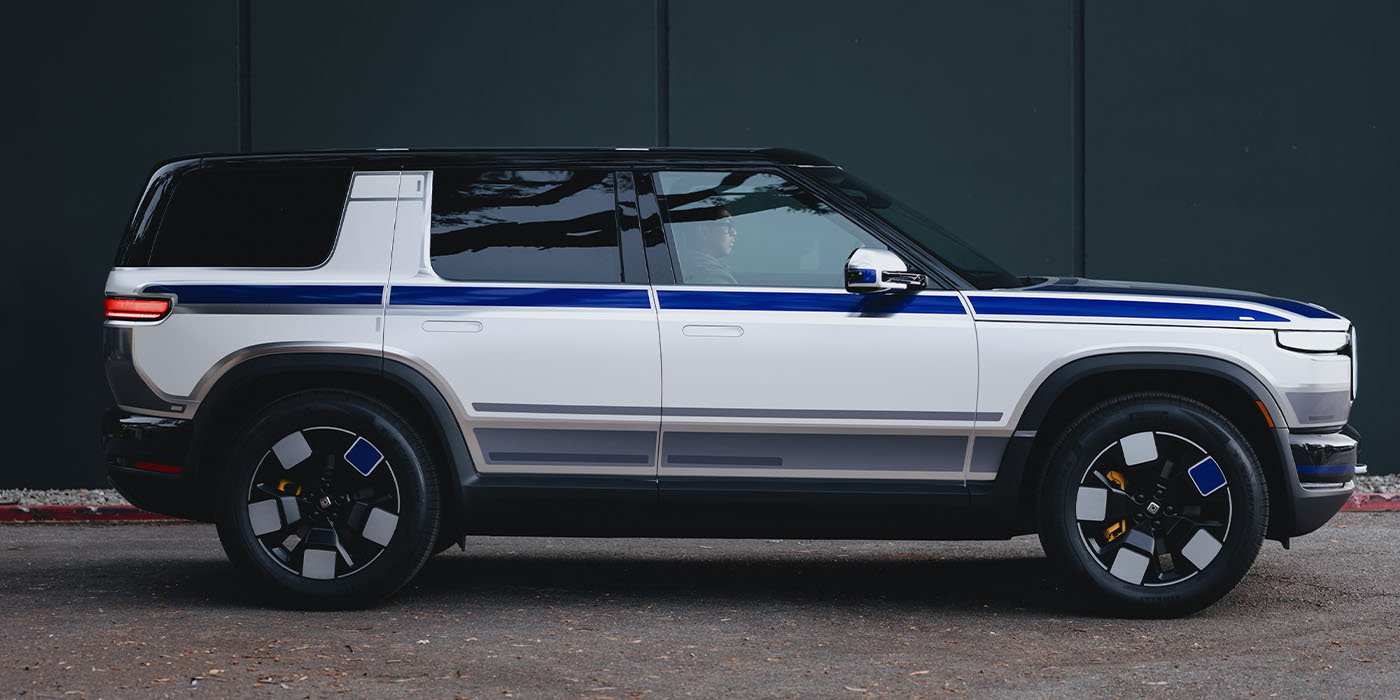
Rivian CEO RJ Scaringe says the money automakers charge for self-driving software won’t last, comparing autonomy to airbags: a paid option today, baked into the price of every car tomorrow.
The comments, made in a new interview with WIRED, amount to a quiet warning shot at Tesla, which just moved its “Full Self-Driving” package to a subscription-only model at $99 per month.
A $2,500 feature that BYD gives away free
Rivian currently sells its Autonomy+ package for a one-time $2,500 or $49.99 per month. Tesla, by comparison, charged $8,000 for FSD before killing the one-time purchase option in February and going subscription-only at $99 per month.
In China, BYD bundles its “God’s Eye” driver-assistance suite into its cars at no extra cost.
WIRED‘s Jeremy White pressed Scaringe on exactly that gap: “How long do you think you’ll be able to charge so much for something others, like BYD, are giving away free?”
Scaringe didn’t dispute the premise. He said the premium exists only while few companies can deliver the capability — and that it erodes from there.
“Once enough companies have developed it, what you can charge will become much lower,” Scaringe said. “But in either scenario it’s very important. Where it becomes free, then it becomes a necessary component to sell vehicles.”
The airbag analogy
Scaringe’s framing is that self-driving follows the same path as safety technology that buyers once paid extra for.
“I think this will become a feature that’s embedded in the purchase price. Do you remember when we used to pay for airbags? There was a time where it was an option. Now it’s just in the car,” he said.
White noted the obvious tension — autonomy stays “massively important,” the only question is whether you can still charge $2,500 for it. Scaringe’s answer was essentially “for now”:
“Well, we can today. Just like you could in 1991 on airbags. If you can, you should — if it supports building your business, building your technology.”
It’s a notably different message from Tesla’s. Tesla has spent years telling customers to buy FSD now because the price would “only go up” as the software improved, and CEO Elon Musk has signaled the $99 subscription will rise as the system moves toward unsupervised driving.
Of course, this turned out to be wrong as Tesla slashed FSD pricing, already proving Scaringe correct:
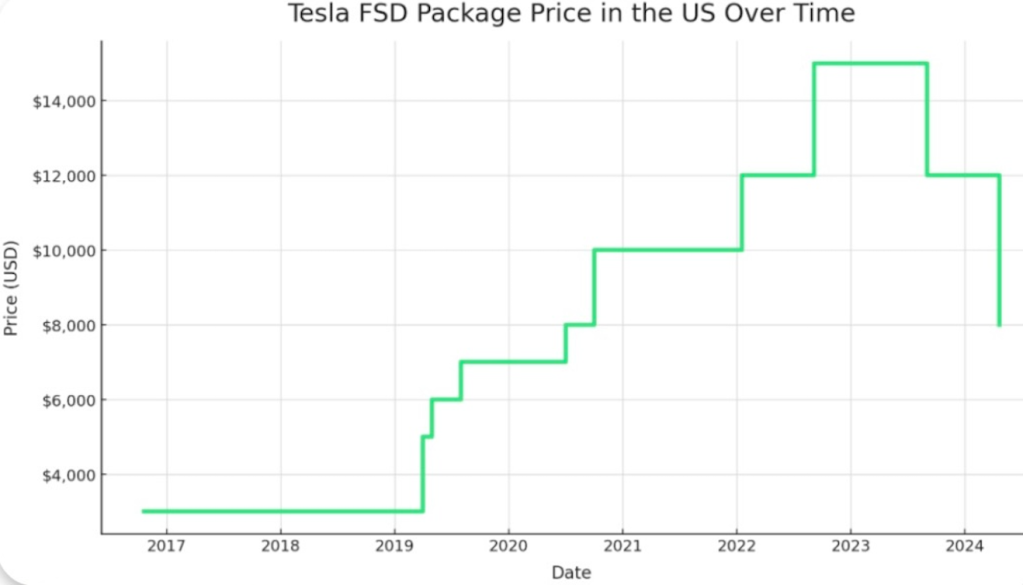
We’ve covered how Tesla’s shift to subscription-only FSD and its decision to paywall basic Autopilot point the opposite direction — toward extracting more recurring revenue, not less.
Where the West can’t compete: cost
Scaringe’s broader point is about cost competition with China, not just feature pricing. He told WIRED that “where the West — North America and Europe — cannot compete today is on cost,” and that Rivian’s tech stack is already being measured against Chinese rivals through its Volkswagen joint venture, which puts Rivian software in the $20,000 VW ID.1.
That context matters for Rivian’s own roadmap. The first R2s will ship with what Scaringe calls a “Gen 2.5” system capable of supervised point-to-point driving but not eyes-off Level 3 or 4 autonomy. The full self-driving hardware — Rivian’s in-house 1,600 TOPS silicon, better cameras, and lidar — arrives in R2 models from late 2026. Rivian is now building that entire autonomy stack in-house, down to potentially making its own lidar, after detailing the platform at its first AI and Autonomy Day in December.
Electrek’s Take
This is one of the more honest things an auto CEO has said about self-driving economics, and it cuts against the entire narrative Tesla has built around FSD.
Top comment by stetrain
Yep. The Tesla hypers' longstanding argument that Tesla can charge whatever they want for FSD once it is actually able to operate unsupervised (someday) falls apart as soon as even a single competitor can offer a similar product at a lower price.
Even if Tesla achieves this at scale before others, I don't see any reasonable possibility that they will hold a monopoly on the technology for any significant span of time.
Tesla’s pitch has always been that autonomy is a uniquely valuable, near-infinite-margin software product — the justification for a big chunk of its valuation. Scaringe is saying the quiet part out loud: the moment everyone can do it, you can’t charge a premium for it, and it collapses into the cost of the car like airbags, ABS, or backup cameras did. BYD giving away “God’s Eye” in China is the preview of where this goes.
He’s not wrong, and notably he’s saying it while Rivian still charges for Autonomy+. His logic — “if you can, you should” charge while the capability is rare — is the same one Tesla uses, but Scaringe is at least clear-eyed that the window closes. Tesla, meanwhile, is sprinting in the other direction: ending one-time purchases, moving everyone to a subscription, and telling customers the price will keep climbing.
The obvious question is what happens to Tesla’s margins-on-software story if the Rivian CEO is right and self-driving becomes table stakes rather than a luxury upsell. If autonomy ends up embedded in the sticker price across the industry, the company with the most riding on FSD as a standalone profit center has the most to lose.
If you’re shopping for an EV with pricey software add-ons, powering it with home solar is one of the smartest ways to lock in low running costs. With electricity rates climbing nearly 10% last year, home solar protects you against future rate increases. And with lease and PPA options, you can go solar with zero upfront cost and start saving immediately. If you want to find the best deal, check out EnergySage. It’s a free service with hundreds of pre-vetted installers competing for your business, so you save 20 to 30% compared to going it alone. No sales calls until you pick an installer. Get your free quotes here.


FTC: We use income earning auto affiliate links. More.


Comments