
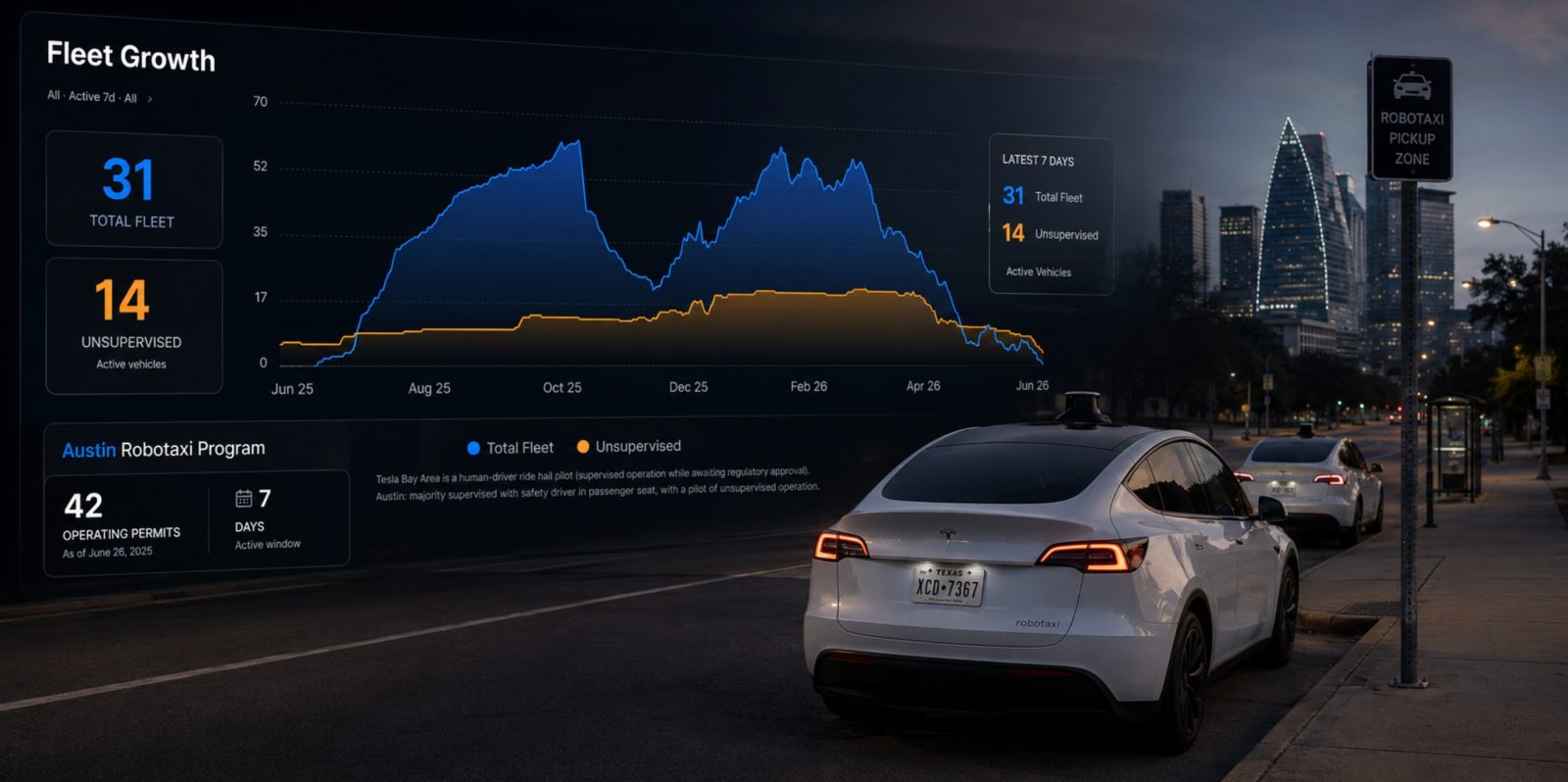
Tesla didn’t report a single at-fault “Robotaxi” crash in the latest NHTSA autonomous-vehicle data — its only fresh incident was a Model Y getting rear-ended while stopped, clearly the other driver’s fault.
That sounds like good news for Tesla’s safety record. But live fleet data points to the real reason the crashes have dried up: Tesla’s robotaxis are barely running, and the active fleet is shrinking a year into the program.
A clean crash report — because there’s almost nothing on the road
Under NHTSA’s Standing General Order, every company operating an automated driving system has to report crashes. Tesla’s total now sits at just 18 ADS incidents since its Austin launch, compared to roughly 697 for Waymo.
Tesla supporters frame that gap as a safety win. It isn’t. It’s an exposure gap. Waymo operates approximately 3,000 robotaxis and completes more than 500,000 paid trips per week. A higher raw crash count is what you get when you actually run a fleet at scale.
And when Tesla finally unredacted its 17 crash narratives last month, the data confirmed what we suspected: most of its crashes weren’t the autonomous system’s fault. A large share were rear-endings and sideswipes from inattentive human drivers — the exact pattern Waymo reports across the majority of its incidents. The latest report continues that trend with another stopped-and-rear-ended event.
So the headline result, Tesla “avoids” at-fault crashes, isn’t a measure of how good the system is. It’s a measure of how little it’s being used.
42 permits in Texas, but Tesla runs fewer than half
The clearest evidence is now a matter of public record. When a new Texas law took effect on May 28, the state’s Department of Motor Vehicles published a database of every company authorized for driverless operation. Tesla self-certified its Model Y robotaxis as SAE Level 4 and obtained authorization for exactly 42 vehicles.
For context, Waymo holds 577 authorizations in Texas, and Avride has 317. Tesla’s permitted fleet is less than one-tenth the size of Waymo’s in the same state.
But the permit count is the ceiling, not the reality. According to the latest Robotaxi Tracker data, Tesla’s total active fleet across all markets is just 31 vehicles seen on the road in the past seven days — and only 14 of those are operating unsupervised. The rest still run with a human safety monitor on board.
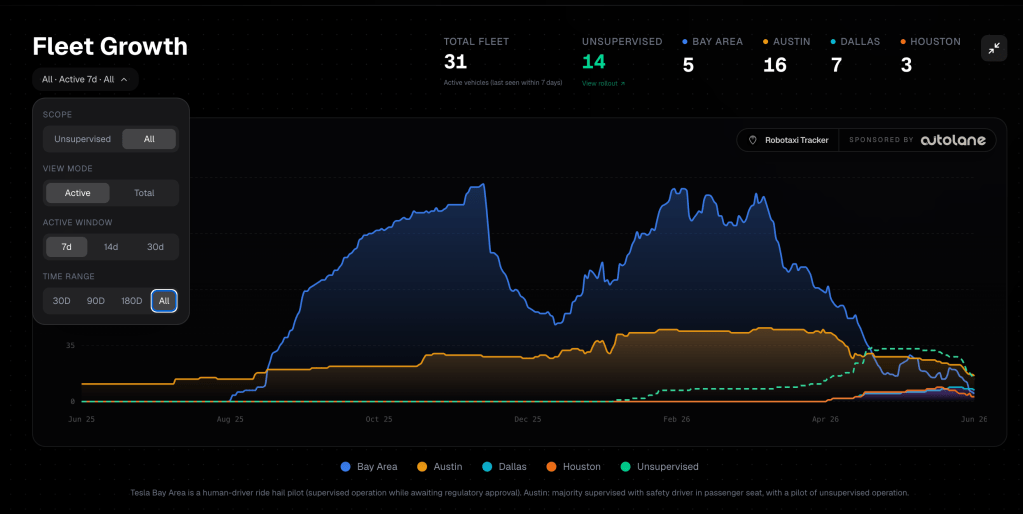
Break it down by city and the picture gets worse: 16 active in Austin, 7 in Dallas, 3 in Houston, and 5 supervised human-driver vehicles in the Bay Area. That’s roughly 26 active vehicles in Texas against 42 permits — and just 14 of them are the genuinely driverless robotaxis the entire program is supposed to be about.
In other words, Tesla isn’t even using a third of its Texas permits for unsupervised operation at any given time. The permits exist. The robotaxis to fill them don’t.
A year in, the fleet is shrinking — not scaling
Tesla launched its “Robotaxi” service in Austin in June 2025. We’re now a full year in, and the trend line is pointing the wrong way.
The unsupervised fleet peaked at 25 cumulative vehicles in late April, then began declining rather than growing. Dallas and Houston, which launched in April with tiny geofences, have barely moved since. Meanwhile, Tesla keeps expanding the one metric that costs nothing — the geofence — recently drawing the service area around the entire Austin metro while the cars to serve it dwindle.
This is a long way from what CEO Elon Musk promised. He projected 500 robotaxis in Austin and over 1,000 in the Bay Area by the end of 2025. He later quietly slashed the Austin goal from 500 to roughly 60. The actual number of unsupervised vehicles on the road today is 14.
Musk now says Tesla is waiting on its FSD v15 software rewrite before scaling aggressively — pushing any real ramp to late 2026 or 2027. He has attached self-driving growth to upcoming software updates before, and they came and went.
While Tesla’s fleet contracts, Waymo just raised $16 billion to fund expansion to London and Tokyo and continues adding US cities, having grown its coverage to over 1,400 square miles across 11 markets — backed by thousands of vehicles that actually exist.
Electrek’s Take
We’ve been tracking this program closely since launch, and the safety framing cuts both ways. Yes, the latest NHTSA report is good news in the narrow sense — Tesla’s system isn’t causing serious at-fault crashes, and the rear-endings it keeps absorbing are genuinely not its fault. We’ve always said that it was most likely the case, and it was strange for Tesla to redact the context in the NHTSA reports.
Top comment by PurpleTurtle
Even though rear-ending collisions are pretty much by definition the fault of the driver behind the vehicle being hit, there are a lot of behaviors that can make getting hit more likely. I wonder how many of those behaviors robotaxis engage in.
But you can’t separate the crash record from the deployment record. A program with 14 unsupervised vehicles is going to have very few crashes by definition. That’s not a vindication of the technology; it’s the statistical consequence of barely operating. The real test only comes when Tesla puts hundreds or thousands of driverless cars on the road and the crash count is measured against actual rides delivered — the way it is for Waymo.
The Texas permit data made the gap impossible to spin. Tesla self-certified Level 4, got 42 permits, and is running fewer than half of them unsupervised a full year after launch. The geofence keeps growing because drawing a bigger box on a map is free. The fleet keeps shrinking because building, deploying, and trusting driverless cars is hard.
Until the active fleet starts climbing instead of falling, every “clean” crash report should be read as exactly what it is: a sign of how little is happening, not how well it’s going. The question now is whether FSD v15 finally changes that — or becomes the next milestone that quietly slips.
If you’re a Tesla owner, powering your EV with home solar is one of the smartest ways to lock in low fuel costs. With electricity rates climbing nearly 10% last year, home solar protects you against future rate increases. And with lease and PPA options, you can go solar with zero upfront cost and start saving immediately. If you want to find the best deal, check out EnergySage. It’s a free service with hundreds of pre-vetted installers competing for your business, so you save 20 to 30% compared to going it alone. No sales calls until you pick an installer. Get your free quotes here.


FTC: We use income earning auto affiliate links. More.


Comments