
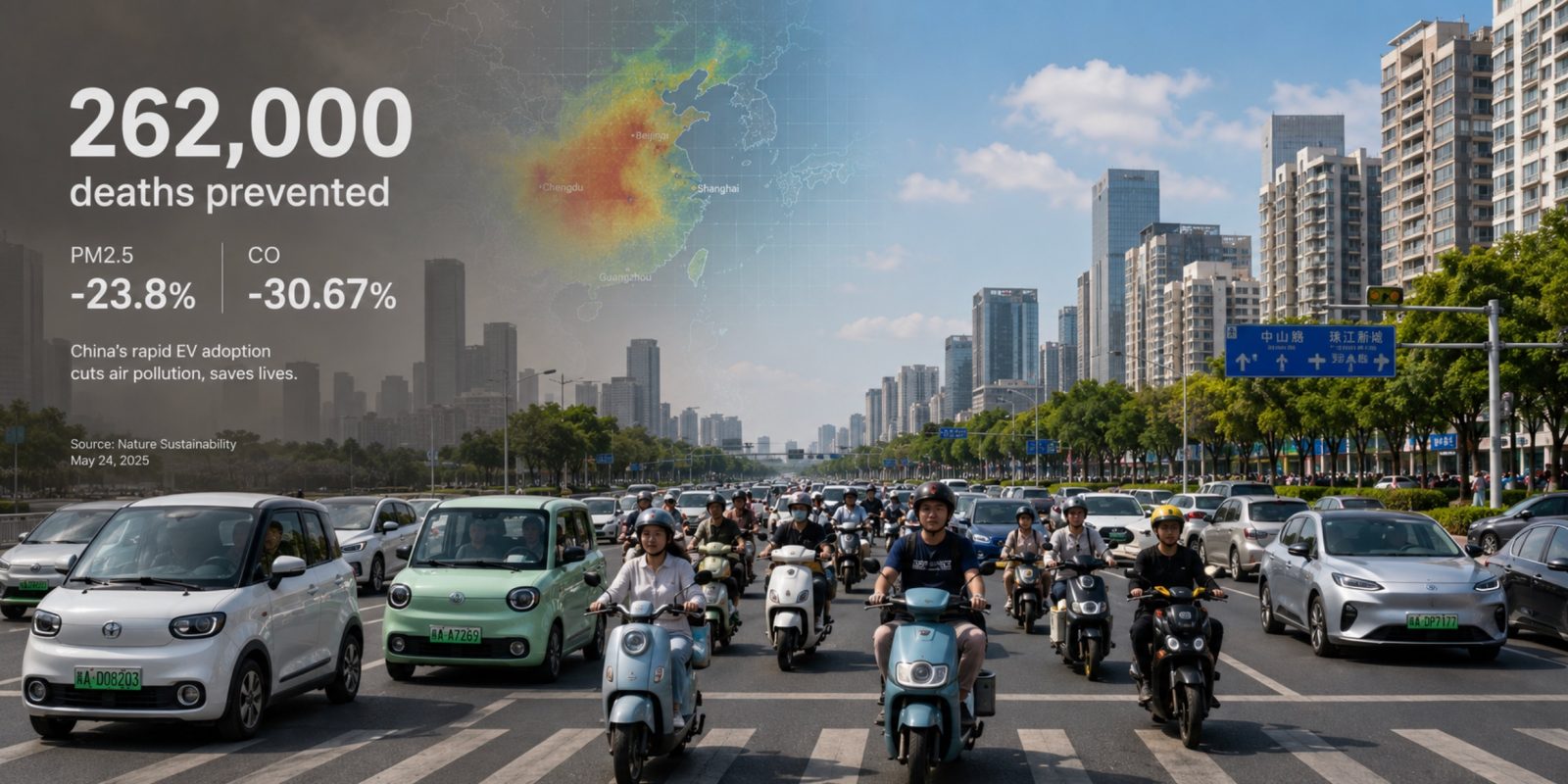
China’s rapid switch to electric and other new energy vehicles cut urban air pollution enough to prevent an estimated 262,000 premature deaths, according to a new peer-reviewed study published in Nature Health.
It’s some of the strongest real-world evidence yet that electrifying transportation delivers measurable public-health benefits, not just lower tailpipe emissions on paper.
What the study found
The study, published May 13 in Nature Health, used high-resolution satellite air-quality data and machine learning to measure pollution across 150 Chinese cities. The researchers compared actual pollution levels to a counterfactual scenario in which every vehicle on the road still ran on an internal combustion engine.
By 2023, the spread of new energy vehicles (NEVs) — a category that includes battery-electric, plug-in hybrid, and hydrogen vehicles — was linked to a 23.80% reduction in fine particulate matter (PM2.5), a drop of 8.97 micrograms per cubic meter. Carbon monoxide fell even further, down 30.67%.
The researchers estimate those air-quality improvements prevented roughly 262,000 non-accidental deaths, along with about 75,000 all-cause deaths.
The numbers matter because outdoor air pollution causes more than 4 million premature deaths worldwide each year, and roughly a quarter of those occur in China. Long-term exposure to PM2.5 and other pollutants is tied to stroke, heart disease, lung cancer, and respiratory illness.
Not all pollutants dropped equally
The study is notable for being honest about where electrification did not move the needle much.
While PM2.5 and carbon monoxide fell sharply, nitrogen dioxide dropped by only 1.81 micrograms per cubic meter, and reductions in coarser particulate matter were also low. The authors point to a clear culprit: heavy-duty diesel trucks, which remain largely un-electrified and are a major source of NO2 and coarse particles.
The benefits were also unevenly distributed. They were concentrated in China’s wealthier, more economically developed cities, where NEV adoption has been fastest. Less-developed regions saw smaller gains.
The researchers’ conclusion is pointed: to extend the health benefits, China needs to accelerate the electrification of heavy-duty diesel vehicles and push NEV deployment into lower-income regions.
The backdrop: a market that has already flipped
The findings land against a backdrop of staggering EV adoption in China. As we reported last year, electric vehicles crossed the tipping point in the world’s largest auto market, surging past 50% of new car sales.
That shift has continued. We recently covered how gas car sales in China dropped 37% as the internal combustion engine goes into structural decline there. China’s government is estimated to have invested hundreds of billions of dollars over two decades in subsidies and incentives to get to this point.
This isn’t the first time researchers have flagged the health upside. Back in 2019, we covered modeling work suggesting EVs could benefit health more than climate in China. The difference now is that this study measures what actually happened, using satellite observations rather than projections.
The US is seeing it too
The effect isn’t unique to China. A separate study published in January 2026 in The Lancet Planetary Health, led by a University of Southern California team, found that California’s adoption of zero-emission vehicles is measurably improving air quality.
Analyzing daily nitrogen dioxide levels at 1,700 residential locations between 2019 and 2023, the researchers found that for every 200 additional zero-emission vehicles registered in a given area, NO2 concentrations fell by about 1.1%.
Electrek’s Take
I’ve traveled to China three times over the past year to see the rise of its EV industry up close, and it’s even more impressive in person. At Electrek, we spend a lot of time on the scale, variety, and technology behind China’s EV sector — but the sheer speed of adoption deserves just as much attention. In a few short years, the country went from buying a handful of EVs to electric and plug-in models making up more than half of all new cars sold.
You feel it in the big cities. EVs are everywhere, and the effect is most striking for scooter riders, who are overwhelmingly electric too — they’re no longer stuck breathing exhaust behind a line of gas vehicles in traffic. They get fresh air, or at least fresher air. It’s beautiful to watch the EV revolution translate so directly into better human lives. Saving 200,000 people a year would have sounded like a miracle not long ago. Now it’s a repeatable result of smart policy and better electric powertrains.
This is the kind of data that’s easy to overlook in the day-to-day churn of sales figures and price wars, but it’s arguably the most important argument for electrification.
Top comment by Craig Merrow
Very impressive results! They still have a ways to go, but they are making great strides in reducing air pollution and creating a healthier environment. Wish we were doing the same here in the US.
The climate case for EVs is well established, even if the timeline is long and diffuse. The air-quality case is immediate and local — 262,000 prevented deaths is not a 2050 projection, it’s something that already happened, measured by satellite. That’s a powerful answer to the perennial “but where does the electricity come from” objection. Even on China’s coal-heavy grid, the net effect on urban air was a sharp reduction in the pollutants that actually kill people.
What we appreciate about this study is that it doesn’t oversell. The researchers are upfront that NO2 and coarse particles barely budged, and they correctly identify heavy-duty diesel trucks as the remaining problem. That’s the next frontier, and it’s one China is already attacking — electric and hybrid semi truck sales topped 231,000 units there in 2025.
The uncomfortable question for the rest of the world: China is now banking measurable, life-saving health benefits from a transition that the US is actively trying to slow down. Who ends up breathing cleaner air, and who doesn’t, is increasingly a policy choice.
With EV adoption cutting pollution and fuel costs, locking in low home energy costs with solar makes more sense than ever. With electricity rates climbing nearly 10% last year, home solar protects you against future rate increases. And with lease and PPA options, you can go solar with zero upfront cost and start saving immediately. If you want to find the best deal, check out EnergySage. It’s a free service with hundreds of pre-vetted installers competing for your business, so you save 20 to 30% compared to going it alone. No sales calls until you pick an installer. Get your free quotes here.


FTC: We use income earning auto affiliate links. More.



Comments