
For the last few weeks, we’ve been running a sidebar survey about what Electrek readers think it would take to convince the most EV-resistant fleet operators to realize that electric vehicles are ready for work TODAY. After receiving 1,700 responses, here’s what you told us.
In case you missed the survey, the question read, “ACT Expo just wrapped up for 2026, and while battery-electric commercial vehicles are clearly gaining traction, there are still plenty of people spreading that ‘messy middle’ garbage … what do you think it’ll take for the holdouts to realize EVs are ready for real work — today?”
Before we get too far into the results, however, it should be noted that industry-leading fleet experts like GEOTAB and Transport Canada have shown that the majority of commercial vehicles on the road today could be fully electrified tomorrow without hardly missing a beat – and, in the case of semi trucks, save fleets up to $160,000 per truck.
This survey isn’t about whether EVs work. They do, and that fact isn’t up for debate. What we’re interested in is here, then, what readers think it will take for the remaining holdouts to accept what operators are already seeing firsthand in the field.
By the numbers
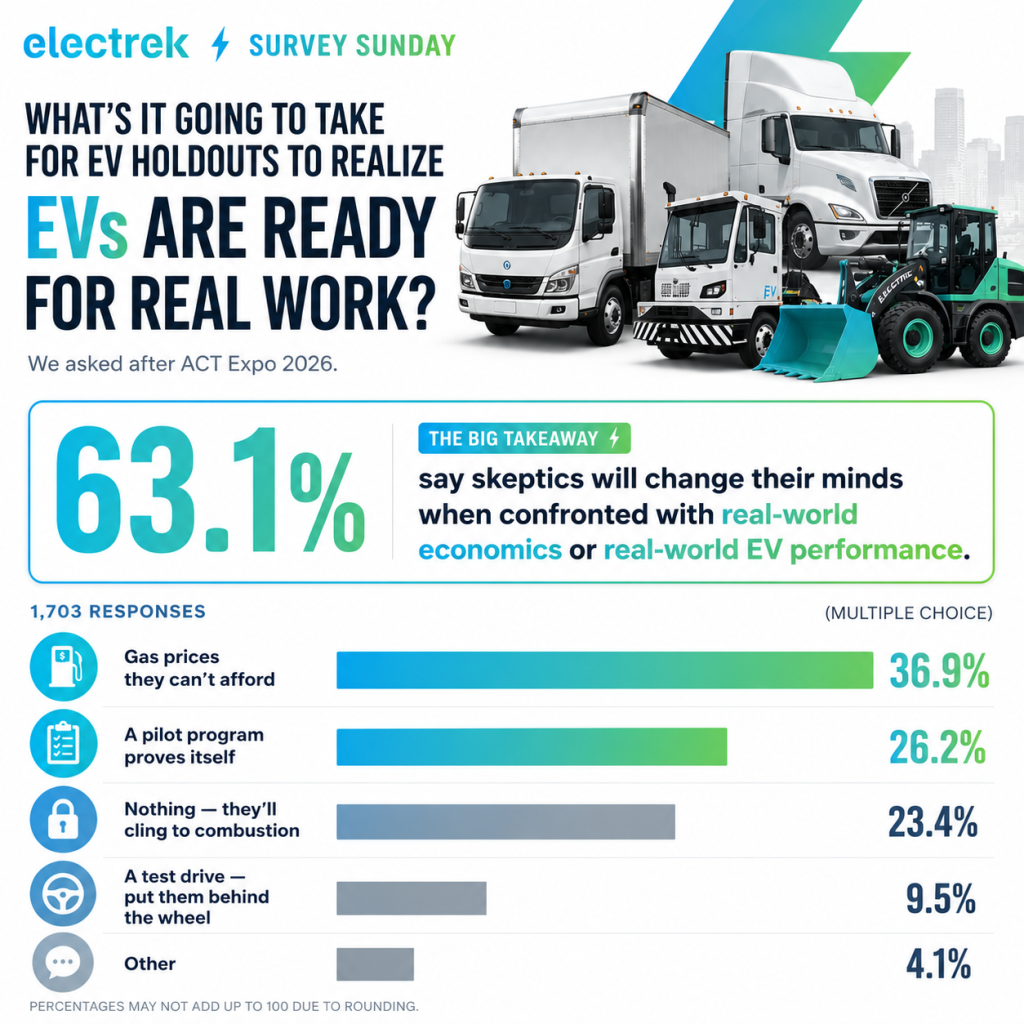
The good news is that the vast majority of Electrek readers seem to be holding on to some hope that commercial fleet buyers will get “plugged in” to reality somewhat sooner than later, with over 70% of you responding that either higher fuel costs, a convincing pilot program, or even just some seat time will be enough to convert the non-believers.
Even so, I thought the most interesting take. came from a commenter who seemed to be one of the “Other” responders.
“There was an old saying: nobody ever gets fired for buying IBM.” wrote Nx. “That’s the idea that if you stick with what everybody else has always done, your job running a data center was safe. Widespread fleet dominance won’t happen until fleet managers feel that their safest choice is to do what everybody else is doing, and [until that becomes] buy electric, or at least (EREV).”
That’s a different argument than the ones I’ve heard at events like ACT Expo or the local, IACT version I was a speaker at last month. Those conversations focus on things like TCO, charging infrastructure, and other “tangible” things.
Nx’s comment rings true, because it’s irrational, totally emotional, and because the last words any fleet buyer wants to hear are, “Why’d you buy that thing?”
If it makes cents, it makes sense

Nx’s point about the industry’s unspoken peer pressure, intangible as it is, is 100% right – and that’s something that needs to be overcome in very different ways when we’re talking about a single vehicle pilot one day and a sweeping, 600-unit order that fundamentally transforms the way you think about your fleet the next.
Still other commenters took on the same “peer pressure” argument as Nx, but turned it around like the double-edged sward that it is.
When a business sees their competitor using it for a competitive advantage they then will adopt it.
There were lots of other great comments, mostly about the politics involved or the different financing considerations of businesses compared to private individuals that highlight the higher cap costs traditionally associated with electric and electrified fleet assets – but those barriers are coming down, and as more fleets begin to understand how they can structure equipment leases to convert those numbers from CapEx to OpEx, I think that’ll start to change, too.
Top comment by PurpleBug
When we went from LPs to CDs, it happened slowly, then all at once. When Apple got rid of the floppy drive, others followed slowly, then all at once. When we went from CDs to streaming, it happened slowly, then all at once. The switch to EVs will be no different, both for individual buyers and for businesses.
Or, maybe it won’t! Time will tell – and I hope you head down to the comments to tell us what you think of this weeks’ survey results in the comments.
Original content from Electrek.

If you’re considering going solar, it’s always a good idea to get quotes from a few installers. To make sure you find a trusted, reliable solar installer near you that offers competitive pricing, check out EnergySage, a free service that makes it easy for you to go solar. It has hundreds of pre-vetted solar installers competing for your business, ensuring you get high-quality solutions and save 20-30% compared to going it alone. Plus, it’s free to use, and you won’t get sales calls until you select an installer and share your phone number with them.
Your personalized solar quotes are easy to compare online and you’ll get access to unbiased Energy Advisors to help you every step of the way. Get started here.


FTC: We use income earning auto affiliate links. More.




Comments