
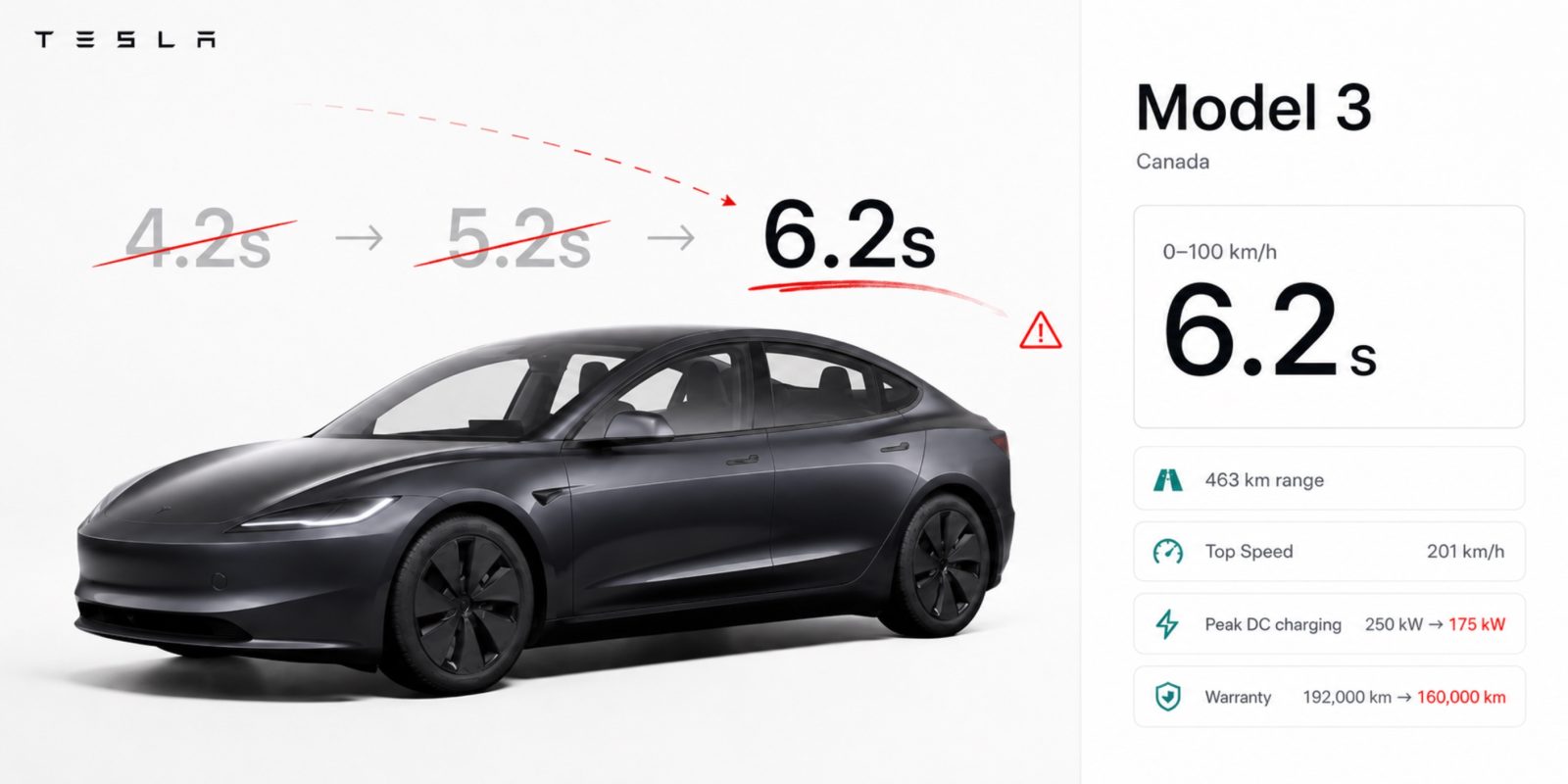
Tesla has changed the 0-100 km/h acceleration spec on its new $39,490 CAD Model 3 Premium RWD in Canada for a second in less than three weeks. The car now lists a 6.2-second sprint — two full seconds slower than the 4.2 seconds Tesla advertised at launch on May 1.
The repeated spec changes on the Shanghai-built sedan — from 4.2s to 5.2s and now 6.2s — are raising legitimate consumer concerns.
A timeline of shrinking specs
When Tesla launched the new Model 3 Premium RWD in Canada at the beginning of May, the configurator listed impressive specs: 463 km of range, a 0-100 km/h time of 4.2 seconds, and 250 kW peak DC charging. The $39,490 CAD price — roughly $29,000 USD — was a record low for the Model 3 in Canada, made possible by sourcing from Giga Shanghai under the new 6.1% tariff deal with China.
Within 48 hours, Tesla quietly revised the acceleration to 5.2 seconds, calling the original 4.2-second figure a “website error.” The charging speed was also cut from 250 kW to 175 kW, and the battery warranty was reduced from 192,000 km to 160,000 km. Tesla told customers who inquired that the previous specs had been posted in error.
Now, roughly two weeks later, the configurator shows 6.2 seconds — another full second slower. That’s a cumulative two-second degradation from the number Tesla used to sell the car at launch.
Here’s the full timeline:
| Date | 0-100 km/h | Charging | Warranty |
|---|---|---|---|
| May 1 (launch) | 4.2 sec | 250 kW | 192,000 km |
| ~May 3 | 5.2 sec | 175 kW | 160,000 km |
| ~May 19 | 6.2 sec | 175 kW | 160,000 km |
Why the car is slower than originally listed
The 6.2-second time aligns with what Tesla lists for the Model 3 Standard RWD in Europe and other markets that receive the same Shanghai-built, LFP-equipped variant. So this is likely the real number — which means the original 4.2 seconds was never accurate in the first place.
The Canadian Model 3 Premium RWD uses a different rear drive unit than the one in the previous Fremont-built Model 3 that was sold in Canada. The car uses Tesla’s 3D7 motor, rated at 194 kW peak power and 340 Nm of torque. The previous unit — the 3D6 — was rated at 220 kW and 440 Nm. That’s a reduction of 26 kW (roughly 35 horsepower) and 100 Nm of torque.
Combined with the Lithium Iron Phosphate (LFP) battery chemistry, which delivers lower peak discharge rates than NMC cells, the result is a significantly slower car off the line. The LFP pack is cheaper and more durable, which is why the Model 3 can hit that $39,490 price point, but performance is the tradeoff.
Electrek’s Take
This is a bit embarrassing for Tesla. There’s no way around it.
We gave Tesla the benefit of the doubt when the acceleration was corrected from 4.2 to 5.2 seconds — typos happen, and the switch from Fremont to Shanghai production could have caused a configuration mix-up. But changing the spec again to 6.2 seconds makes the “website error” explanation increasingly hard to accept.
Top comment by diglossia
"If the first one was a typo, then why didn’t you correct it to the right power?"
It's a deliberate manipulation. The initial wave of media coverage cited the lower figure. The vast majority of people saw that number and will never notice that it changed.
If the first one was a typo, then why didn’t you correct it to the right power?
The 6.2-second time matches European specs for the same LFP-equipped variant, so this is clearly the real number. The question is why Tesla’s Canadian configurator launched with a number that was off by two full seconds.
At $39,490 CAD, this is still the cheapest Model 3 ever sold in Canada, and 6.2 seconds is perfectly adequate for a commuter sedan. But Tesla needs to get its act together on spec accuracy — especially when it’s entering a market where BYD is about to open 20 dealerships with vehicles that are not only correctly spec’d from day one, but also often out spec’d Tesla.
If you’re considering a Tesla Model 3 or any EV, home solar is one of the smartest ways to cut your charging costs for good. With electricity rates climbing nearly 10% last year, home solar protects you against future rate increases. And with lease and PPA options, you can go solar with zero upfront cost and start saving immediately. If you want to find the best deal, check out EnergySage. It’s a free service with hundreds of pre-vetted installers competing for your business, so you save 20 to 30% compared to going it alone. No sales calls until you pick an installer. Get your free quotes here.


FTC: We use income earning auto affiliate links. More.





Comments