
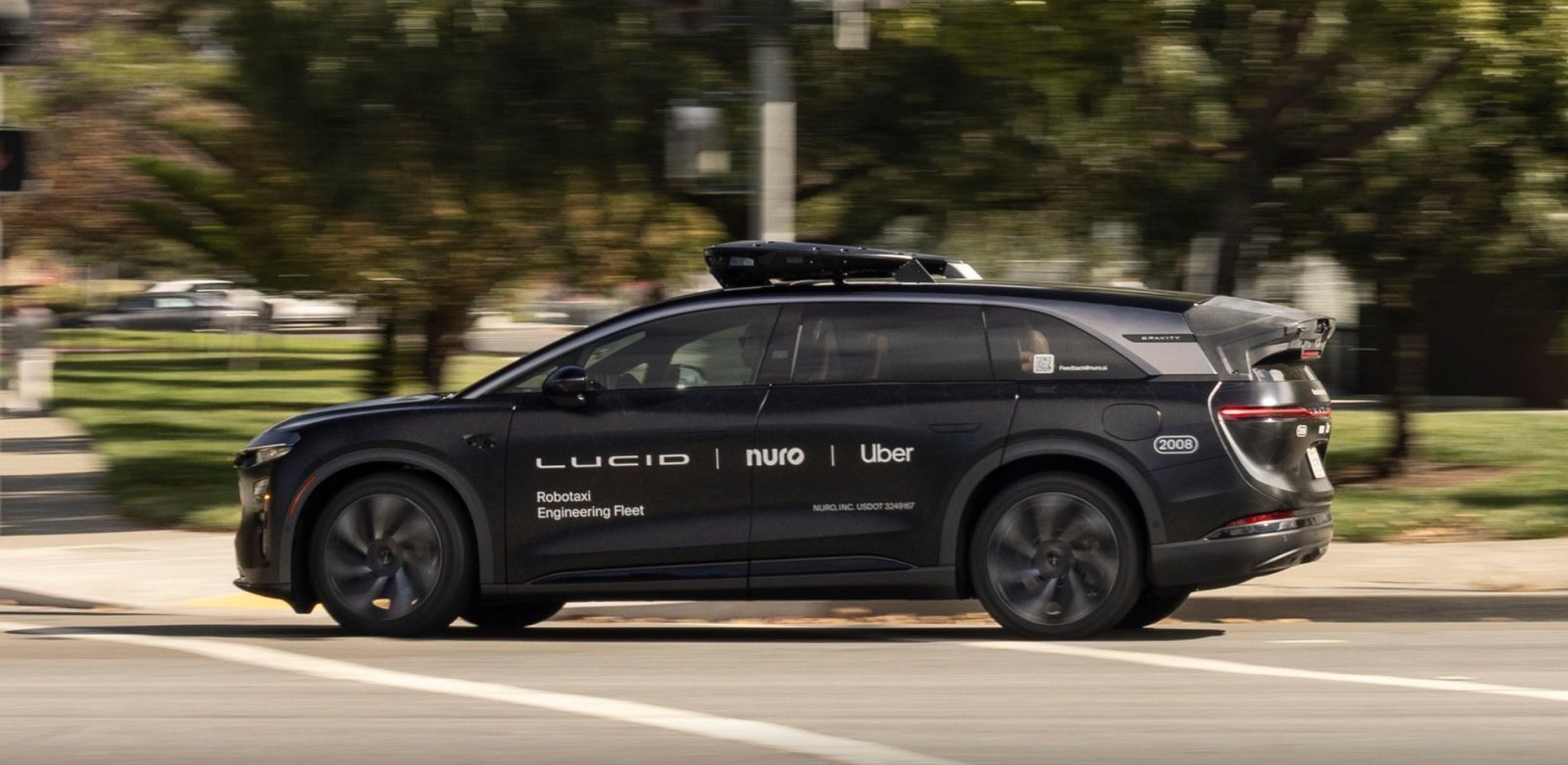
Nuro has received a permit from the California Department of Motor Vehicles (DMV) to test its Lucid Gravity SUVs without a human safety driver on public roads — a critical milestone before the company can launch Uber’s planned robotaxi service later this year.
The updated permit covers testing in Santa Clara and San Mateo counties at speeds up to 45 mph, day or night, clearing the way for fully driverless testing of the vehicles that Uber plans to deploy in a fleet of at least 35,000 robotaxis.
From safety drivers to fully driverless
The permit marks a significant upgrade from Nuro’s current testing operations. Since April, Uber employees have been able to request Lucid Gravity robotaxi rides through the Uber app in the Bay Area, but those rides have all operated with safety drivers behind the wheel.
Now, Nuro can begin removing the safety driver entirely — at least in testing. The Lucid Gravity vehicles are equipped with high-resolution cameras, solid-state lidar, and radar sensors, all running on Nuro’s autonomous driving stack built on NVIDIA’s Drive AGX Thor computing platform.
Nuro spokesperson David Salguero said the company expects to begin driverless testing later this year but did not provide a specific timeline.
A $500 million bet on Uber robotaxis
The driverless testing permit is one piece of a much larger robotaxi play. When Lucid, Nuro, and Uber unveiled their production-intent robotaxi at CES in January, the deal called for 20,000 vehicles. That commitment has since ballooned.
In April, Uber expanded its investment in Lucid to $500 million and now owns 11.5% of the EV maker. The fleet commitment jumped 75% — from 20,000 to at least 35,000 Lucid Gravity robotaxis. Lucid has delivered 75 engineering vehicles to Nuro and Uber so far, with testing and mileage accumulation ongoing in several US cities.
The first Uber-native robotaxis are expected to be available for rides exclusively via the Uber app in the San Francisco Bay Area in late 2026.
Regulatory hurdles remain
The DMV driverless testing permit is necessary but far from sufficient. Before Uber can actually offer paid driverless rides to the public, Nuro still needs two additional approvals: a deployment permit from the California DMV and a driverless ride-hailing permit from the California Public Utilities Commission (CPUC). Neither has been filed yet.
That puts the Nuro-Uber-Lucid partnership in a fundamentally different position than Waymo, which has held all necessary permits and has been offering paid, fully driverless rides in San Francisco for years. Waymo now completes roughly 500,000 paid trips per week across its operating cities and has over 3,000 robotaxis on the road.
Amazon-owned Zoox is also planning to launch a paid robotaxi service in San Francisco in the second half of 2026, adding another competitor to an increasingly crowded market.
Meanwhile, Tesla still does not have permission to test autonomous vehicles in California without a safety driver and has only secured an Arizona permit for paid rides with a human operator present.
Electrek’s Take
The driverless testing permit is a meaningful step, but we need to be clear-eyed about where Nuro actually stands in the robotaxi race. Getting permission to test without a safety driver and actually launching a commercial service are very different things. Waymo spent years in the testing phase before it could offer paid rides, and it had the backing of Alphabet’s deep pockets throughout.
What makes the Nuro-Uber-Lucid partnership interesting is the sheer scale of the commitment. With $500 million invested and 35,000 vehicles on order, Uber is making by far its biggest bet on autonomous driving yet. That dwarfs the typical pilot-program approach most companies have taken. But scale commitments on paper don’t mean much until the technology actually works without a safety driver in real-world conditions — and Nuro hasn’t demonstrated that publicly yet.
Nonetheless, it is fascinating to see this somewhat nascent Uber-Lucid-Nuro partnership already leapfrogging Tesla to some degree on autonomous vehicle testing in California.


FTC: We use income earning auto affiliate links. More.



Comments