
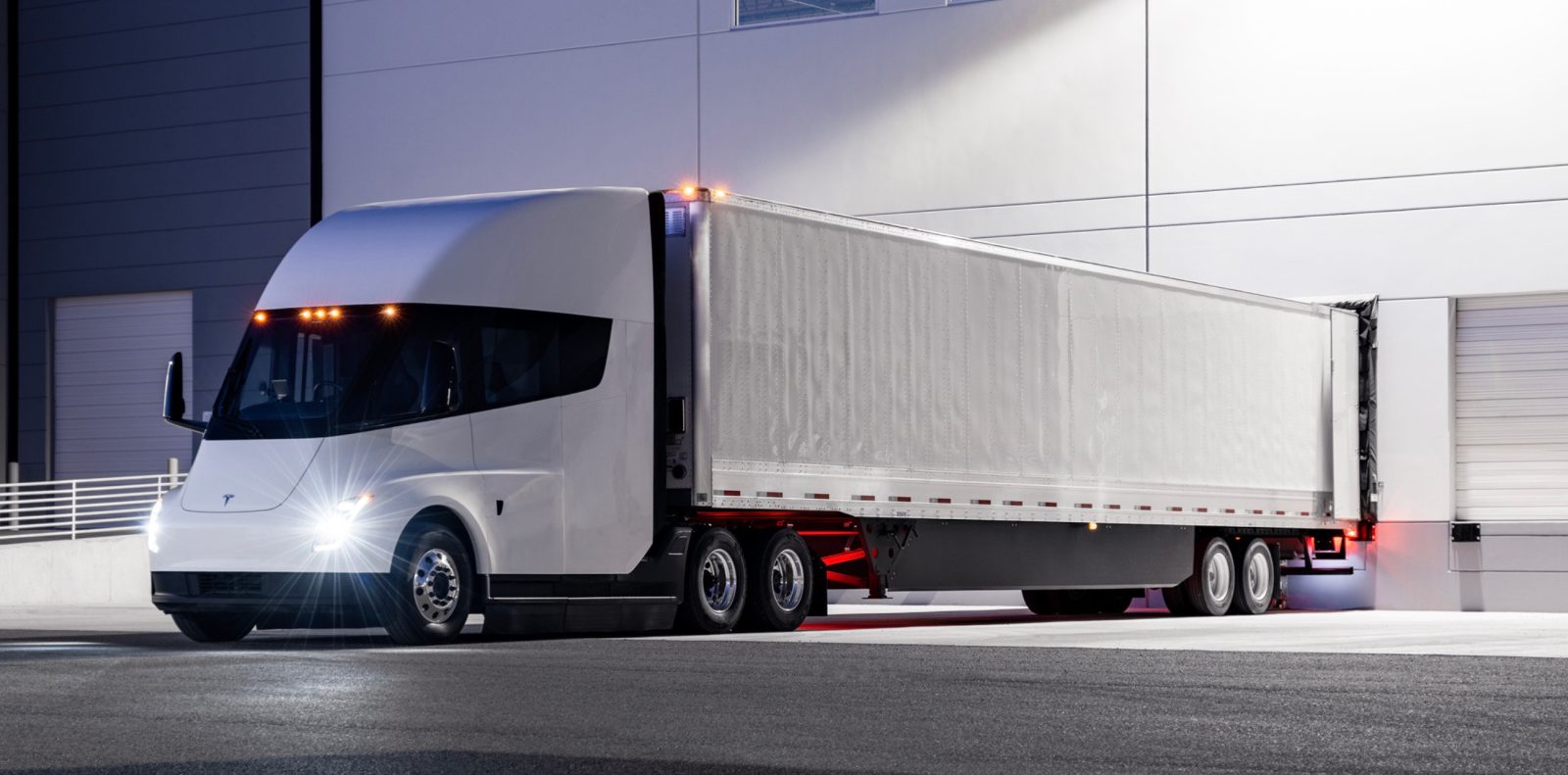
Two California port trucking operators have ordered a combined 60 Tesla Semi trucks through Forum Mobility, the charging infrastructure provider backed by Amazon and CBRE. It marks one of the largest Tesla Semi fleet commitments to date from the drayage sector.
The orders come from Big F Transport, which committed to 40 units, and NICA Container Freight Line, which ordered 20. Both fleets will operate out of Forum Mobility’s new charging depot under development in Rancho Dominguez, California.
Growing demand from port operators
Forum Mobility announced NICA Container as its latest Tesla Semi customer, following a separate 40-truck commitment from Big F Transport. Together, the 60-truck order represents a significant vote of confidence in the Tesla Semi for short-haul port drayage — the repetitive container hauling routes between ports and inland warehouses where electric trucks are most competitive on total cost of ownership.
NICA Container Freight Line is a family-owned company founded in 2014 that operates out of the Port of Long Beach, Port of Los Angeles, and Port Houston. Jakeline (Jacky) Lopez, CEO of NICA Container, framed the investment as a commitment to next-generation technology for the company’s customers and drivers.
Big F Transport, meanwhile, already operates nine Daimler eCascadia electric trucks out of a facility at the Port of Long Beach. The company tested the Tesla Semi in real-world operations before committing to 40 units — a notable switch given its existing relationship with Daimler Truck North America.
Both fleets are expected to begin operations from Forum Mobility’s FM Santa Fe depot in Rancho Dominguez in early 2027. The facility will feature 14 megawatt-class chargers and is designed to support the daily charging needs of more than 200 zero-emission trucks.
Forum Mobility’s full-service model
Forum Mobility is positioning itself as a one-stop shop for fleet electrification, offering vehicle leasing, depot-based charging infrastructure, and energy management for heavy-duty operators. The model targets drayage companies that lack the capital or scale to build their own charging infrastructure — a significant barrier to adoption for smaller carriers.
The company has raised $15 million in Series A funding and established a $400 million joint venture with CBRE Investment Management to build out its charging depot network. Amazon’s Climate Pledge Fund, Edison International, and Obvious Ventures are also investors.
Forum Mobility plans to commission four additional shared depots this year and into 2027, expanding beyond its initial focus on the Ports of Long Beach and Oakland.
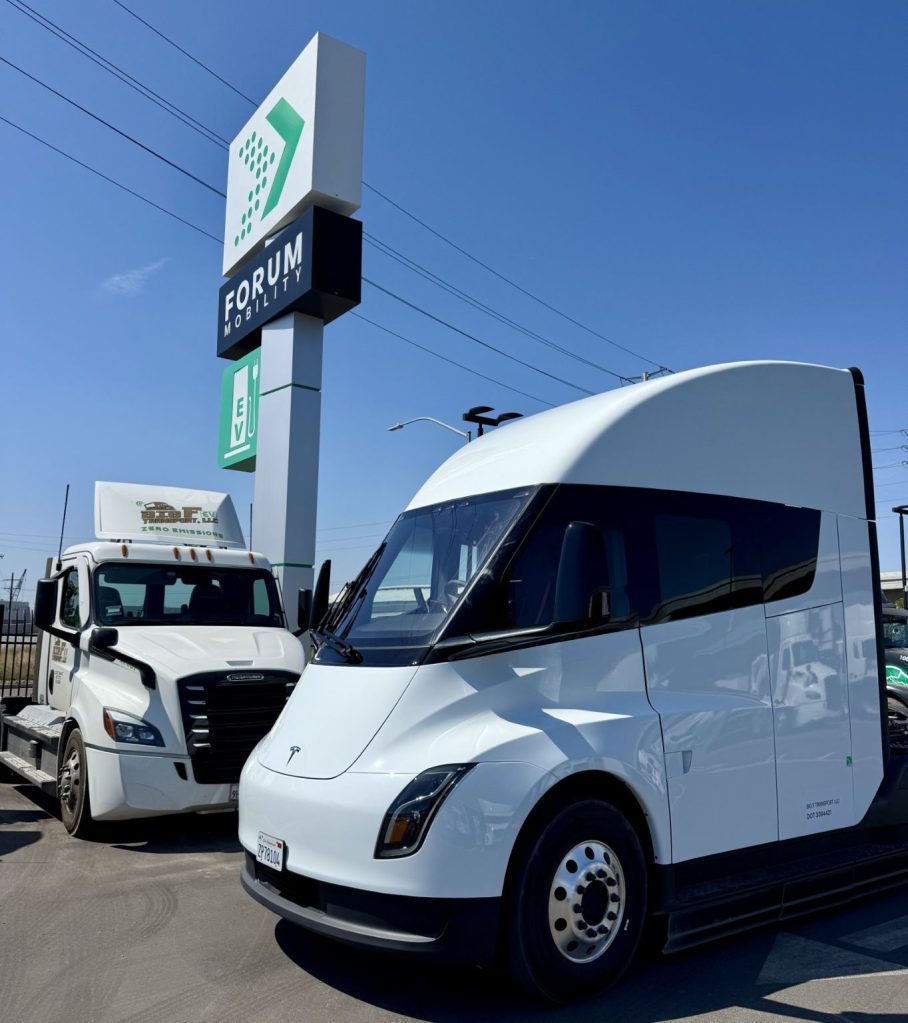
Tesla Semi momentum builds
The 60-truck order lands at a pivotal moment for the Tesla Semi program. Last week, Tesla confirmed that the first Semi rolled off its new high-volume production line at Gigafactory Nevada — a 1.7-million-square-foot factory designed for annual capacity of 50,000 trucks. The Long Range model is priced at $290,000 with 500 miles of range, while the Standard Range comes in at roughly $260,000 with 325 miles, according to quotes obtained by Electrek.
Demand signals are strong. In California’s Clean Truck & Bus Voucher program — a useful proxy for commercial interest — the Tesla Semi accounted for 965 of 1,067 applications between January 2025 and February 2026. Daimler, PACCAR, and Volvo combined received fewer than 100.
Port drayage is emerging as the Tesla Semi’s beachhead market. MDB Transportation recently launched a three-week pilot running a Tesla Semi on active freight lanes out of the Ports of Los Angeles and Long Beach, while Hight Logistics has already taken delivery for port operations.
Top comment by Dan B
I don't like Musk. I may not be very excited about Tesla vehicles (but I don't have a problem with others buying them. I just won't buy one). I may feel like Tesla/Musk have given the environmental side the middle finger.
But................I'm really happy to see these Tesla Semi's coming out. This is an area where we can make and see the biggest differences for climate change and improving that.
What's more, I like that the Tesla semi is instantly recognizable for what it is. Unlike the other EV semi's out there where even I can't really tell if they are EV or not. We need others on the road (ahem, ICE drivers) to see and know that there are EV semi's and they are doing a great job. That may help ICE drivers realize that an EV would work for them.
Meanwhile, Tesla is building out the charging ecosystem. The company revealed 64 Megacharger locations across 15 states and recently launched its Semi Charging for Business program with Megacharger units starting at $188,000 for two posts. Third-party providers like Forum Mobility add another layer of charging access for operators who don’t want to build their own.
Electrek’s Take
This is exactly the kind of use case that can kick-start Tesla Semi’s commercial viability. Port drayage — short, repetitive routes with predictable daily mileage. It is the perfect use case for battery-electric trucks. The total cost of ownership math works today, especially in California where diesel prices remain elevated and electricity rates at commercial depots are manageable.
What’s particularly telling is Big F Transport’s decision to go with 40 Tesla Semis after already operating nine Daimler eCascadias. That’s a real-world competitive comparison, and the Tesla Semi apparently won. The California voucher data tells the same story — Tesla is dominating commercial demand over legacy truck makers by a staggering margin.
The question now is production. Tesla’s Nevada factory just started ramping, and the company needs to prove it can deliver trucks at scale — not just announce orders. If Tesla can keep the production line moving, the demand from drayage operators alone could fill a significant portion of early capacity.


FTC: We use income earning auto affiliate links. More.




Comments