
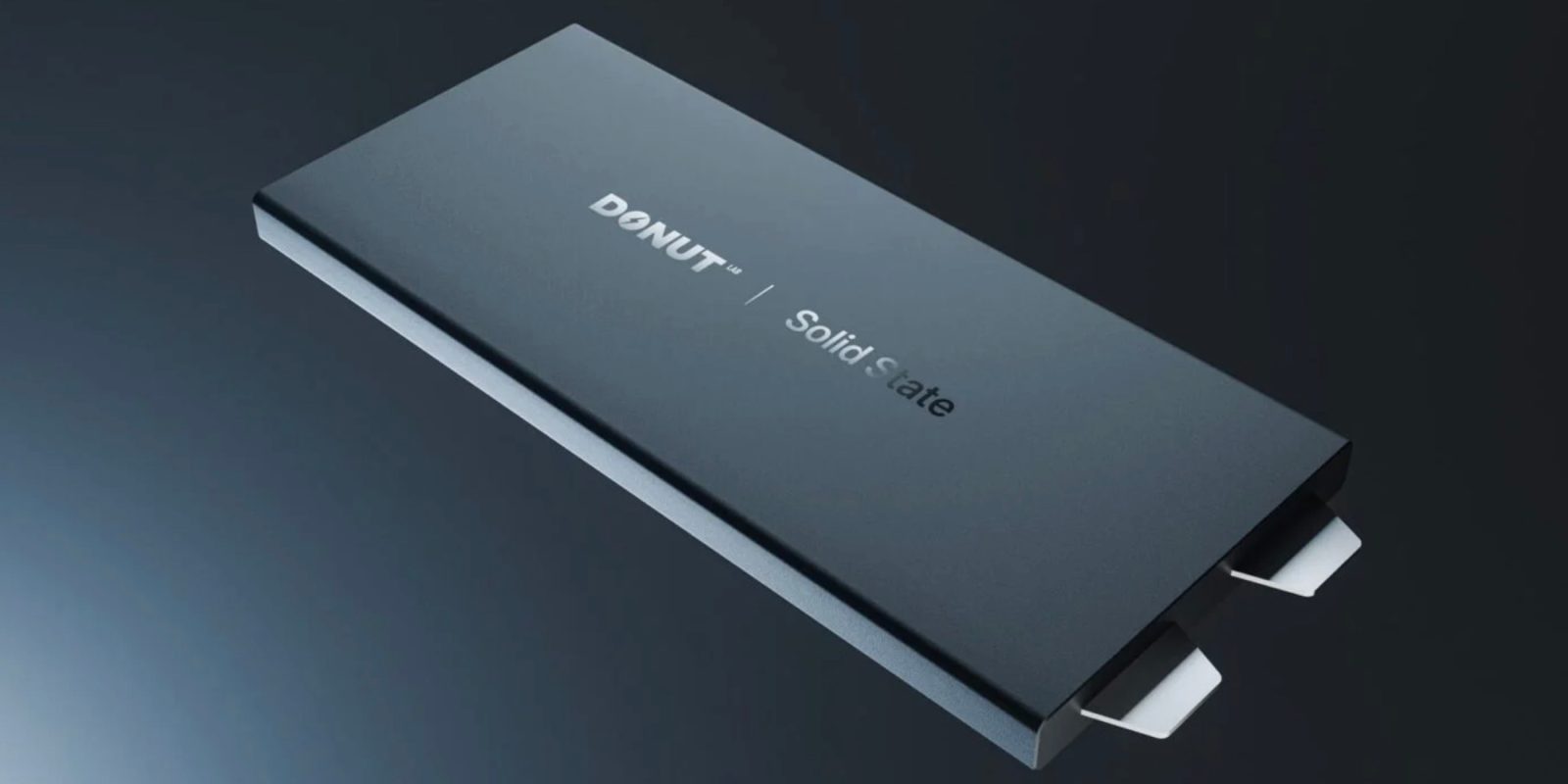
Donut Lab has released its third independent test report from VTT, the Finnish Technical Research Centre, and it confirms another claim: the solid-state battery retains 97.7% of its charged capacity after sitting idle for 10 days.
The new report (VTT-CR-00125-26) adds self-discharge performance to the growing list of independently verified specs — but three reports in, the two most extraordinary claims remain completely untested.
What the third VTT report shows
The self-discharge test followed a straightforward methodology. VTT first ran an initial capacity test on cell DL1, measuring a discharge capacity of 26.5 Ah at a 1C rate, above the nominal 26 Ah spec provided by Donut Lab and notably higher than the 24.9 Ah measured on a different cell in the previous high-temperature test.
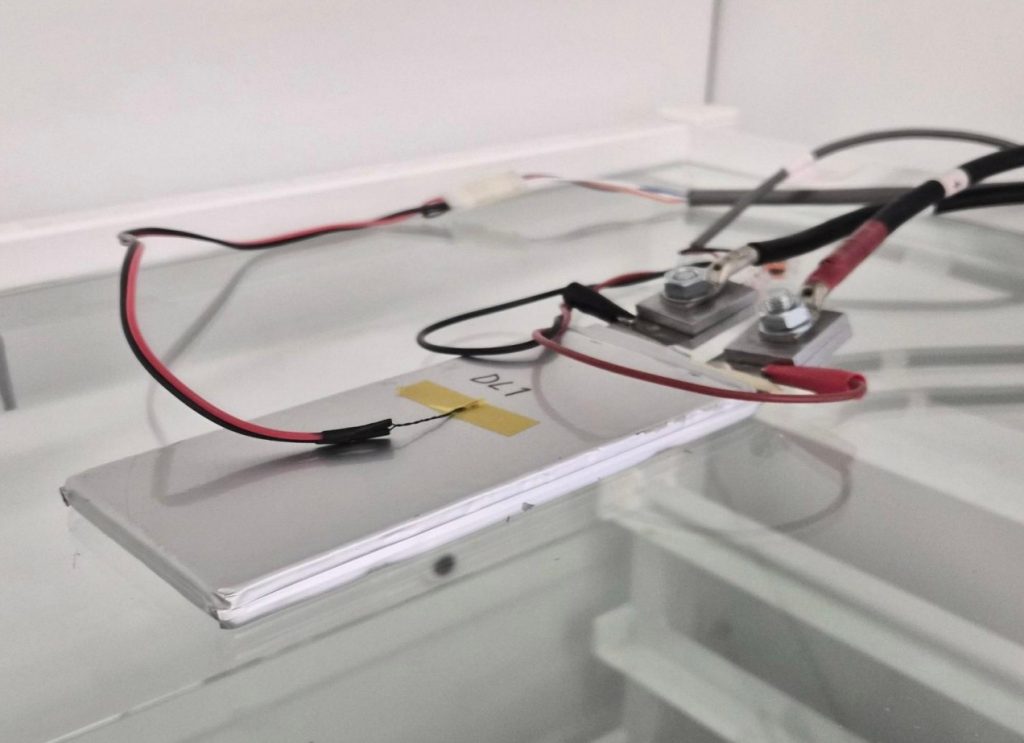
For the self-discharge test itself, VTT charged the cell to approximately 50% state of charge (13.335 Ah), then left it idle for 240 hours (10 days) at ambient temperature (22–28°C) while recording voltage every 10 seconds. After the idle period, VTT discharged the cell and recovered 13.029 Ah — 97.7% of what went in.
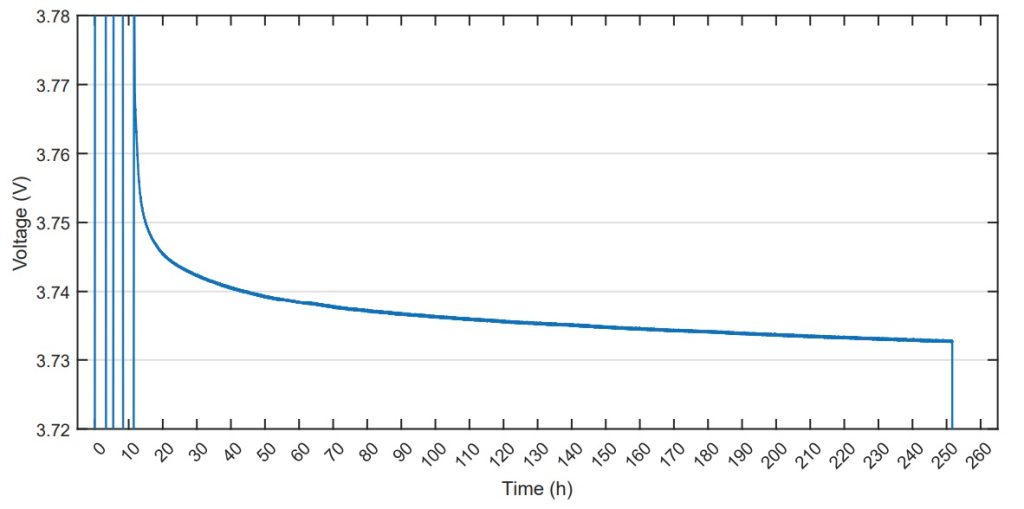
The voltage data tells an interesting story. The cell dropped 60 mV in the first 10 seconds and 103 mV in the first hour — that is mostly voltage relaxation after charging, not true self-discharge. From 10 hours to 240 hours, the voltage only dropped an additional 12 mV (3,745 mV to 3,733 mV), showing the cell had essentially stabilized.
VTT concluded that the testing caused no visible damage or changes to the cell.
How does that compare?
Standard lithium-ion cells typically self-discharge at a rate of 1–3% per month at room temperature, with Battery University noting that Li-ion cells lose about 5% in the first 24 hours before settling into a 1–2% per month steady-state rate.
Solid-state batteries are theoretically expected to have lower self-discharge rates because their solid electrolytes are less prone to the parasitic chemical reactions that cause energy loss in liquid-electrolyte cells.
Donut Lab’s 2.3% loss over 10 days at 50% SOC is not a standout result in isolation. Extrapolated linearly, that would put it in the 5–7% per month range — worse than typical lithium-ion. But self-discharge is not linear, and the voltage curve shows most of the loss concentrated in the initial relaxation period. The extremely flat voltage profile from hour 10 to hour 240 — just 12 mV of drift over 230 hours — suggests the long-term self-discharge rate is actually very low.
Without a longer idle period (30 or 60 days), it is difficult to separate initial relaxation effects from true steady-state self-discharge with precision. The 97.7% capacity retention result is solid but not the kind of data point that rewrites textbooks.
Three reports in, a pattern emerges
This is the third VTT report in three weeks. The first report confirmed fast charging at 11C (0–80% in 4.5 minutes), the second confirmed high-temperature discharge up to 100°C, and now the third confirms acceptable self-discharge performance. The cadence is impressive, more transparency than most battery startups have ever offered.
But the pattern is also telling. Donut Lab continues to prove the claims that the battery industry considers achievable — fast charging, thermal tolerance, low self-discharge. These are engineering challenges, not physics challenges. Solid-state batteries, by their nature, are expected to perform well in all three areas.
The two specifications that drew the harshest criticism after CES remain completely untested by any independent party: the 400 Wh/kg energy density that Svolt Energy’s chairman called “physically impossible,” and the 100,000-cycle life that would be orders of magnitude beyond anything demonstrated in the industry. VTT’s reports have not included cell weight or physical dimensions, making independent verification of energy density impossible from the data provided.
One additional detail worth noting: the initial capacity test on cell DL1 measured 26.5 Ah and 91.8 Wh of discharge energy. The nominal spec lists 94 Wh. If the cell weighs around 235 grams, that would put it near the 400 Wh/kg claim, but VTT does not report the weight, and calculating backward from an energy density claim is not the same as measuring it.
CEO Marko Lehtimäki staked his personal reputation on shipping Verge Motorcycles with these cells in Q1 2026. That deadline is now days away.
Electrek’s Take
These three independent VTT reports in three weeks are encouraging, but there’s nothing completely groundbreaking yet.
Top comment by fromEurope
Three of five. Density is not as test. 100k cycles will be interesting as is the price. Assuming 400wh/kg. That would be about 50 kg battery i the Verge motorcycle 20Kwh battery. About 13 L battery pack in volume. Seem reasonable. Big pack 33kWh /400Wh=82 kg and 20 L
The charge rate is probably the most impressive one, but moot as we see what’s entering commercialization in China, such as BYD’s second-gen Blade battery.
We said after the first report that Donut Lab was proving the easier claims first, and that assessment holds after the third. Fast charging, high-temperature tolerance, and self-discharge performance are all within the realm of what the solid-state battery community expects. They are necessary conditions for a real product, but they are not sufficient to validate the extraordinary claims that made Donut Lab famous.
The self-discharge data is fine, 97.7% retention over 10 days is a workable number for real-world applications. We would have liked to see a longer test period to better separate relaxation effects from true self-discharge, but what VTT measured shows a cell that behaves normally.
What we are really waiting for is the energy density and cycle life data. Those are the specifications that, if confirmed, would make this battery genuinely revolutionary rather than just another solid-state cell with good thermal properties. Until VTT weighs the cell and runs it through thousands of cycles, the verdict remains the same: promising but unproven where it matters most. We are getting closer to the point where Donut Lab either delivers the proof or runs out of easier claims to validate.


FTC: We use income earning auto affiliate links. More.



Comments