
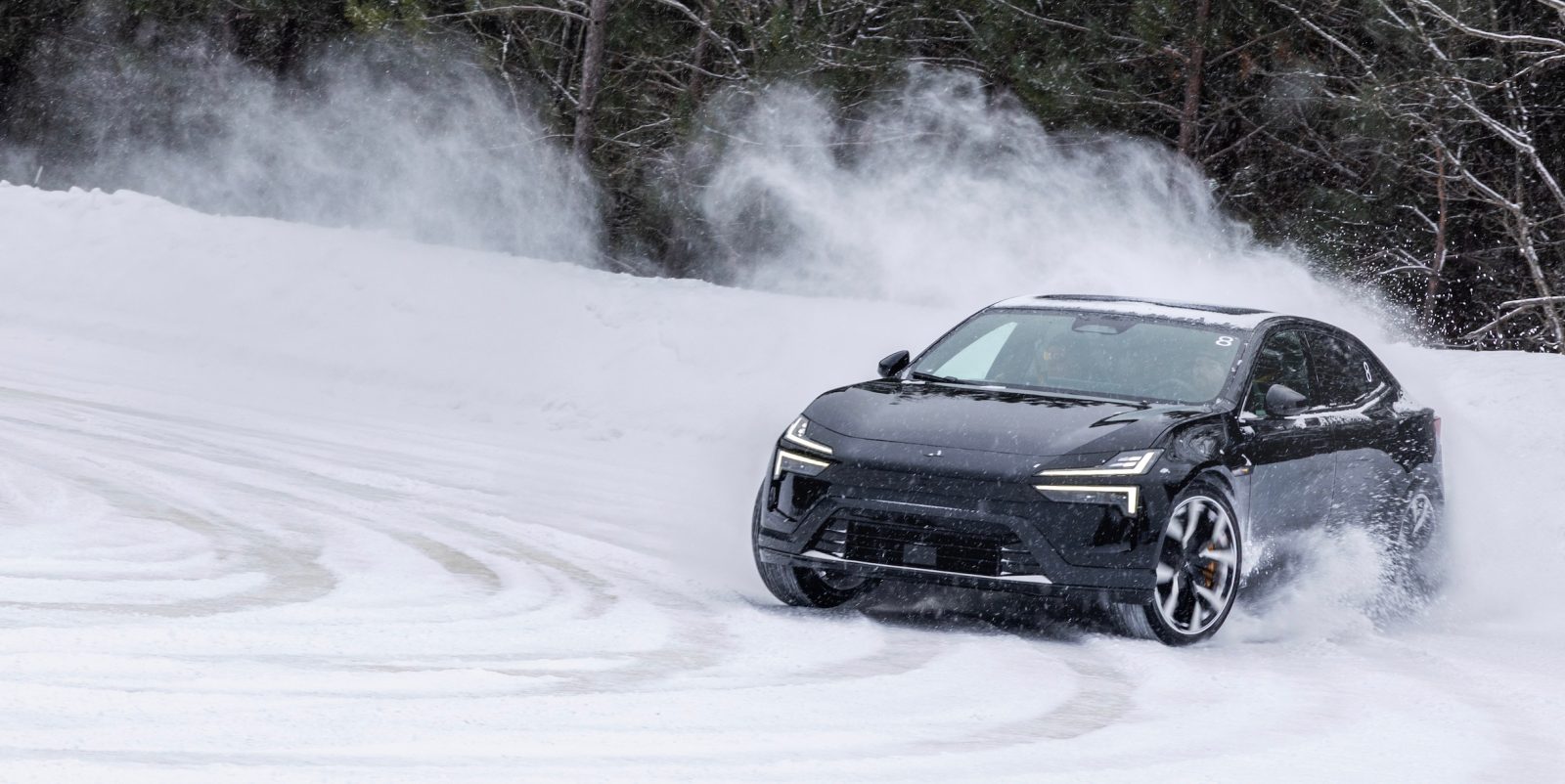
I spent a full day drifting the Polestar 4 on ice at Quebec’s Mecaglisse track, and I came away seriously impressed with how well Polestar has tuned the dynamics of its 544-hp electric SUV coupé.
The ice driving event gave me a chance to experience the dual-motor Polestar 4’s all-wheel-drive system in slow motion — pushing the vehicle to its limits in a controlled environment that reveals every nuance of how power is distributed and how the chassis responds.
A full day on ice
Being from Quebec, I’ve spent a significant chunk of my driving life on ice and snow. I’m quite used to it and rarely lose control in winter conditions. But performance driving on ice is a completely different discipline from simply feeling confident in difficult weather. On ice, you’re deliberately pushing past the limits of grip, which strips away any safety margin and exposes exactly how a vehicle’s drivetrain, stability systems, and suspension work together.
I started the day slow, getting familiar with how the Polestar 4 rotates and how its all-wheel-drive system distributes torque between the front and rear motors. By the end of the day, I was putting in smooth, controlled laps with long, sustained drifts. The single-day improvement is a credit to the excellent instructors Polestar brought to the track, thanks to Xavier in particular, but also to the Polestar 4 itself, which is a remarkably easy vehicle to learn and master on ice.
By the end of the day, I was able to nail the two turns that were giving me trouble:
That’s the real takeaway: the Polestar 4’s dynamics are extremely well fine-tuned. The dual-motor system’s torque vectoring between the front and rear axles is predictable and progressive, which is exactly what you want when you’re sliding sideways at speed. There’s no sudden snap of oversteer or unexpected corrections from the stability control. The vehicle communicates clearly through the steering what it’s doing and what it’s about to do.
Polestar 4 specs: a quick refresher
For those unfamiliar, the Polestar 4 went on sale in the US in 2025 and deliveries started in the US and Canada in December 2025. It’s Polestar’s SUV coupé, a sleek, fastback-style crossover that notably has no rear window, using a camera-based rearview system instead.
The dual-motor all-wheel-drive version I drove produces 544 hp and 506 lb-ft of torque from its two electric motors, hitting 0-60 mph in 3.7 seconds. All Polestar 4 variants use a 100 kWh battery. The dual-motor version delivers an EPA-rated 280 miles of range, while the single-motor rear-wheel-drive model stretches to 310 miles.
Pricing starts at $46,400 for the single-motor version and $52,900 for the Long Range Dual Motor AWD. The Performance pack adds another $10,000.
Polestar also built a one-off Arctic Circle edition of the Polestar 4, a rally-inspired version with Öhlins 3-way adjustable dampers, a 20mm ride height increase, studded Pirelli tires, a hydraulic handbrake, Recaro seats, and Stedi LED spotlights. While I drove the standard production Polestar 4 at Mecaglisse, the Arctic Circle edition was also present at the event for demonstration, and it looked fantastic in its white and yellow livery against the snow.
Even though I was satisfied with my ice driving by the end of the day, I got quickly humbled by drift champion Tommy Lemaire who gave me a “cold” lap in the Arctic Circle:
Why ice driving matters for EVs
Ice driving is one of the best ways to evaluate an EV’s powertrain calibration. Because the available grip is so low, you feel every decision the vehicle’s software makes about torque distribution in real time. A poorly calibrated system will fight you — cutting power abruptly or overcorrecting when you’re trying to hold a slide. A well-calibrated one works with you, letting the driver modulate the drift with throttle input alone.
The Polestar 4 falls firmly in the latter category. The dual-motor system’s response to throttle inputs is smooth and linear, which means you can use the accelerator to steer the car through a drift. Want to tighten the line? Lift slightly. Want to extend the slide? Feed in more power. It’s the kind of intuitive behavior that takes sophisticated engineering to achieve, and Polestar has clearly put in the work.
The roughly 5,000-lb weight of the vehicle is noticeable, you feel the mass when transitioning between turns, but Polestar has managed to make it feel composed rather than clumsy. The low center of gravity from the floor-mounted battery helps significantly here.
Electrek’s Take
I now have a peculiar relationship with the Polestar 4: I’ve driven it on two separate occasions, and both times have been exclusively on ice. I’d genuinely love a chance to drive this vehicle in a more regular environment, because I enjoyed my time with it quite a bit, and I think it’s a very interesting addition to the EV market.
What I can say with confidence is that Polestar has nailed the driving dynamics. The dual-motor system’s calibration is among the best I’ve experienced in terms of predictability and driver engagement. On ice, where every flaw is amplified, the Polestar 4 felt confident and approachable, qualities that should translate well to dry-road performance too.
At $52,900 for the dual-motor AWD version, the Polestar 4 competes in an interesting range, but it offers a distinctly different character than everything in the segment. The SUV coupé design, the no-rear-window approach, and the driving dynamics all set it apart. We’d like to see how those qualities hold up over extended real-world driving, hopefully we’ll get that chance soon.


FTC: We use income earning auto affiliate links. More.



Comments