
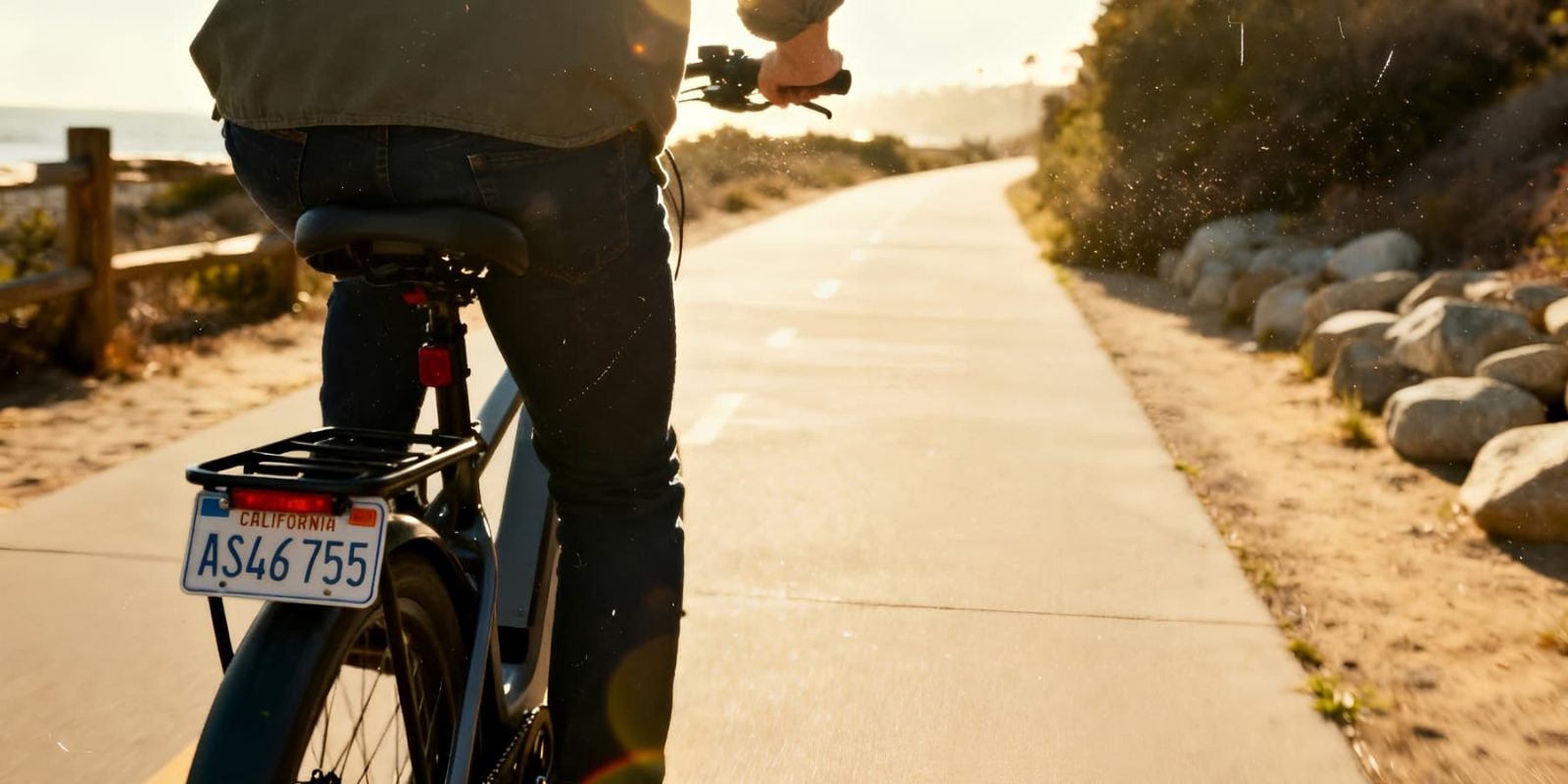
A newly introduced bill in California could dramatically change how electric bikes are treated under state law – and it may put license plates on most e-bikes.
Assembly Bill 1942, introduced by Assemblywoman Rebecca Bauer-Kahan, would require all Class 2 and Class 3 electric bicycles to be registered with the California Department of Motor Vehicles and to display a special license plate issued by the DMV.
Under current California law, e-bikes are divided into three classes: Class 1 (pedal assist up to 20 mph or 32 km/h), Class 2 (throttle-equipped up to 20 mph or 32 km/h), and Class 3 (pedal assist up to 28 mph or 45 km/h). These classifications, established nearly a decade ago, were specifically designed to treat e-bikes more like bicycles than motor vehicles. That means no registration, no insurance, and no license plates – one of the key reasons e-bikes have become such an accessible alternative to driving. They’re as hassle-free as a bicycle while being easier to ride.
AB 1942 would change that for Class 2 and Class 3 models, which make up likely over 90% of the road-legal electric bikes in the state. Riders would need to register their bikes, obtain a plate, and carry proof of ownership tied to the bike’s serial number. Operating a Class 2 or 3 e-bike without registration would become an infraction punishable by fines. The bill would also create an Electric Bicycle Registration Fund to collect fees and fund the administration of the program.
The bill, while still in committee with a ways to go before potentially becoming law, joins a growing trend towards e-bike crackdowns in many states.
Supporters argue the California bill is about accountability and public safety, pointing to rising concerns about reckless riding and injuries. But here’s the rub: this proposal doesn’t just target illegal, high-powered “e-motos” or modified bikes that exceed the 750-watt limit. It applies to fully legal class 2 and class 3 e-bikes – the same commuter bikes used by parents, students, and delivery workers across the state. These are fully legal electric bicycles that have always been legally considered bicycles, not vehicles.
Unfortunately, it appears that the bill’s author, Assemblywoman Rebecca Bauer-Kahn, doesn’t quite understand that. In a press conference announcing the new legislation, she described the bill while making a number of factual errors, explaining that “the bill we introduced today is incredibly simple. It says that the class 2 and the class 3 e-bikes, the ones with the throttles, the ones that can either be modified to or do go 60 or 70 mph, have to be registered with the state and have a license plate.”
The problem is that while it sounds like the Assemblywoman is attempting to regulate non-street-legal high-speed electric motorcycles, she’s accidentally targeting street-legal electric bicycles. Class 3 e-bikes in California legally can’t have throttles, and any e-bike that is capable of “60 or 70 mph” is by definition not a class 2 or 3 e-bike, which tops out at 20 or 28 mph. Thus, it appears a fundamental lack of understanding of the very bikes Bauer-Kahn is trying to regulate has caused her to miss the mark considerably.
And that’s where the impact could be devastating.
For many riders, the appeal of a street-legal class 1, 2, or 3 e-bike is its simplicity. You buy it, you ride it. There’s no DMV appointment, no paperwork, no plate bolted to the back, and basically no fuss. It’s a consumer product, not a vehicle. Introducing registration requirements – even if fees are relatively modest – adds friction. And friction matters a lot when the main selling point of a mode of transportation is its ease of use.
Top comment by Robert Mittelstaedt
Enforce existing laws against emotos. They are the problem. Who is going to enforce the new law if they aren’t enforcing the existing law? Sacramento needs to diagnose the problem before prescribing a remedy.
We’ve already seen how confusion around e-bike rules can chill adoption. If someone considering ditching their car now has to factor in DMV registration, possible inspections, and the risk of tickets for non-compliance, some will simply decide it’s not worth the hassle. Instead of switching to an e-bike for short trips, they may stay in their car.
There’s also the question of enforcement. Critics argue that targeting compliant, legal e-bikes won’t address the core issue of illegal or out-of-class machines that are already breaking existing laws. Meanwhile, hundreds of thousands of law-abiding riders could find themselves navigating a new layer of bureaucracy.
California has long been a national leader in e-bike policy, helping normalize electric bicycles as legitimate, low-impact transportation. AB 1942 signals a potential shift – one that could redefine whether e-bikes continue to be treated like bicycles, or start inching closer to motor vehicles in the eyes of the law.
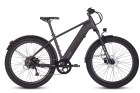
Note: The top image is an AI-generated example of an electric bicycle license plate


FTC: We use income earning auto affiliate links. More.


Comments