
The largest real-world study yet, accounting for nearly a million plug-in hybrid vehicles, shows that PEVs use far more gasoline than previously claimed. The study comes just as Europe is about to change PHEV regulations, with industry lobbying to maintain the current highly inaccurate numbers.
There are a lot of different types of electric vehicles out there, enough to confuse even those who follow the industry. BEV, FCEV, EREV, PHEV, and so on.
We here at Electrek tend to prefer and report on battery electric vehicles, sometimes referred to as “all-electric.”
But another option, favored by some, are plug-in hybrids (PHEVs), vehicles with both an internal combustion and electric powertrain existing side by side in the same car. These can either run off of a battery or a gas engine, theoretically adding flexibility and covering for the weaknesses of each powertrain.
Unlike conventional hybrids which get 100% of their energy from gasoline, plug-in hybrids can get some of their energy from the electric grid, which can be produced with more economical and low-carbon methods, like hydropower, wind, or even rooftop solar, allowing owners to become self-sufficient and create their own fuel.
Combustion engine manufacturers also like PHEVs because it means they get to keep selling engines – an incredibly complex piece of machinery that has been refined over the last century, leaving those with the intellectual property necessary to build one loathe to surrender their long-held trade secrets.
The problem with PHEVs is that, despite them being thought of as a futuristic technology, they still rely on the same-old polluting engines that combustion cars rely on. In theory they can and should be driven on electric power most of the time, since the fuel is cheaper and the cars produce lower emissions when doing so, but it turns out that doesn’t happen nearly as much as automakers claim it will.
We’ve seen several studies before that show plug-in hybrids use more gasoline and produce more emissions than claimed. These studies have mostly suggested that PHEVs simply don’t get plugged in as much as they should, and thus can be indistinguishable from gas-powered conventional hybrids in operation.
But a new study by the Fraunhofer Institute shows that in average operation, PHEVs on average use more than 3x as much fuel as government estimates suggest – and they even use more fossil fuels in electric power mode than previously claimed.
Study says PHEVs use 3x as much fuel as claimed
The study used on-board fuel consumption monitoring (OBFCM) data from 981,035 vehicles across Europe. With a data set that enormous, it naturally covered a wide variety of models and usage patterns.
The headline result is that PHEVs were found to use over 300% as much fuel as the EU’s previous PHEV regulations claim they do.
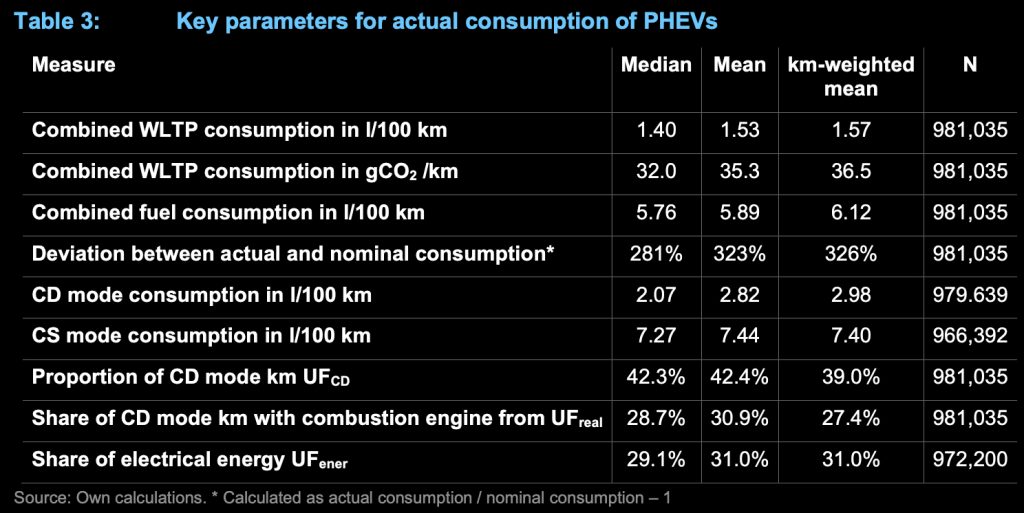
The tested vehicles were supposed to use an average of 1.57 liters per 100km (~150MPGe), but instead they were found to use an average of 6.12 L/100km (~38MPGe). That means that PHEVs used 3.26x as much fuel as Europe’s WLTP testing cycle indicates they should.
Going further into the data, the Fraunhofer Institute also analyzed how much fuel was used in “charge depleting” (CD) mode, or in other words, a PHEV mode where the battery is being drained rather than being sustained with the engine. Most PHEVs have a way to switch between these modes, which is especially important in Europe where many city centers limit the use of combustion engines and require PHEVs to run in battery mode.
The data shows that even when in battery-using mode, PHEVs used more fuel than WLTP testing would suggest. WLTP claims 1.57 L/100km of consumption, but the average amount of fuel used in CD mode was 2.98 L/100km, almost double as much – meaning the engine is coming on more often than estimated.
This is exceptional, given that WLTP is supposed to measure average usage between both battery and combustion modes, and even in the cleaner of the two modes, PHEVs still managed to use more fuel than WLTP averages would suggest.
The study also breaks down the problem by model, with some models being charged more often than others.
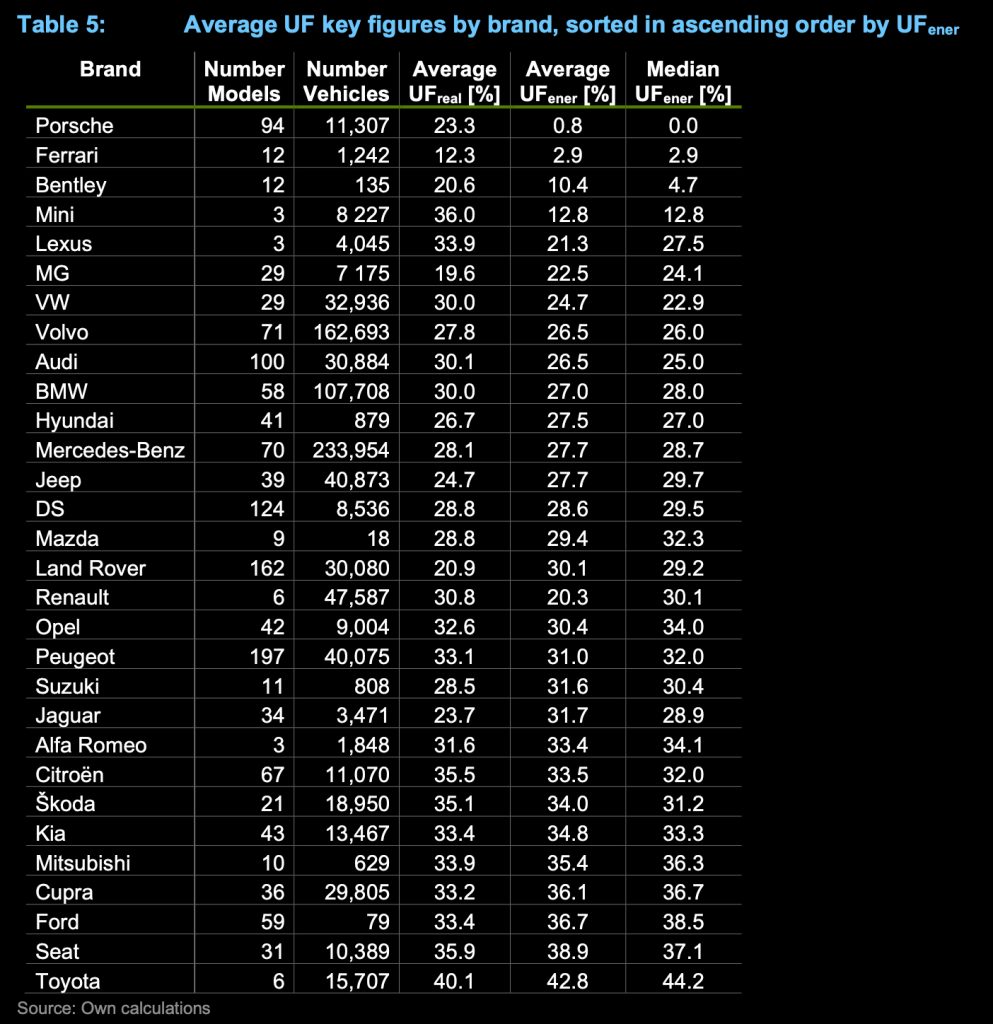
Typically, more budget-focused brands were charged more often, whereas luxury brands were charged far less – with some being charged almost not at all.
This is actually somewhat interesting – the cost of installing a charger at home, could be more difficult for lower-income folks, especially if one lives in an apartment or parks on the street. Those who can afford a Porsche, Bentley or Ferrari ought to be able to easily absorb the cost of installing a charger, and be more likely to have their own garage to charge it in.
But those three brands are on top of the list for the least-charged vehicles. The study calls out Porsche specifically as “particularly striking,” stating that the average Porsche in the database was only charged for a total of 7kWh worth of electricity over a distance of 27,000km (~17k miles). The median Porsche used electricity 0.0% of the time, which means more than half of the 11,307 Porsche vehicles included in the study were never plugged in a single time over the study period.
How do we fix this problem?
Inaccurate WLTP estimates are nothing new – the study points out that combustion-engine vehicles use about 20% more in real-world usage than government estimates suggest. But a gap of over 300% is much more severe, and makes it hard to regulate something when the estimated numbers are so wildly different from reality.
Thankfully, the EU already knows about this problem, and is taking some measures to fix it. This comes in the form of an adjusted “utility factor” (UF) for PHEVs, which is the government estimate of how often PHEVs get used on fossil power versus electric power.
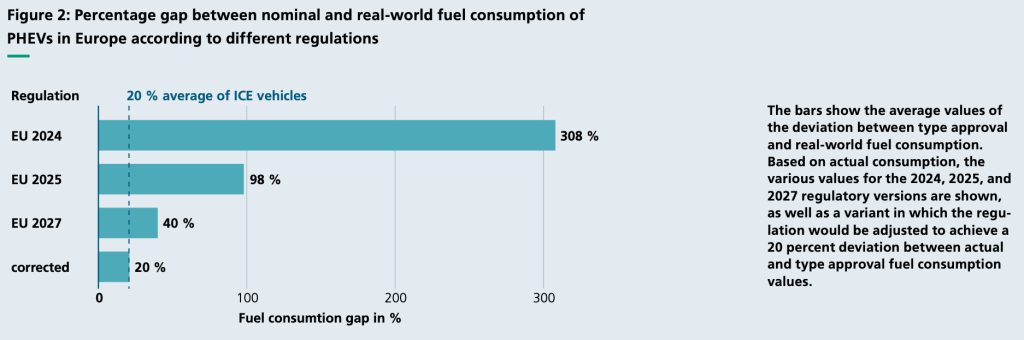
A planned change in PHEV utility factor was supposed to be implemented in EU’s 2025 emissions regulations, which would give PHEVs far less credit than they currently get in terms of emissions reductions, and bring these numbers closer to reality. (Closer to reality – the 2025 regulations still leave a 98% gap between regulations and reality).
But the proposed utility factor changes have been targeted by automaker lobbying, who seek to maintain the gobs of extra credit they’re getting for selling vehicles that apparently pollute over three times as much as they’ve claimed. They want to roll back current and planned utility factor changes and carve out a long-term role for vehicles that still rely on combustion engines.
We’ve seen other analyses showing the gap between estimates and the real-world is growing for PHEVs, and it’s due to unrealistic utility factor calculations.
And so, even though European regulators have been moving in the right direction on PHEV regulation, this study shows that progress must not stop or be rolled back, and that utility factors need to be further adjusted until the gap between the real world and estimates can be closed (at least closed to that 20% number for gas-powered vehicles).
Some other suggestions to correct for this gap have been suggested, namely “display transparency” which would allow drivers to see what percentage of the time their cars are used on electric vs. fossil power, or “inducement” which would force drivers to charge their cars at least every 500km.
Top comment by EV_Wisconsin
plug in hybrid mazda - can't be bothered to plug into a completely free L2 charger, but happy to block an EV from charging. These chargers work flawlessly too; I use them frequently.
The study suggests that both of these would only result in minor reductions in real-world emissions, and that utility factor corrections would have a far greater effect – and concludes that planned adjustments to utility factor must not be eliminated or reduced, as automaker lobbying currently targets.
If utility factor changes from 2025 are rolled back, the study says 23-25 million more tons of CO2 emissions would be released in the next 20 years. If the next planned adjustment in 2027 is not adopted, that would instead result in an additional 7 million tons of CO2. Although in reality, both of these numbers might be significantly higher, since they do not account for Europe’s other recent rollback in EV targets.
Instead, the study says, the empirical values from observation of nearly a million vehicles should bet taken into account, and the planned 2027 utility factor adjustments should be further strengthened in order to close the gap between claimed and real-world emissions.
Charge your electric vehicle at home using rooftop solar panels. Find a reliable and competitively priced solar installer near you on EnergySage, for free. They have pre-vetted installers competing for your business, ensuring high-quality solutions and 20-30% savings. It’s free, with no sales calls until you choose an installer. Compare personalized solar quotes online and receive guidance from unbiased Energy Advisers. Get started here. – ad*


FTC: We use income earning auto affiliate links. More.




Comments