
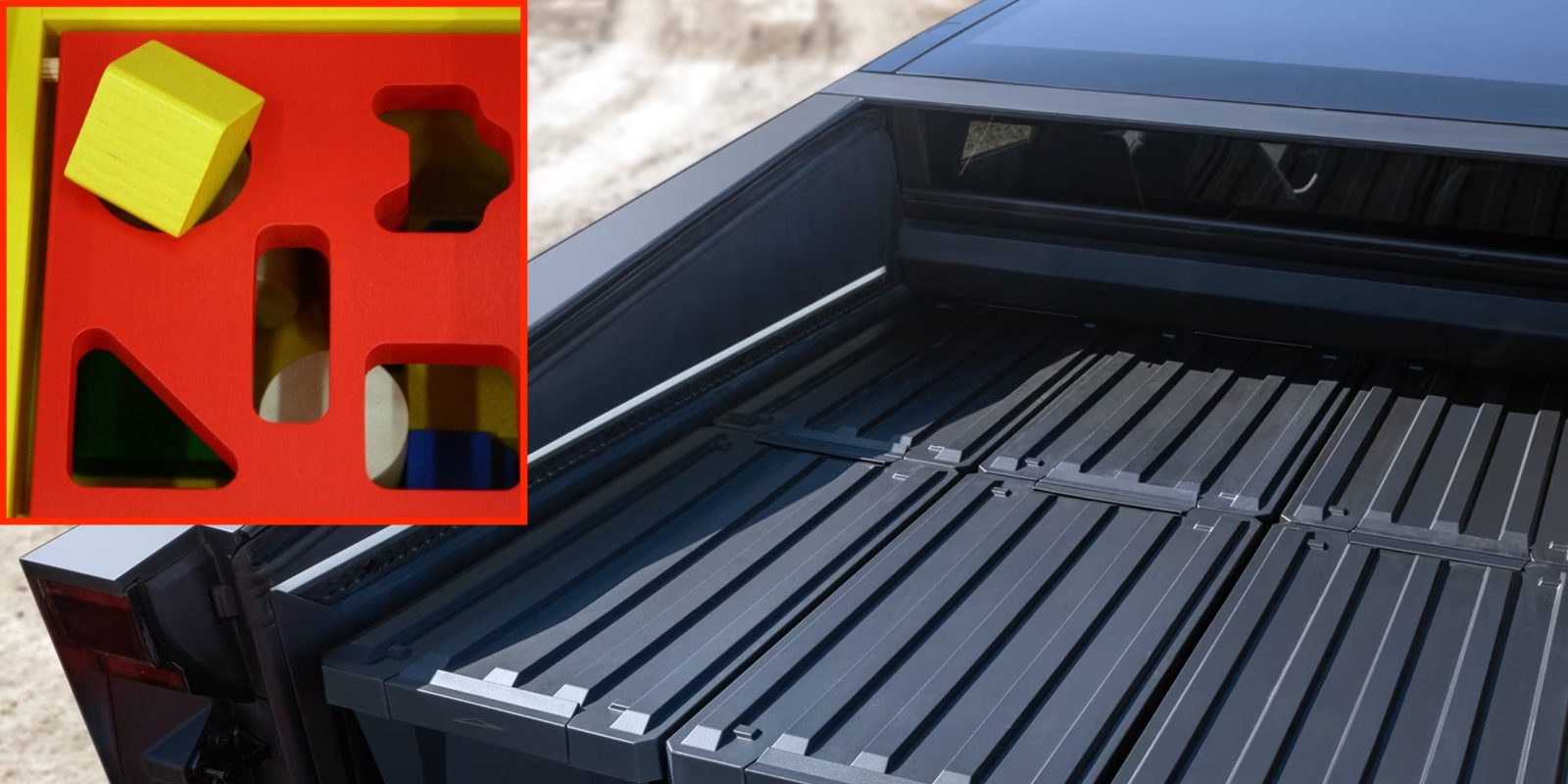
On today’s Tesla Q4 earnings call, Tesla CEO Elon Musk responded to a question about Cybertruck’s failed design by stating that Cybertrucks could be used for intra-city autonomous deliveries.
But that betrays a simple misunderstanding of how shapes work – and why the Cybertruck has not become accepted as the hyper-utility vehicle that it was originally marketed as.
Tesla just concluded its Q4 and full year 2025 earnings call today, giving investors insight into the company’s plans for the future.
During the call, the company answered questions both from analysts and shareholders, and one of the top voted questions went thusly:
After the unveiling of the Cybertruck, Musk stated if it didn’t sell well, Tesla would build a more conventional looking pickup. How practical would it be to create this new design on the Cybertruck architecture and could it be conveniently built on the existing production lines?
In answering the question, Tesla VP Lars Moravy said that in fact the Cybertruck is selling well, saying that it continues to be the best-selling electric pickup (which isn’t true… nevermind the fact that the Cybertruck’s competition isn’t electric trucks, but instead is gas trucks, and it has fallen orders of magnitude short of the sales goals that Tesla set and continues to set for it).
Moravy went on to state that Tesla designs its manufacturing lines to be flexible, and that the Cybertruck line is also flexible, and is “one of our most fully ready for autonomy” platforms.
So, it was somewhat of a non-answer, partially saying “no” because Tesla thinks the truck is selling well, and partially saying that flexibility remains and that the platform could be modified.
But the fact remains that the truck has fallen so far short of expectations that Tesla is trying to find any market it can find for the hundreds of millions of dollars worth of inventory that has built up.
It started selling the trucks in UAE recently, and Musk has used his oft-used other-company slush fund to buy tens of millions of dollars worth of Cybertrucks for SpaceX.
So, what is a company to do with a product that is selling tremendously short of expectations?
Musk followed up Moravy’s answer, and claimed that the Cybertruck could be used for autonomous deliveries:
“We will transition the Cybertruck line to just a fully autonomous line and there’s obviously a market there for cargo delivery, like localized cargo delivery within a city, within a few hundred miles, something like that. There’s a lot of cargo that needs to move locally within a city and an autonomous Cybertruck could be useful for that”
In this answer, he doesn’t suggest that this could be done by a different format vehicle on the Cybertruck line, but by the Cybertruck itself.
But there’s a reason that Cybertruck doesn’t get used for intra-city deliveries: because its design isn’t good for that task.
Why Cybertrucks are bad for deliveries
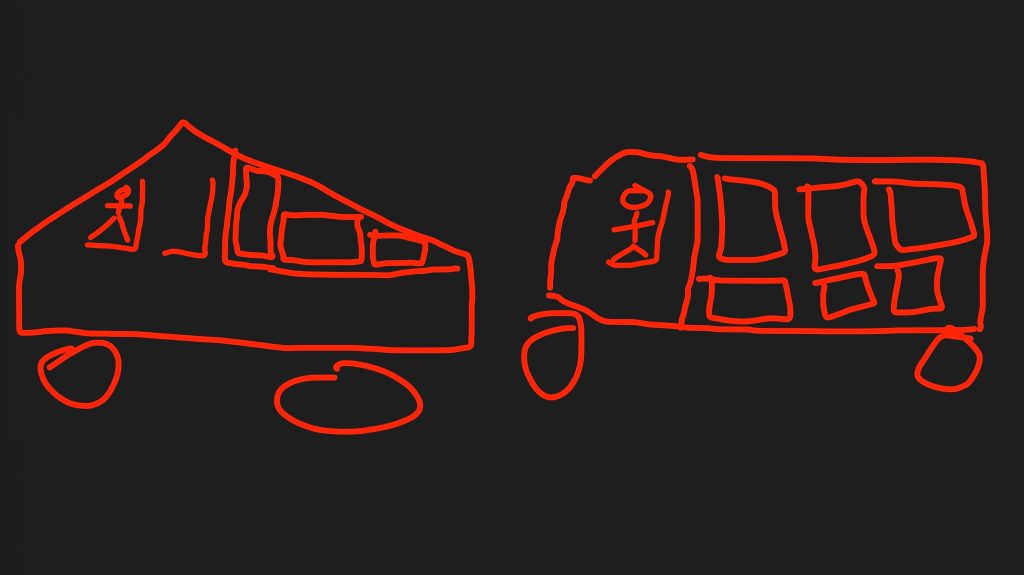
Cargo vans typically have small, cab-forward areas for the driver (and occasional passenger – often in the form of a jump seat, not even a full seat) and large, tall, square boxes on the back for cargo. These boxes can be upfitted in various ways, with shelving to accomplish various goals.
Further, the ceiling is often high and the floor is usually low so it’s easy for a delivery driver to walk through the vehicle to get to packages, and to get in and out of the vehicle (including sliding doors that are easy to operate repetitively, and can open even when parked in tight spaces).
None of this is true of the Cybertruck: it has a triangle-shaped covered bed, a second row of seats, no pass-through between driver and cargo area, a low ceiling and can’t be stood in, and doors that are difficult to operate.
Here’s a simple mockup to demonstrate the issue:
Logistics companies tend to be overly interested in cost efficiency, far moreso than the typical consumer. Their purchasing decisions not driven less by style or making a statement, and more by a spreadsheet: if it lowers your costs, you should buy it.
Those costs aren’t just about purchase price – though purchase price of a Cybertruck remains much higher than a much more capable delivery van. And they’re not just about the cost of fueling the vehicle, either.
They’re also the cost of various ergonomic issues that crop up. If your drivers keep getting injured from a design that is not made for repetitive use, that will increase costs for your company in terms of worker’s compensation, retraining, injury days and whatnot.
This is why the new USPS trucks are so popular with drivers, because they were designed with ergonomics in mind. Not only are they far more capable than previous vehicles, they’re also more comfortable and cause less pain from repetitive movements. The LLVs had their time and performed well, but the new NGDV is just much better.
Again, the Cybertruck has none of those benefits. It does have a comfortable and spacious interior to drive in for consumers, but it does not fit the hop-in hop-out duty cycle needed by a delivery driver.
Another consideration is that Tesla has already shown a concept that could work as a cargo van, the Robovan, but Musk seems to have forgotten about it and is now claiming that the Cybertruck could do that job instead.
But what if it’s autonomous?
Then again, Musk said that these delivery trucks would be “autonomous.”
However, there is no indication that Tesla is on the verge of creating actually-autonomous vehicles, other than the words of its serial-overpromising CEO. And besides, for a long time the Cybertruck was behind Tesla’s other vehicles in its autonomous capabilities.
Further, the goods would still need to be moved out of the truck somehow. That would take either a delivery person, a system to notify people to come get their packages (which would increase wait time at each delivery for the truck), or some sort of drone or robot.
Well, Tesla is working on a robot, so, one point for them there. But each time that robot has been displayed in public, it has shown signs of being teleoperated, sometimes embarrassingly so.
So we’re back to square one: there’s still a human somewhere managing the tasks, but instead of being in the car, they have the latency of a wireless internet connection and the dexterity of a machine rather than a person.
Reliability is also an issue unrelated to human usage of the vehicle. Logistics companies want a vehicle with a long history of reliability, with access to service networks they are familiar with, with a dedicated fleet sales team for support, and so on. These are all aspects of the business that Tesla would have to build up.
Top comment by Beckler
To be fair, he didn't mention what cargo to be delivered, and to what destination. What he means is the entire fleet will deliver itself to the local scrapyard for recycling.
And even in the case of a robot, you would still want to have a simpler method of ingress and egress and walking through the vehicle. I doubt very much that an Optimus bot would be able to get a box from the back of a Cybertruck bed.
And finally, going back to that diagram: the bed is still a triangle. Squares don’t fit well in triangles. Someone get Musk a copy of this child’s toy, stat (and get him off twitter, so he can think a bit about cars, rather than spending all his time trying to advance white supremacy).
So in short, this sounds like another example of Musk’s mouth getting in front of itself, and tossing out an idea that wasn’t fully considered. Not the first time we’ve seen that, and it surely won’t be the last.
Charge your electric vehicle at home using rooftop solar panels. Find a reliable and competitively priced solar installer near you on EnergySage, for free. They have pre-vetted installers competing for your business, ensuring high-quality solutions and 20-30% savings. It’s free, with no sales calls until you choose an installer. Compare personalized solar quotes online and receive guidance from unbiased Energy Advisers. Get started here. – ad*


FTC: We use income earning auto affiliate links. More.



Comments