
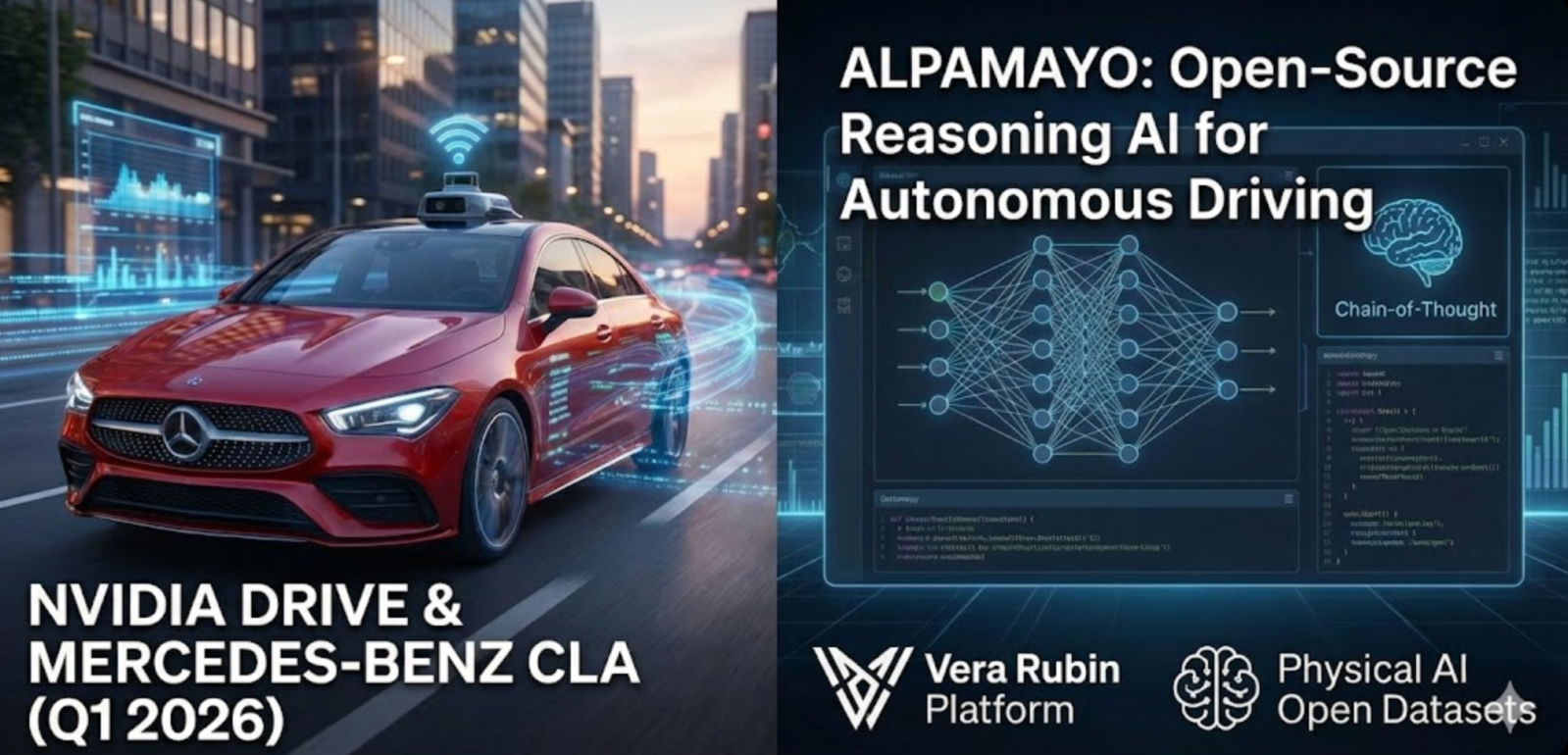
Nvidia (NVDA) held its CES 2026 keynote today, and as expected, Jensen Huang dropped a massive amount of news on the autonomous driving front. The biggest takeaway? Nvidia is moving beyond just “perceiving” the road to “reasoning” about it with a new family of open-source models called Alpamayo, which will power new autonomous and driver-assistance features.
Starting with Mercedes-Benz as soon as this quarter.
Here’s the breakdown of everything Nvidia announced for self-driving technology today.
The ‘Alpamayo’ Reasoning Model
Nvidia is calling this the “ChatGPT moment for physical AI.”
The company unveiled Alpamayo, a family of open-source AI models designed to solve the “long tail” problem of autonomous driving, those rare, weird edge cases that usually cause self-driving stacks to disengage or fail.
The flagship is Alpamayo 1, a 10-billion-parameter Vision-Language-Action (VLA) model. Unlike traditional AV stacks that just detect objects and plan a path, Alpamayo uses “chain-of-thought” reasoning. It processes video input and generates a trajectory, but crucially, it also outputs the logic behind its decision.
Jensen Huang explained that the model can “think through rare scenarios” and explain its driving decisions.
To sweeten the deal for developers, Nvidia is going the open-source route. They are releasing:
- Alpamayo 1 model weights on Hugging Face.
- AlpaSim, an open-source end-to-end simulation framework.
- Physical AI Open Datasets, containing over 1,700 hours of driving data covering complex scenarios.
This is a clear play to become the default “Android of Autonomy” while Tesla continues to keep its Full Self-Driving (FSD) stack completely closed.
Mercedes-Benz CLA: the first with NVIDIA’s new AV stack
We’ve been hearing about the Nvidia-Mercedes partnership for years, but today we got a concrete timeline.
Huang confirmed that the 2025 Mercedes-Benz CLA will be the first production vehicle to ship with Nvidia’s entire AV stack, including the new Alpamayo reasoning capabilities.
- US Launch: Q1 2026
- Europe: Q2 2026
- Asia: Later in 2026
While it’s officially launching as a “Level 2+” system, much like Tesla’s ‘Full Self-Driving’, which in reality is a level 2 driver assistance system as it requires attention from the driver at all times, it appears that the goal is to push toward level 4 capabilities.
Here’s how Mercedes describes the system right now:
With Mercedes-Benz’s MB.DRIVE ASSIST PRO, driving assistance and navigation merge to create a completely new and safe driving experience. At the press of a button, the vehicle can help navigate through the city streets – from the parking lot to the destination – with advanced SAE-Level 2 assistance. Thanks to Mercedes-Benz’s cooperative steering approach, steering adaptions are possible at any time without deactivating the system.
The sensor stack consists of 30 sensors, including 10 cameras, 5 radar sensors and 12 ultrasonic sensors.
The Hardware: Vera Rubin

Powering all this backend training and simulation is Nvidia’s new Vera Rubin platform, the successor to Blackwell. It’s a six-chip AI platform that Nvidia claims is now in full production. While much of this is data-center focused, the “Rubin” GPUs and “Vera” CPUs are what will likely be training the next iterations of Alpamayo that end up in your car.
Electrek’s Take
This is a very interesting move from Nvidia.
Top comment by MorinMoss
"while Tesla continues to keep its Full Self-Driving (FSD) stack completely closed"
who remembers Tesla "all our patents are belong to you" pledge?
The fact that Alpamayo outputs a “reasoning trace” is huge for regulators who are terrified of black-box AI models crashing cars without us knowing why.
The open-source aspect is also brilliant. By giving away the model and the simulator, Nvidia ensures that startups and other automakers get hooked on their CUDA ecosystem. If you can’t build an autonomous system by yourself (which, let’s be honest, most legacy automakers can’t), you now just grab Alpamayo and run it on Nvidia chips.
As for the Mercedes CLA, “Level 2+” that feels like plans to deliver something like Tesla has with FSD without the promise of unsupervised self-driving, something Tesla has consistently failed to deliver despite selling it to its customers since 2016.
If Mercedes actually ships a car in Q1 that can have similar capabilities as Tesla’s FSD, and it is based on an open-sourced system that any automaker can buy, it could shake up the industry and start to commoditize this idea of “level 2+” autonomous systems.


FTC: We use income earning auto affiliate links. More.



Comments