
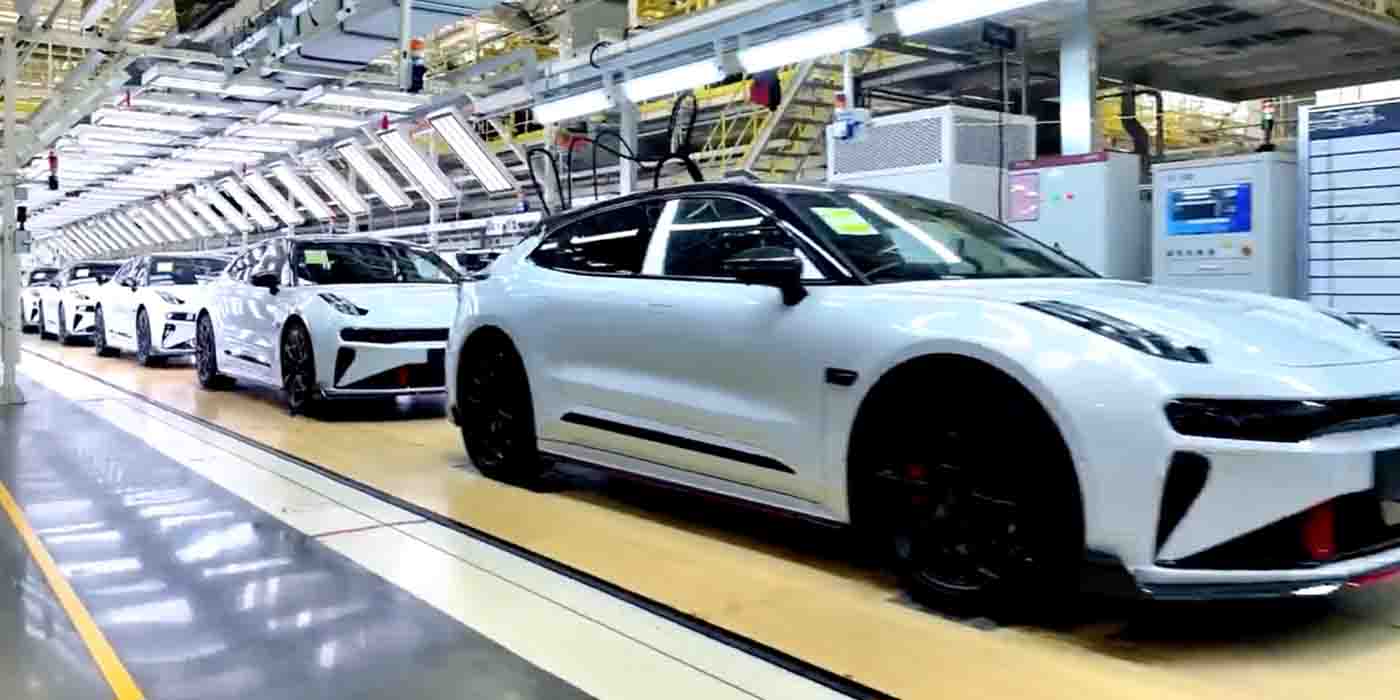
Geely is at CES this week, giving journalists test drives in the Chinese EVs from the various brands it owns. And it dropped a bit of a bomb about its plans to enter the US market, still leaving some wiggle room, but signaling a more concrete intention than we’ve heard yet.
Autoline Network posted a video interviewing Ash Sutcliffe, head of global communications for Geely Holding Group. Geely is a massive Chinese conglomerate, with several brands around the world. Some of those brands are Western brands, such as Volvo, Polestar, Smart and Lotus. It also owns its own homegrown brands, Zeekr and Lynk & Co.
The interesting part about this interview is that it happened at the Consumer Electronics Show, which is currently happening in Las Vegas, Nevada. The interesting thing about Las Vegas is that it’s in America, and in case you haven’t heard, America effectively bans Chinese cars from being imported.
So, what’s Geely doing at CES? Well, they’re getting ready to enter the US market, according to Sutcliffe.
Sutcliffe mentioned that CES has become a primary show for high tech vehicles in the US, so Geely wanted to bring its cars here to let US media have a good look at them. Sutcliffe continued and said Geely is “looking at all global markets where we can expand… the big question for us is when and where will we go to the USA? I think we will have an announcement on that in the next 24-36 months. So, I think its exciting times for Geely Holding Group.”
Notably, Sutcliffe said that an announcement will come within 2-3 years, not that cars would be on the road by then. He specifically brought up Zeekr and Lynk & Co. as potential brands to bring to the US.
When pressed on tariffs, Sutcliffe brushed them aside, stating that Geely is a global company and understands how to work around or work with trade restrictions. He did point out that since Geely is a major shareholder in Volvo cars, its facility in South Carolina would be a natural option for local production. After all, Volvo and Polestar are already producing cars in the US, so bringing Geely cars wouldn’t be a big jump (Lotus also sells in the US, but doesn’t produce here).
Another concern is recent US regulations on Chinese software in cars, but Sutcliffe said that this won’t be an issue: as a global company it’s used to following various countries’ data protection regulations, so it will just do whatever needs to be done to follow those regulations, whatever they may be when the time comes. After all, EU has GDPR, California has CCPA, and so on.
See the full interview on Autoline’s youtube here:
Electrek’s Take
While the interview fell short of telling us about any specific plans for launch dates, it seems clear that Geely has put plenty of thought into this, and an entry into the US market seems likely, if not inevitable. Tariffs were never going to keep Chinese EVs out of the US forever, so we hope the US is ready to pick up the pace and get down to competing (hint: it’s not).
I haven’t had the opportunity to drive a Zeekr or Lynk & Co vehicle yet (though my Electrek colleagues have), but I have driven a few Chinese EVs, and have driven Volvos and Polestars, which both still have largely Western operations despite their Chinese ownership.
And what I, and any journalist or auto industry professional I trust, have found, is that there’s a lot of quality coming out of China right now.
There’s been a long-held belief in America that Chinese products are cheaper, lower quality, and that they merely consist of stolen ideas.
But regardless of whether that was ever true, what’s clear is that it’s not true in EVs. Chinese EVs are good, varied, affordable, and getting better quickly – and they have a lot of their own ideas, too.
The Chinese auto industry is booming, it’s booming because of EVs specifically, and that has catapulted it to being the largest auto exporter in the world, dethroning all the traditional automaking powers which have held the top position for the last several decades.
Meanwhile, Western governments are asleep at the wheel, kowtowing to automaker pleas to let them pollute just a little bit longer. And the automakers themselves fail to grasp trends in their own industry, in a year marked by several automakers ignoring their own sales numbers and doubling down on the shrinking fossil-fueled portion of the market.
I don’t think that’s a recipe for success for the West. Ignoring trends and refusing to adapt has rarely worked well for any company or any industry. And trying to delay the inevitable with tariffs doesn’t work either.
Top comment by CCATX
I hope this is accurate and I hope their timeline remains consistent. I also hope BYD, Xiaomi and others have similar plans. Detroit and Tesla have had their chance. They should no longer be allowed to hide behind tariffs. Innovation and competition are desperately needed in the US when it comes to EVs.
Geely’s pre-announced entry into the US could, and should provide a wake-up call for this nation’s automakers and government. They should have woken up long ago, but now they’ve been given a deadline: 2-3 years and we’re (announcing that we’re) coming for your market.
I’d like to hope the US will take this wake-up call… but let’s be honest, with the type of idiocy we have at the top, currently busy trying to steal a soon-to-be-worthless resource from a sovereign nation, that wake-up call is unlikely to happen until we get some real leadership around here.
There is still an open question as to whether US consumers will accept Chinese EVs, given the high levels of sinophobia in the country. But I think that if the US consumer is provided with high quality and affordable prices, the question will be easily answered. Besides, it’s not like we haven’t seen this before – many of the same things were said about Japanese cars in the 70s, and yet, here we are.
Charge your electric vehicle at home using rooftop solar panels. Find a reliable and competitively priced solar installer near you on EnergySage, for free. They have pre-vetted installers competing for your business, ensuring high-quality solutions and 20-30% savings. It’s free, with no sales calls until you choose an installer. Compare personalized solar quotes online and receive guidance from unbiased Energy Advisers. Get started here. – ad*


FTC: We use income earning auto affiliate links. More.



Comments