
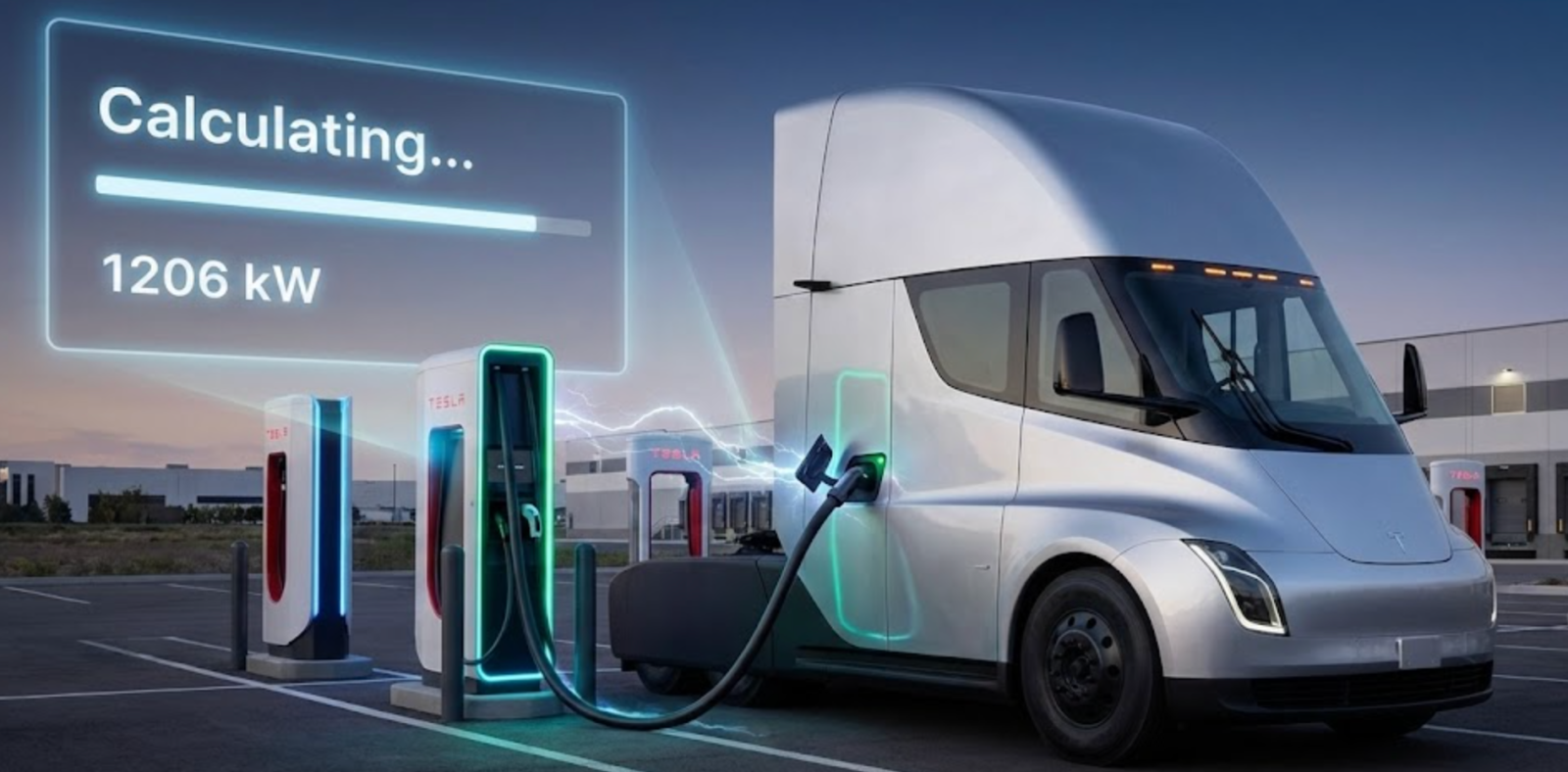
Tesla has released a new video showing a Tesla Semi truck charging at a massive 1.2 megawatts (MW), finally giving us a clear look at the charging speeds that will enable long-haul electric trucking.
For years, we have been waiting to see the “Megacharger” in action. While Tesla has delivered Semi trucks to partners like PepsiCo, who have been using them for real-world routes, detailed data on the charging performance has been somewhat scarce.
We knew the target: Tesla claimed the Semi would be able to charge 70% of its range in 30 minutes. For a truck with a 500-mile range and an estimated battery pack of around 800-900 kWh, that requires an incredibly high power output, well beyond the 250 kW or even 350 kW we see on passenger EVs in North America.
Today, the official Tesla Semi account on X released a video showing exactly that.
In the video, Tesla engineers are seen monitoring a charging session where the power output climbs to a peak of 1.2 MW (1,206 kW):
This is consistent with the capabilities Tesla announced for its new V4 Cabinet architecture earlier this year. The V4 cabinets are designed to support 400V-1000V vehicle architectures and can deliver up to 500 kW for cars (like the Cybertruck) and up to 1.2 MW for the Semi.
There is some information missing from the video. For example, we don’t see the state-of-charge of the truck, so we don’t at what battery percentage Tesla Semi can achieve and maintain this charge rate.
Peak speed is one thing, but sustaining that power without overheating the pack or the cable is the real challenge. The liquid-cooled charging cable and the immersion-cooled connector (part of the Megawatt Charging System or a high-power proprietary Tesla solution, though Tesla has been leaning toward MCS compatibility) seem to be doing their job.
At 1.2 MW, you are adding approximately 20 kWh of energy every minute. If the Semi indeed has an ~850 kWh pack (based on the 1.7 kWh/mile efficiency rating Tesla has touted), this charging speed theoretically allows a 10-80% charge in under 45 minutes, provided the curve doesn’t taper too aggressively.
This comes just as Tesla is gearing up for volume production of the Semi at its new factory expansion near Gigafactory Nevada. The automaker is targeting a start of production in the first half of 2026 and a ramp up to volume production in the second half.
Electrek’s Take
When Tesla first unveiled the Semi back in 2017 (yes, it has been 8 years), the biggest skepticism from the trucking industry wasn’t about whether the truck could move a trailer, electric motors have plenty of torque. It was about the downtime.
Diesel trucks can refuel in 15 minutes. If an electric truck takes 2 hours to charge, it kills the economics for many logistics operations. But if you can hit 1.2 MW and get 400 miles of range back during a mandatory driver break (which is usually 30 minutes in the US after 8 hours of driving), the equation changes completely.
1.2 MW is an insane amount of power, but to be fair, it is not exactly unprecedented.
In China, some passenger electric cars can now charge at 1 MW.
But it’s great to see Tesla finally showing the receipts on this. We’ve seen the trucks on the road, we’ve heard the feedback from PepsiCo drivers who love the regenerative braking and the power, but the charging infrastructure was the missing piece of the puzzle.
Now, the question remains: how fast can Tesla deploy these Megachargers? The V4 cabinets should make it easier since they are modular, but getting 1.2 MW connections from utilities at truck stops across the country is going to be a massive grid challenge.
I think Tesla is going to rely increasingly more on its own batteries to handle these impressive peak charge rates.


FTC: We use income earning auto affiliate links. More.




Comments