

Its solid-state batteries are already showing promise with real-world tests delivering over 745 miles of range on a single charge. Now, Factorial Energy is going public as it aims to bring the promising new battery tech to market as soon as 2027.
Factorial Energy to accelerate solid-state EV battery tech
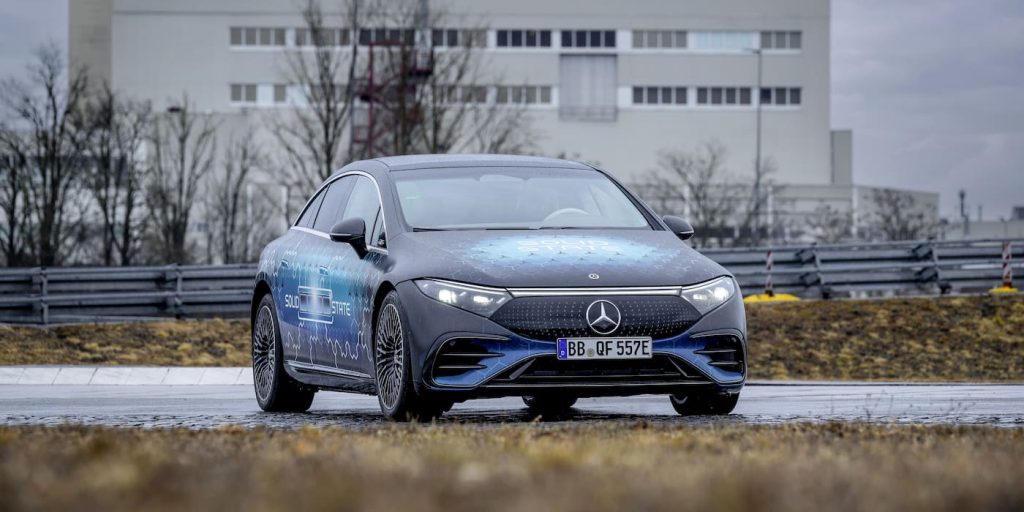
A modified Mercedes EQS, fitted with solid-state EV batteries, drove over 745 miles (1,200 km) without stopping in September. And it still had some charge left.
The battery cells that Mercedes is already calling “a true gamechanger” were supplied by US-based solid-state specialist, Factorial Energy.
Factorial is working with Mercedes-Benz, Stellantis, Hyundai Motor, and other major OEMs to commercialize the promising new battery tech.
The batteries may be in vehicles sooner than expected. Factorial is planning to tap into the public markets to fund its next growth stage through a business merger with Cartesian Growth Corporation III.
Cartersian III is a special-purpose acquisition company, or SPAC, designed as a blank-check company to acquire a business for listing on a public stock exchange.
Factorial’s CEO, Dr Siyu Huang, called the agreement “a pivotal inflection point” as it transitions from the lab to real-world testing and commercialization. “We’ve proven our solid-state platform delivers what customers want – longer range, lighter weight, and greater cost efficiency,” Huang said.
The battery cells have been proven on public roads, as seen in the Mercedes EQS equipped with Factorial’s 106 Ah cells.

Jeep and Ram maker Stellantis verified 77 Ah cells in lab testing, “demonstrating high energy density, fast charging, and robust performance across temperature extremes.”
Outside of electric vehicles, Factorial plans to offer solid-state battery cells for other markets, including defense, aerospace, and robotics.
The proposed merger is expected to close in mid-2026. Once closed, the company will list on the Nasdaq exchange under the ticker symbol FAC. The merger values Factorial at about $1.1 billion, and provides the company with $100 million to fund growth.

Top comment by BetterFuture
Stay away from SPACS. The only people who make money are usually the ones that issue the spac. Legitimate companies will go the IPO route.
From Gemini:
Statistically, most "De-SPACs" (the companies after they merge) have performed poorly.
Post-Merger Losses: In 2021 and 2022, many companies that went public via SPAC lost 60% to 70% of their value within a year.
Selection Bias: Companies that choose the SPAC route are often those that might not survive the rigorous "roadshow" and due diligence required for a traditional IPO.
A traditional IPO requires a high level of SEC scrutiny and "price discovery" where the market determines the value. In a SPAC, the valuation is negotiated privately between the sponsor and the target company. This often leads to "hype-based" valuations that don't hold up once the company starts trading as a public entity.
During an interview with The New York Times, Huang said Factorial’s batteries could be powering EVs as soon as 2027. According to Huang, they will likely launch in high-performance or luxury models at first, such as the Dodge Charger Daytona, before becoming more widely available.
Factorial is not worried about US automakers, such as Ford, pulling back on EV plans, because it believes new battery technology will help boost adoption.
“The existing battery is not big enough and it’s not light enough, it’s not efficient enough,” Huang said during the interview, adding that “there needs to be a next generation to address the issues that our U.S. consumers are facing.”
Are Factorial’s solid-state EV batteries the answer? That’s what the battery specialist is banking on.


FTC: We use income earning auto affiliate links. More.


Comments