
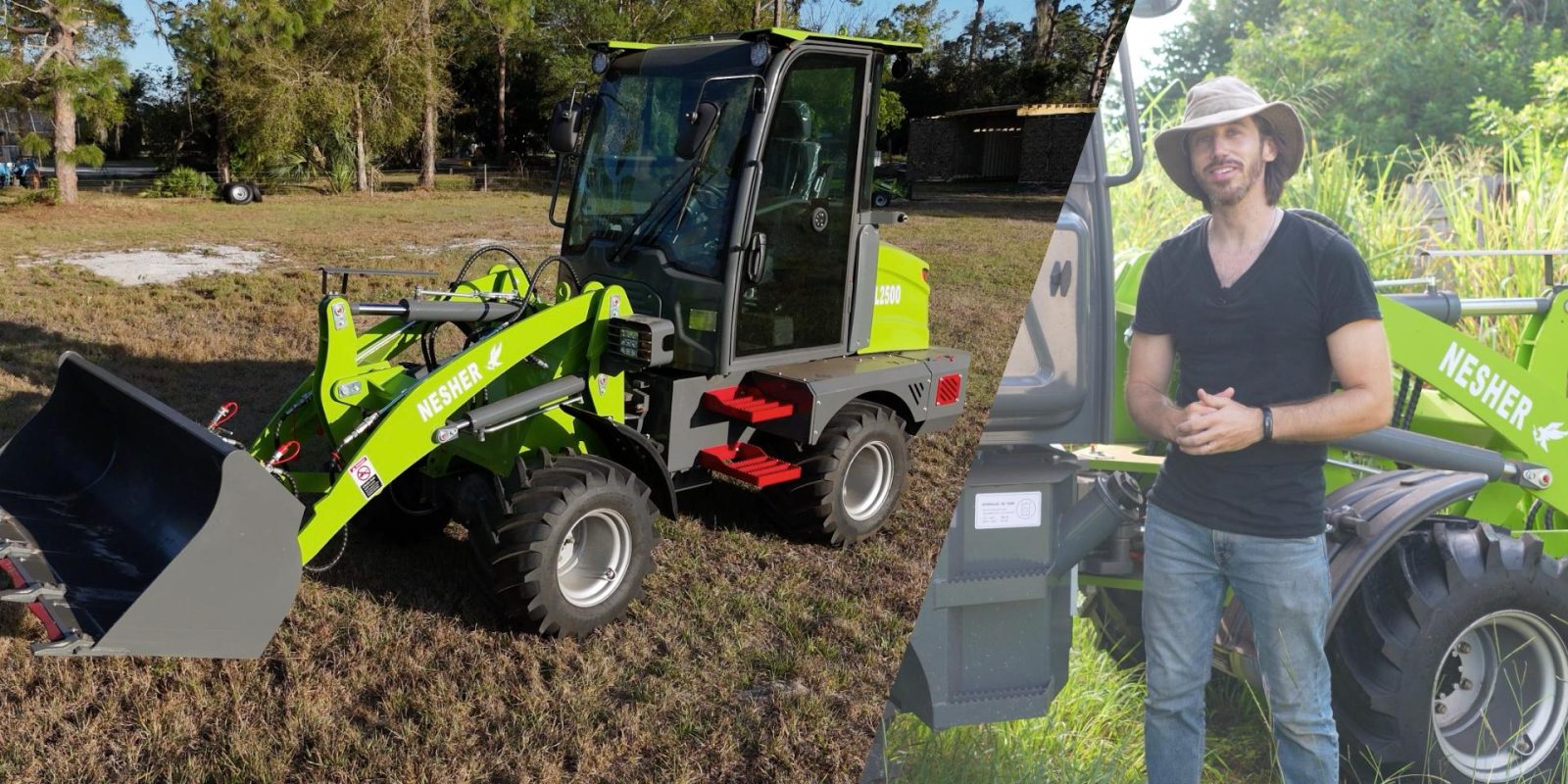
When a 40-foot container rolled up to my property and the doors swung open, I finally got to meet a machine I’d only last seen half-finished on a factory floor in China. Sitting up front, nose practically pressed against the container doors, was my new 10,000-plus-pound (4,700 kg) electric tractor: the NESHER L3000 wheel loader.
Technically, it’s part of a class known as articulating front loaders, a subset of the broader tractor family, and not a farm tractor like you may have seen before (though I’m working on a farm tractor!).
But if you need to lift, pull, drag, grapple, dump, drill, or dig things around your property, this is what these types of machines were made for.
And as wild as it was to see that giant electric machine roll down the ramps, it turns out that wasn’t the only “new toy” I got.
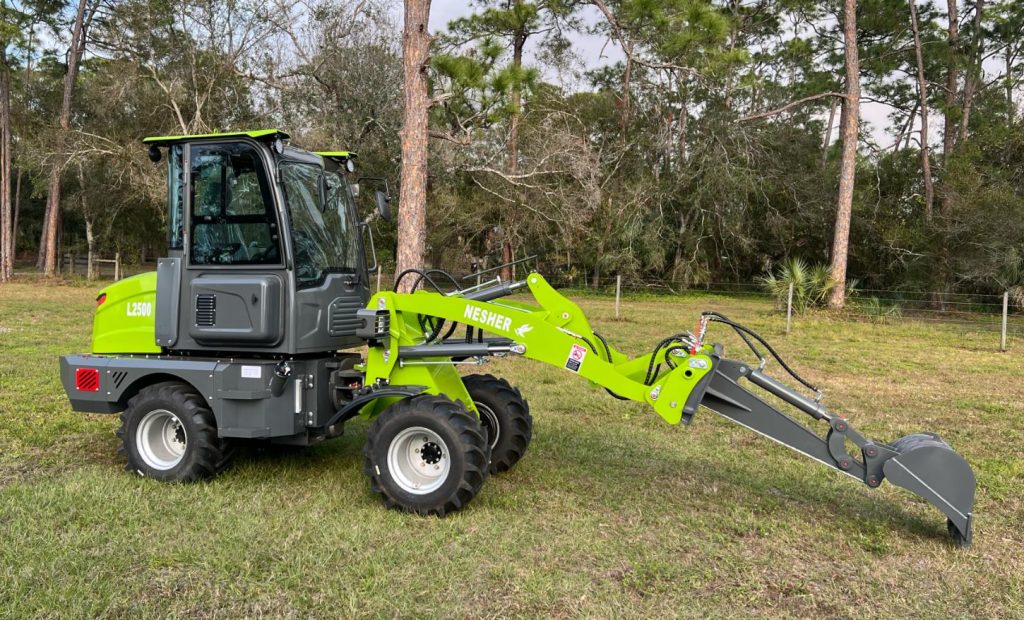
Soon after the arrival of the big guy, I had a second surprise to unload: a slightly smaller, much more approachable NESHER L2500, tipping the scales at a more manageable 6,400 lb (2,900 kg).
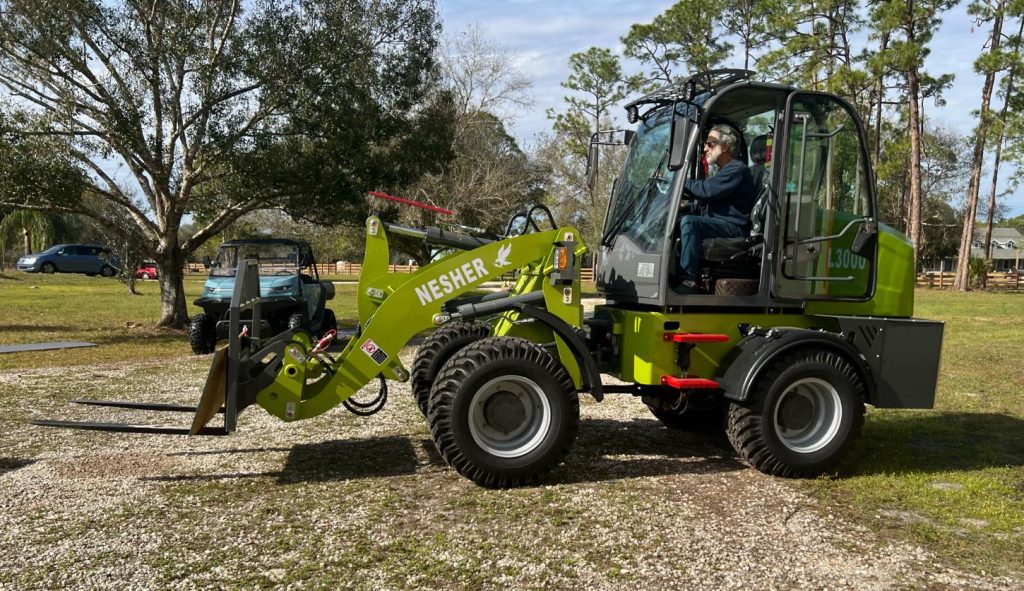
Meet the 5-ton lb NESHER L3000
Unloading these things and getting to know them well has been an incredibly fun process, and one that I love getting the chance to share in videos and articles like this one.
The L3000 is the biggest machine I’ve ever brought into the NESHER lineup, and it’s very much a “because we can” kind of loader. It’s rated for a 3,000 lb (1,360 kg) lift capacity (and it’s underrated), but that stat doesn’t really hit home until you see what that looks like in real life.
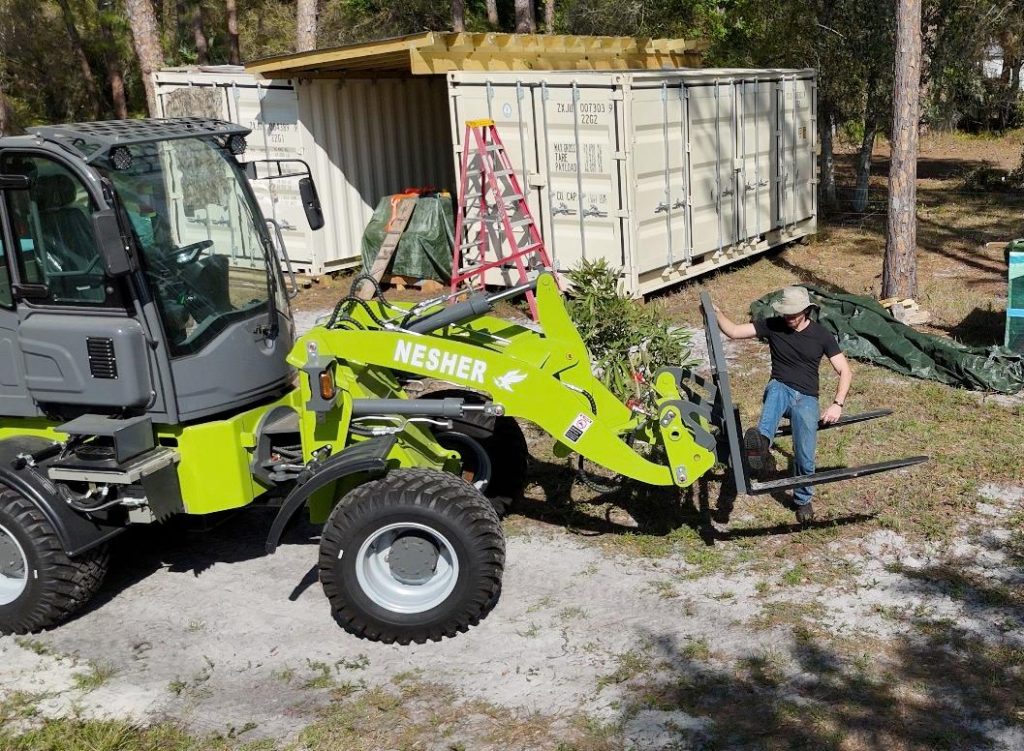
Right away I put it to work moving all sorts of heavy equipment around the property, from lifting a wooden shipping crate with an entire mini-excavator inside, to carrying around a full-size golf cart in a steel shipping crate as if it was a grocery bag, to even pushing shipping containers around the property and into position (I’ve been welding on roof structures between them to create some nice covered parking).
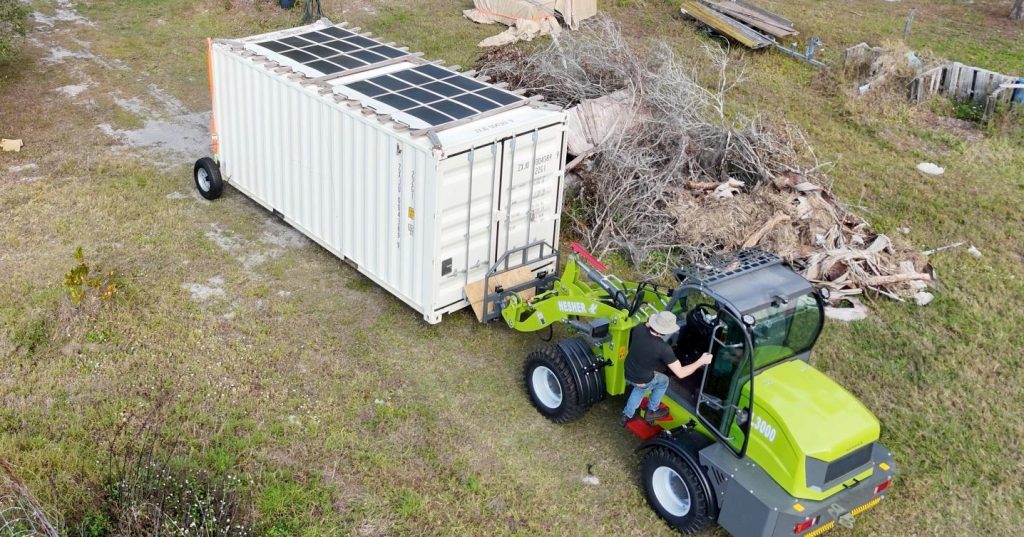
That last one is the moment you really feel the mass working in your favor. A 10,000 lb electric machine has the kind of traction and grunt where you barely notice the load. A tiny press on the accelerator and heavy objects just start moving.
I used a set of EZYwheels on one end of a shipping container and simply lifted the other end using the L3000’s pallet forks, allowing me to push and pull a roughly 5,000 lb (2,250 kg) solar shipping container that I built last year around a grassy pasture as if I were playing with toy cars in a sandbox.
We even used it to right a tree that had blown over in the last hurricane, but was still alive and lying on its side. Without the slightest protest, the L3000 pulled it vertically and let us get some bracing under it so the root structure could regrow and anchor it back the way nature intended.
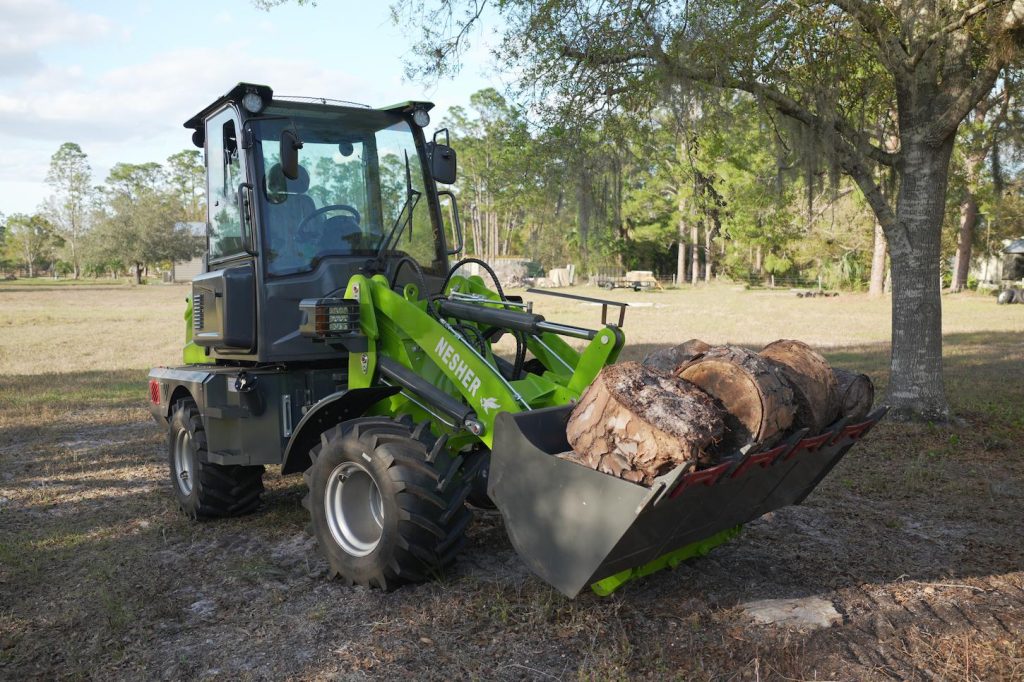
Under the floorboards is a 40 kWh AGM battery pack, good for around 6 hours of typical use on a charge. This isn’t meant for 12-hour highway construction shifts… it’s designed for landowners, homesteaders, small businesses, and anyone with a list of jobs that can be knocked out in a few focused hours.
Charging is fairly straightforward and designed to be done anywhere: it uses standard North American 120VAC outlets, with twin onboard chargers to feed that big pack from a pair of household circuits overnight. The onboard chargers can accept 240V, but the 120V option allows for Level 1 charging anywhere a typical electrical outlet can be found.
I get a lot of questions about batteries, and one reason I liked the AGMs over lithium iron phosphate batteries is the ease of future work. While not rivaling LFP charge cycles, these should last for many years (my oldest NESHER tractors are around 2.5 years old and showing very minimal battery degradation), but when the batteries do eventually need to be replaced, AGM modules can be found much more easily and from local suppliers, even big box stores like Tractor Supply or Home Depot. They can also be removed one pack at a time by a single (strong) individual. Other advantages include better cold-weather performance without needing battery heaters, extra weight that serves as ballast and increases the lifting capacity of the machine, and lower total vehicle cost. Of course there are different unique advantages to LFP batteries, and like everything in life, there are tradeoffs, but this seems to be a good balance so far in our experience.
But wait… there’s a “smaller” one too
As fun as a 10,000 lb loader is, it’s honestly more machine than a lot of people want to maneuver around their property. That’s where my second new arrival comes in.
This smaller beast, my NESHER L2500, is rated for a 2,500 lb (1,140 kg) lift but weighs in at roughly 6,400 lb (2,900 kg). On paper, that sounds like a small step down from the L3000. In practice, it feels like a different category: more compact, more nimble, and more approachable for someone who doesn’t want their “yard tool” to weigh nearly as much as a school bus. It’s also even quieter than the L3000, as it uses a dedicated electric motor on each axle instead of a larger mid-mounted motor with dual drive shafts like the L3000.
Between the two, I actually prefer it. The machine has nearly as much capability, but is around 1/3 lighter and thus easier to maneuver and operate.
We’ve already used the L2500 for some creative jobs around the place. At one point, my dad and I basically turned it into a freight elevator, raising an old couch more than 10 feet up to a mezzanine of his shop. Another day, we used it to drag a massive tree trunk out of a pond after a hurricane turned that long-leaning tree into a floating navigation hazard. The loader treated that water-logged tree trunk like a toothpick.
The L2500 shares the same concept as the bigger machine: enclosed cab and heater, around 6 hours of use from a 25 kWh battery, easy residential charging, and enough lift and pull to make most homesteader and small farm tasks feel trivial. For a lot of people, this is the sweet spot. And in fact, I actually prefer it at this size. The L3000 is fun but more machine than most people need. The L2500 seems like the best balance of power, size, and value.
Attachments turn them into Swiss Army tractors
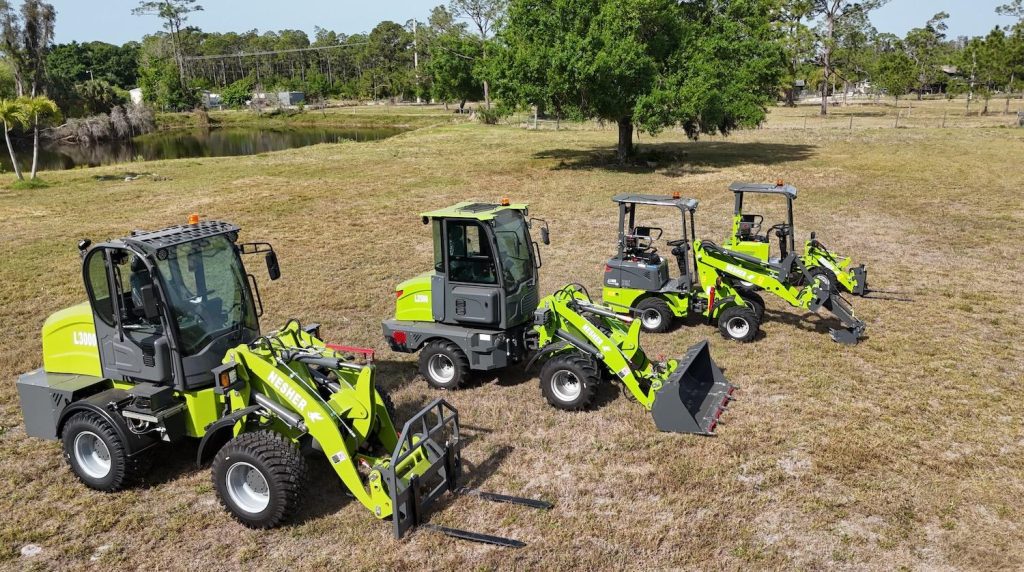
All of the loaders use quick-hitch front attachments, which is where things get fun. From the operator’s seat, you can drive up to a bucket, drop it, roll right into a pallet fork, and latch it without climbing down every time.
For attachments with their own hydraulics, like augers, grapples, and the excavator-style digging attachment, you do still have to hop out to connect hoses, but the tradeoff is big. With the excavator attachment on the larger loaders, you can dig down around 6 feet (nearly 2 meters). That’s a major upgrade compared to my smaller NESHER machines that give closer to about 3.5 feet (around 1 meter) of digging depth from their excavator attachments. That covers a surprising amount of real-world work: laying pipe, planting trees, digging drainage, and shaping land.
That’s the real magic with these: you don’t need separate dedicated machines for every task. One electric loader, a handful of attachments, and suddenly you’re lifting shipping containers, pulling trees upright, digging trenches, moving mountains of dirt or mulch, and doing oddball jobs you never expected to do with a conventional tractor.
Why go electric for heavy equipment?
Regular Electrek readers will already know the big advantages of going electric, and our own Jo Borràs has often covered some of the most interesting new additions to the world of electric heavy equipment from trucking to tractors to tools, but electrification is still a niche part of the industry.
And while I’ve talked a lot about what these machines can do, a question I still often get from curious neighbors and onlookers is, “Why electric?”
Part of it is maintenance. A diesel loader has a lot of ways to ruin your day: fuel system, injectors, emissions equipment, warm-ups, oil changes, filters, and so on. An electric drivetrain is basically a cordless drill scaled up: battery, motor, controller. The maintenance you do have – hydraulic oil, greasing the joints – is for the mechanical bits, not the engine. The powertrain, historically the worst part of owning any vehicle, just quietly works.
Then there’s sound. When you’re walking around an electric loader, you hear your own footsteps in the dirt as much as you hear the machine. You can talk to someone standing nearby without shouting over a clattering diesel engine. As the operator, you can talk to your crew or your family members in the yard without needing walkie-talkies. The reduced noise means you can even work around animals and livestock without spooking them. I can work right alongside the cows in my family’s pasture without bothering them. It’s just a calmer experience.
Health is another big one. If you spend hours a day sitting a few feet from a diesel tailpipe, that exhaust is going into your lungs. Diesel particulates are not something you want to marinate in for years. Electric loaders eliminate that constant stream of fumes.
And of course, there’s the environmental angle too. If you’re working the land because you love it and want to live with it, not just from it, then it feels a little odd to be coating it in exhaust and oil. Electric loaders don’t drip fuel, don’t belch smoke, and don’t add to greenhouse emissions the same way, especially if you’re charging from clean energy.
Final thoughts
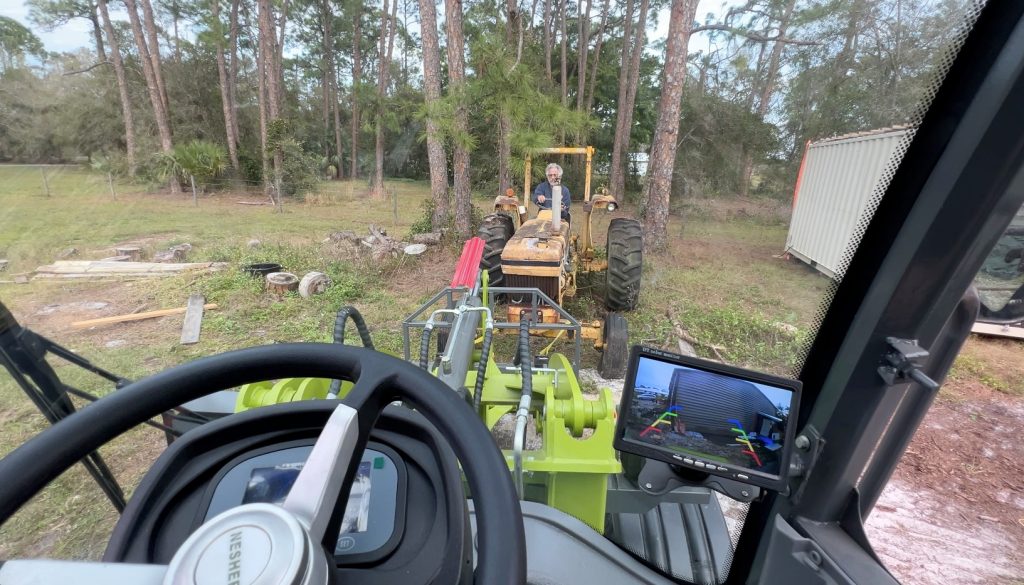
I’ve talked at length about this process before, but for those who may be new around here, allow me to provide full disclosure: these are my machines. I helped design them, I walk the factory floor where I build them in China, I import them, I maintain the local spare parts warehouse, I wrote the operator’s manual, and I spend a ridiculous amount of time thinking about how to make electric machinery like this more accessible to average folks who want to manage their land instead of just for large contractors and businesses who can afford the six-figure machines from the big guys.
Top comment by Vanessa
This is quite interesting, the best part for was the last bit where you had the comparison photo and explained what the tools are for, why electric, and why independent farmers and ranchers might appreciate them. City folks like me have no experience with any kind of tractor aside from keeping well clear of the stench and noise. Hand tools are great as electric, and I would never again buy a gasoline mower even if I ripped out my garden to put in a lawn, it’s just so much trouble and so finicky. I imagine farmers have to also be decent mechanics to keep their equipment running, and fussing with them wastes a lot of their time.
Oh and also that this is a business and what your angle is, very important of course we wonder. Are the vehicles selling in China or has anyone copy-pasted them to sell competing tools. Unlike a regular review, if you find some flaw in the product you could fix them!
I’m proud of the work that has gone into getting them to this point, and of the fact that they are starting to become available in more countries (the first NESHER dealer in Canada just opened recently and a few other countries are in the works).
As a society, even a well-intentioned one looking for electric alternatives to replace our polluting legacy machines, we often spend so much time focusing on flashier vehicles, such as electric cars, trucks, and even bikes and scooters, that it’s easy to forget how much diesel is idling away on farms, work sites, and homesteads. Machines like these show that electric isn’t just possible in this space, but that it can actually be better, quieter, cleaner, and easier to live with.
Sure, that big NESHER L3000 loader isn’t for everyone. Most people would probably be better served by the L2500 or even the smaller L1400 or L880. And if you’re running round-the-clock road crews, you’ll still have a diesel fleet for a while, as there aren’t many electric machines that can do 16 or 20-hour shifts yet.
But for the growing number of landowners, small contractors, and homesteaders who want serious capability without the headaches and fumes of diesel, electric loaders are finally becoming a real option.


FTC: We use income earning auto affiliate links. More.


Comments