

I recently attended Strutt’s Demo Day to check out the company’s new EV1 mobility device, and even if you’ve never paid attention to electric wheelchairs before, you’ll still probably find this interesting.
The EV1 isn’t really a wheelchair in the traditional sense. It’s closer to an autonomous robot that just happens to take the form of a chair. Imagine a self-driving car fused with a humanoid robot, shrunk down to indoor-outdoor mobility scale. That’s the EV1. And after having spent some seat time in it, I can tell you that this technology is going to change lives.
This isn’t my normal scene – you’re much more likely to see me testing out wild new e-bikes or powerful electric motorcycles. But I was intrigued by the idea of a new type of electric mobility device that had the potential to change not just the way people get around, but the way they live. And I’m glad I followed that hunch and visited Strutt’s Demo Day.
If you want to experience the demos and live testing yourself, or rather vicariously through me, then check out my video below. It’s a fascinating experience.
Then keep reading for my complete thoughts.
At its core, the EV1 is a mobility device that can drive itself and think for itself. But the level of tech onboard goes far beyond basic autonomy. It uses a full suite of sensors – lidar, vision cameras, ultrasonic sensors, and more – to constantly map its environment.
As the engineers explained to us, it’s actually a much trickier problem to solve than a self-driving car like Waymo, since self-driving cars generally stick to the simplified world of car lanes. But a mobility device needs to be able to autonomously navigate everything from a packed shopping mall to a grassy park path to the livingroom – all without accidentally driving itself down the stairs or over the family dog. That means the EV1 gets an array of overlapping sensors that would make a Tesla jealous.
And despite all that tech, the entire machine breaks down into five major pieces without tools, without unplugging wires, and without any fuss. In about 30 seconds, it’s ready to be lifted into the trunk of a car. Or for those with a vehicle large enough, it can just drive itself up the ramp and park itself in a vehicle all by itself.
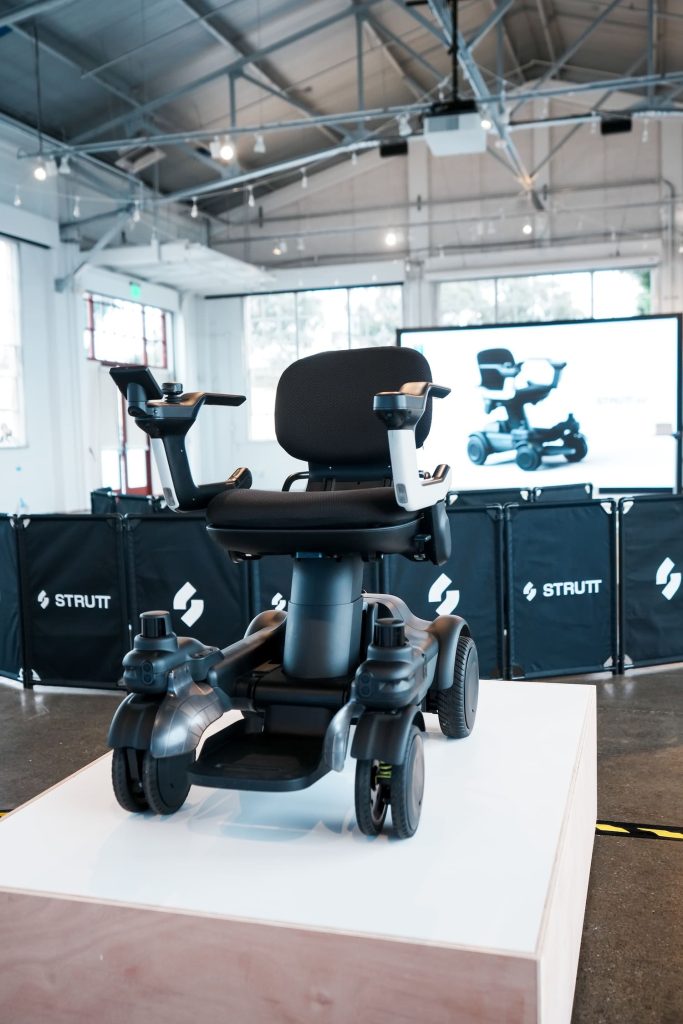
It also includes built-in AI navigation. You can literally tell it where you want to go, like asking it to take you into the kitchen to grab a drink, and it will plan the route and drive you to your fridge. That may sound like a demo-party gimmick until you consider how transformative it could be for people who currently have to navigate narrow, cluttered, or inaccessible spaces by carefully inching forward with both hands on a joystick. Hands-free indoor navigation could be a game changer.
You can even tap a location on the live-view map shown on the display and the EV1 will just start taking you there, completely hands-free. Or you can summon it from another room, for example if you’re sleeping in bed and need the chair to come pick you up in the bedroom. This is autonomous driving on another level.
There’s also a mode called Co-Pilot, which lets the user take control to navigate themselves, but will constantly monitor for obstacles and make corrections if the user is about to hit something. For example, you can drive right through a narrow doorway without worrying about precision steering, since it won’t let you graze the edges of the door frame (and if you’ve ever seen the doorframes in the home of a wheelchair user, you’ll know what a game changer that would be).
Strutt demonstrated this mode by having a user blindfolded while driving through a curved hallway. He was simply pressing forward on the controls, but the EV1 smoothly followed a curved path on its own instead of letting him run into the wall when it began to curve. I tried it myself, and it’s uncanny how natural it feels.
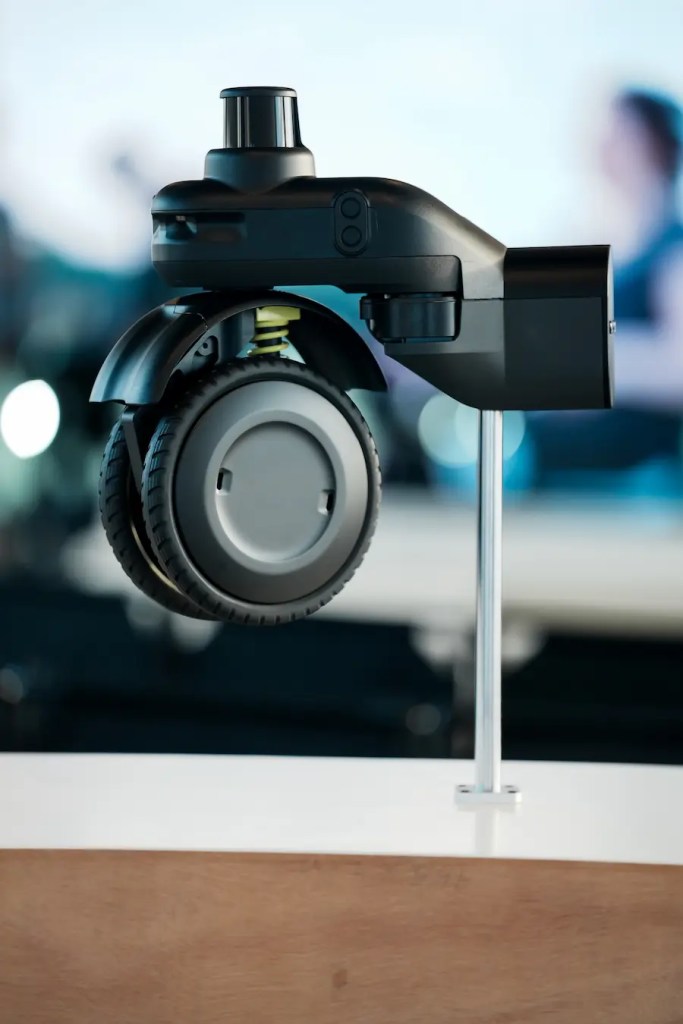
But the EV1 isn’t limited to indoor environments. Strutt built in several clever innovations that make it surprisingly capable off pavement. There’s real suspension. The front wheels are actually dual wheels, helping them roll over gaps and rails such as those found in city trolley systems. Those same front wheels aren’t passive casters; they each have their own motors, giving the EV1 proper power steering instead of relying on tank-turning from the rear wheels. It drives like something purpose-built rather than hacked together. And that allows it to handle terrain and inclines not possible from other devices, such as off-camber turns that would send others sliding sideways down an incline.

During the demo, I asked if I could take the EV1 outside the fancy exhibition hall to see how it handled the real world. As I approached the door, trying to figure out how to open it while driving through at the same time, one of the Strutt staff told me, “Just ram it.”
I hesitated, worried I’d scratch up their expensive prototype, but he assured me it would be fine. Turns out, it was very fine. Then I remembered the clip in the presentation they shared of the EV1 towing a Tesla with a tow strap, so I guess the power was never really going to be an issue.
Speed-wise, Strutt had the units limited to 12 km/h (7.5 mph), but even at that speed they feel legitimately fast. Fast enough, in fact, that I switched into manual mode to really get a feel for it.
With a bunch of YouTubers flying around in fancy electric mobility devices, you can imagine that a drag race pretty quickly materialized. I won’t tell you who won, you’ll have to watch the video above to see. But let’s just say that my putting it in manual override mode to remove all the safety features temporarily might have been a dirty trick that gave me an advantage.

All the while, though, I found myself ping-ponging emotionally. On one hand, I’m having a blast riding a futuristic robot-chair hybrid. On the other hand, I’m constantly reminded that for many people, devices like this aren’t toys – they’re essential tools that allow them to navigate a world that wasn’t built for them. Many of the very people who helped Strutt beta test the device during development were there at the presentation, EV1), it was also a stark reminder that while I’m goofing off racing these things, this is technology meant to help people that need it in order to navigate a world not designed for them.
But maybe those two feelings don’t have to be in conflict. Why shouldn’t a device that empowers people also be enjoyable to use? Why can’t a life-changing device like this bring more than just mobility? Why can’t it actually be… fun? I’ve never looked at a mobility chair and thought it looked like a blast to use. This one genuinely is!
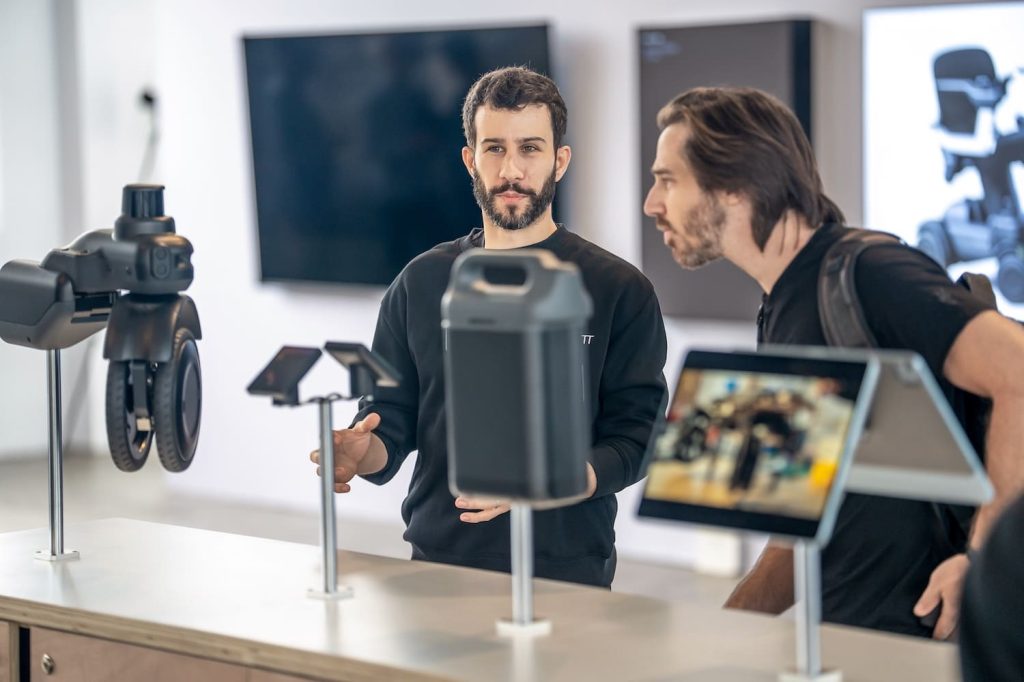
But the last bit here that will be critical, and something we just don’t yet know yet, is what it will cost. Considering traditional powered wheelchairs already run a few thousand dollars for relatively clunky designs, this level of advanced robotics likely won’t come cheap.
Strutt says pricing will be revealed early next year, and has just launched an early reservation program offering 35% off the first 200 units (more info in their Facebook group here). Hopefully the final price ends up within reach for the people who most need it. And like many early-stage technologies, costs will likely come down over time as production scales.
For now, though, the EV1 represents something new in mobility: a device that’s powerful, capable, intuitive, and – unexpectedly – pretty darn fun.


FTC: We use income earning auto affiliate links. More.


Comments