
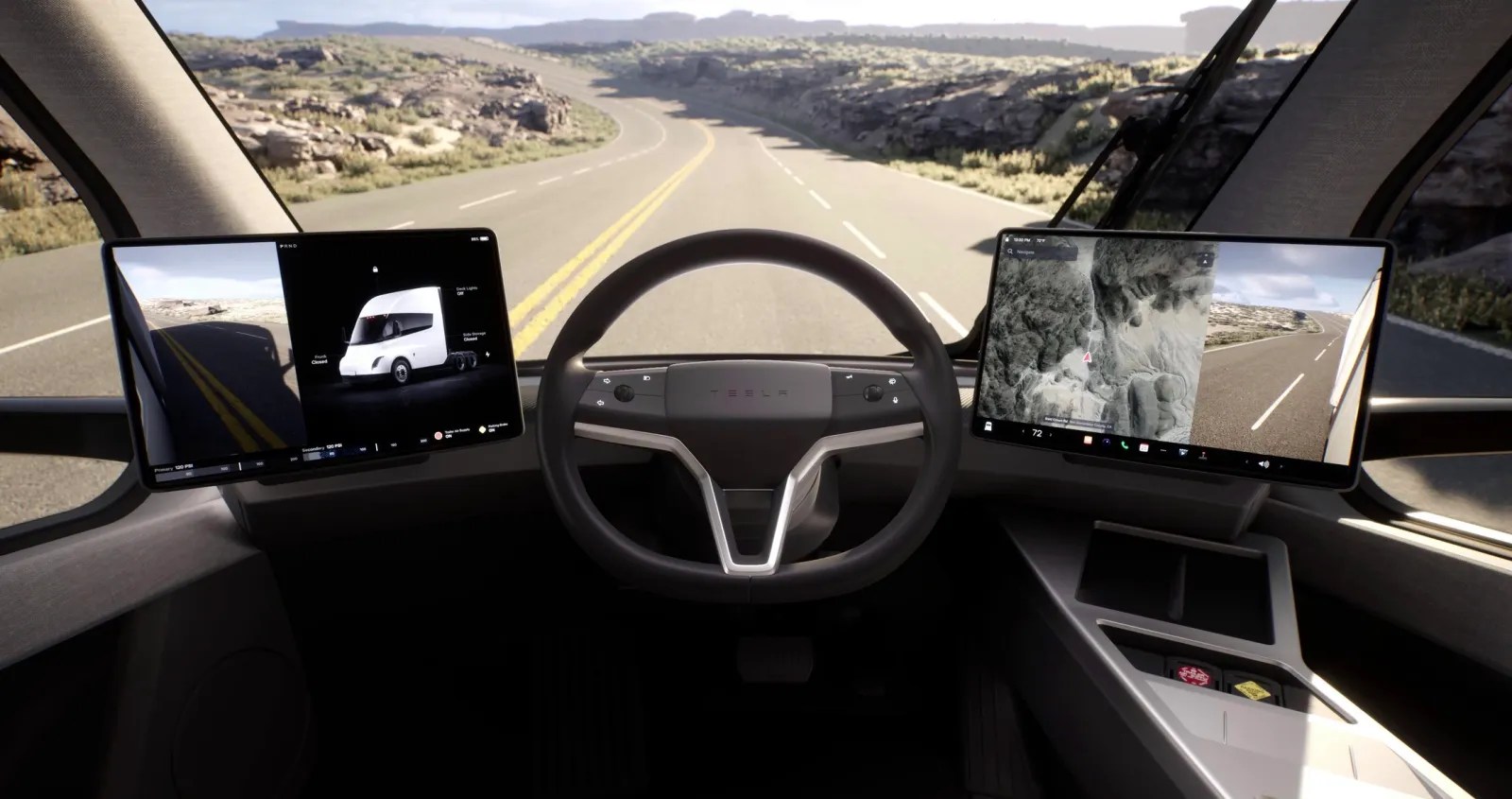
Tesla is quietly but significantly expanding its Tesla Semi sales team, bringing on two seasoned veterans from the electric trucking industry as the company prepares for volume production at Gigafactory Nevada.
Tesla Semi is arguably the company’s most delayed vehicle program ever, and we recently reported that production was again delayed into 2026.
However, it does look like Tesla is getting closer to actually selling those electric trucks.
Electrek has learned that Tesla has recruited Mac Burns and Jason Gies to key roles within the heavy trucking division.
The hires signal a shift in Tesla’s strategy for the Semi. For years, the program has been relatively small, focusing on pilot programs with major partners like PepsiCo. Sales were largely handled directly at a high level. Now, Tesla appears to be building a more traditional, robust sales infrastructure, and it is recruiting from competitors in electric trucking.
Jason Gies has joined Tesla’s Business Development team for the Semi program. Gies is a true veteran of the heavy trucking industry. Most recently, he served as Head of Operations for North America at Windrose Technology, which is likely Tesla Semi’s biggest competitor, and its truck frankly looks quite a bit like the Tesla Semi.
Before Windrose, Gies spent years at Navistar Inc. (International Trucks) and ABB E-mobility, giving him a deep understanding of both the legacy diesel world and the charging infrastructure challenges that electric fleets face.
Mac Burns has also joined Tesla’s new business dev team for the Tesla Semi program. He joins Tesla after serving as Director at Lightning eMotors, a company known for repowering commercial vehicles and building electric fleets. Before that, Burns was a Regional Sales Director at Proterra, the electric bus manufacturer.
He also briefly worked for Xos Trucks, another electric truck manufacturer.
Electrek’s Take
It does look like Tesla is getting serious about starting to sell the Tesla Semi – 8 years after originally unveiling the vehicle, 6 years after it was supposed to go into production, and 2 years after Tesla falsely claimed it was entering production.
While I have been critical of the slow rollout of the Semi, hiring people like Gies and Burns shows that Tesla is getting serious about the “sales” part of the equation.
However, there’s one thing that you should notice from this article. Tesla is hiring from the competition. That’s because there is plenty of competition in the electric trucking space now. A lot more than when Tesla was initially supposed to launch Tesla Semi.
Nonetheless, I think that Tesla has a scale advantage over many competitors and it is a bit more ambitious in the capacity of the Tesla Semi than some other companies.
Top comment by Jilles van Gurp
Also, while there’s already competition, I think the market will grow faster than production.
That's the key point. Electrical trucks are basically hitting the sweet spot where life time TCO for vehicle owners is probably going to be cheaper. Short term with the help of subsidies. But long term it's basically going to be exactly like regular EVs: no diesel cost, some electricity cost (depending how you source it), less maintenance cost, and eventually also less vehicle cost (not short term obviously). This is going to be driven by spreadsheets, not by public opinion/emotions.
Selling these things is not going to be the issue. Even at a premium, they are still desirable. This market will grow at the rate production can be scaled.
If Tesla shows up and produces tens of thousands of these (like they promise), they should be able to sell them provided the cost/performance is alright. The prototypes they've shown so far seem to work as advertised. The cost is a big question mark but it's not like the competition is very cheap. And there are a lot of truckers paying a lot for diesel that maybe would like to spend a bit less on that. Tens of thousands $ per year in diesel cost adds up quickly. These things can be expensive and save money. And they don't have to stay expensive.
Also, while there’s already competition, I think the market will grow faster than production.
As we have been highlighting for a while, unlike a large part of the passenger car market, commercial vehicle buyers do care about the cost of operations and electric trucks have a big advantage over diesel counterparts on that front.
I think once it becomes common knowledge that battery-electric trucks can cover most trucking routes at a lower cost than diesel trucks, adoption will skyrocket.
There are still some long-haul trucking routes that battery-electric vehicles can’t support, but the gap will close rapidly as batteries improve and fast-charging infrastructure expands.


FTC: We use income earning auto affiliate links. More.




Comments