
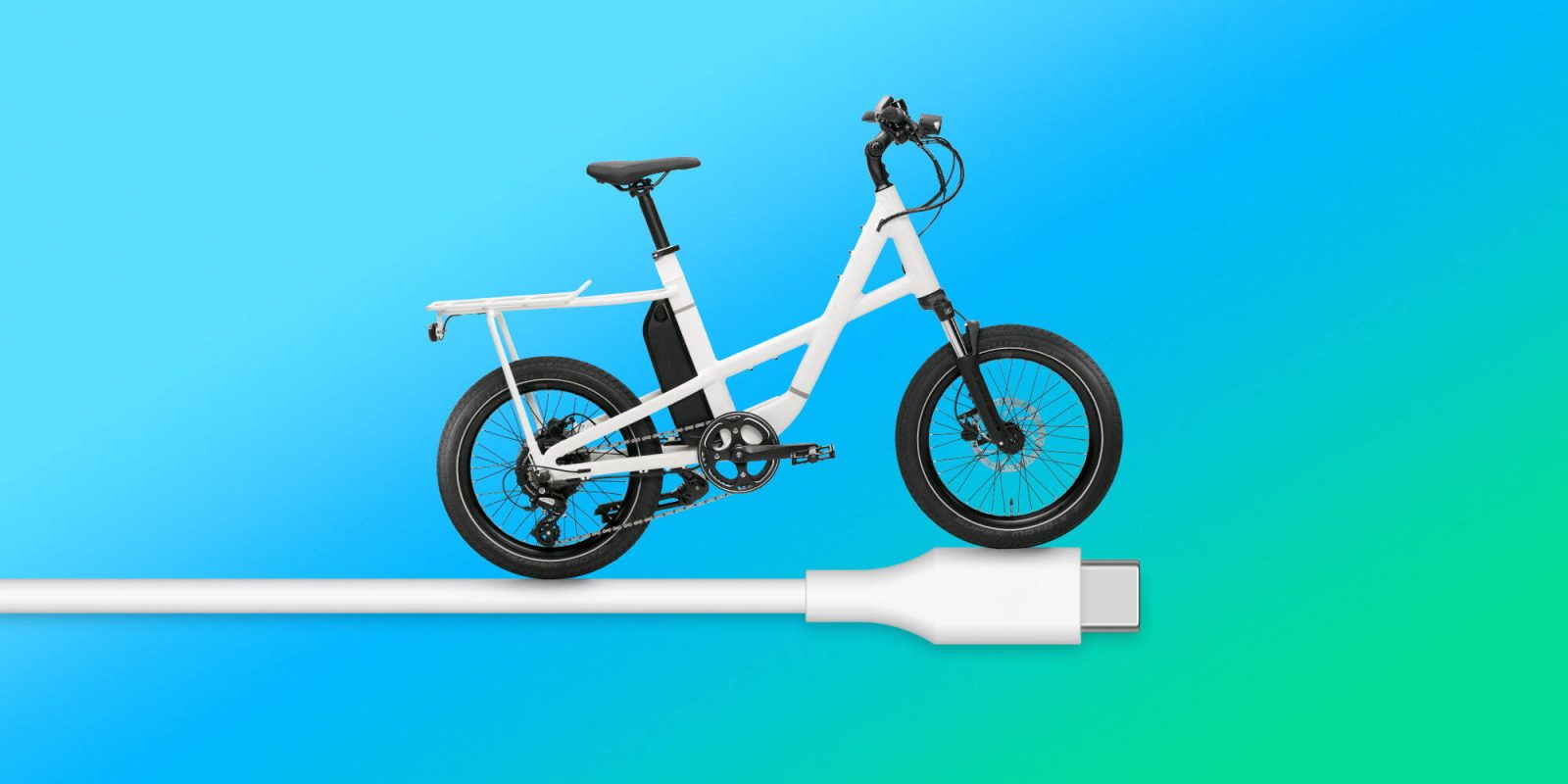
The number of e-bikes that charge via USB-C just doubled. From one… to two.
Rivian’s ALSO e-bike, the company’s new micromobility offering spun out of its automotive division last week, includes a USB-C charging port for its battery – joining Ampler’s Nova, released earlier this year, as the only other known e-bike to embrace this modern charging standard.
Yes, just two. But that tiny number is surprisingly meaningful.
Despite how universal USB-C has become across phones, laptops, tablets, headphones, and now even Apple’s latest accessories, the e-bike industry has remained stuck in a sprawling mess of incompatible barrel plugs, XLR jacks, Rosenberger magnets, proprietary magnetic ports, and other one-off connectors that no two companies seem to agree on. For consumers, that means one more proprietary charger to keep track of – and if you lose it, good luck finding a replacement without contacting the manufacturer directly.
USB-C, on the other hand, could solve this.

Why USB-C on e-bikes could be a game-changer
USB-C is already being used to charge everything from power tools to drones. It’s standardized, widely available, and increasingly required by law (just ask Apple). With the release of USB Power Delivery (PD) 3.1, the spec now supports up to 240W of power at 48V – just enough for many commuter-level e-bikes that charge at around 2 to 4 amps. That’s not going to cut it for ultra-high-power dual-battery fat tire beasts with heavy-duty chargers, but it’s perfect for the kinds of urban mobility vehicles most normal e-bike riders want.
But here’s where it gets interesting: USB-C charging can actually be safer too.
Many e-bike fires today aren’t caused by bad batteries, but by mismatched or incompatible chargers – plugging a 48V charger into a 36V bike, or using a cheap knockoff power brick that over-delivers current. There are safeguards in batteries to prevent this from being an issue, but they only work until they don’t.
By embedding a DC-DC boost converter inside the battery, a USB-C charging system ensures that only compliant power levels are accepted, and all voltage conversion is done internally, under strict control. In other words: you can’t plug in the wrong thing. That’s a serious step toward fire prevention.
Plus, USB-C is a robust, proven port that can be made fully waterproof, and is ripe for a product anticipating UL-compliance – a major hurdle that many e-bike companies have struggled with. Just a few years ago, the 5.5×2.1 mm barrel jack was becoming a de facto standard on value-oriented e-bike batteries, but that faded quickly when manufacturers realized how hard it was to pass UL 2271 and 2849 certifications using such a connector. That actually pushed us backwards towards more fragmentation as e-bike makers adopted a variety of charging connector alternatives that were better suited for UL-compliance testing.
So if USB-C is safer, more user-friendly, compliance-ready, and more compact than the bulky connectors we’ve been using for years, what’s stopping everyone from jumping on board?

What’s the holdup?
Top comment by boomer from germany
Great news, I think standardisation on USB-C is good thing!
However, two caveats:
1) For a bike, there is a higher likelihood that moisture or dirt will get into the USB-C port on the bike than for, say, a laptop. It would be great if the USB-C receptacle could be easily replaced by the User with a standard part in case of contact problems.
2) Manufacturers trying to shave costs off the charging hardware may rely mostly or even entirely on the voltage regulation and current limiting of the Third-Party USB charger 🙁 On the other hand, Third-Party-USB-Charger manufacturers trying to shave costs on the charger could rely mostly or even entirely on the "overengineered" brand name laptop's voltage and current control and safety measures 🙁 Now a cheap Ebike meets a cheap charger: Disaster in 3-2-1 ... !
Supplying 240W over a couple of contacts a lot of people couldn't see without a magnifying glass is a tough task. I think it would be about time to increase safety here, for example by mandating that this power be split evenly between two identical circuits, and shutting the connection off redundantly on both ends if there is a higher resistance and thus exessive power dissipation in one of the wires or connectors, which could easily be detected by a current imbalance.
Power limitations can still be a bottleneck. Sure, at 240W, that’s enough for a large 48V battery charging at 5 amps. But how many of us have a 240W USB-C charger? The charger that came with your laptop is probably a 65W, or maybe a 100W charger if it’s a big laptop. But that’s a somewhat slow charge on a big e-bike battery. And you also need the right USB-C cable to charge at such high power. The frayed mess at the bottom of your backpack may not cut it.
And many manufacturers don’t want to take on the added cost and thermal complexity of embedding a DC-DC converter into the battery housing – especially in a price-sensitive market where shaving $5 from the BOM matters. Add into that equation the fact that most e-bike companies don’t even design their own batteries and you’ve got a system that’s reliant on whatever the major Chinese battery makers end up choosing. And let’s be honest: it’s easier to just keep using the same power brick and charging connector from the last model year.
But ALSO and Ampler are showing it can be done. And as USB-C continues to evolve – with even higher power support likely coming in future revisions of the PD spec – we may look forward to 2026 as the year the e-bike industry finally starts catching up to the rest of the tech world.
At the very least, we’re now up to two.


FTC: We use income earning auto affiliate links. More.


Comments