
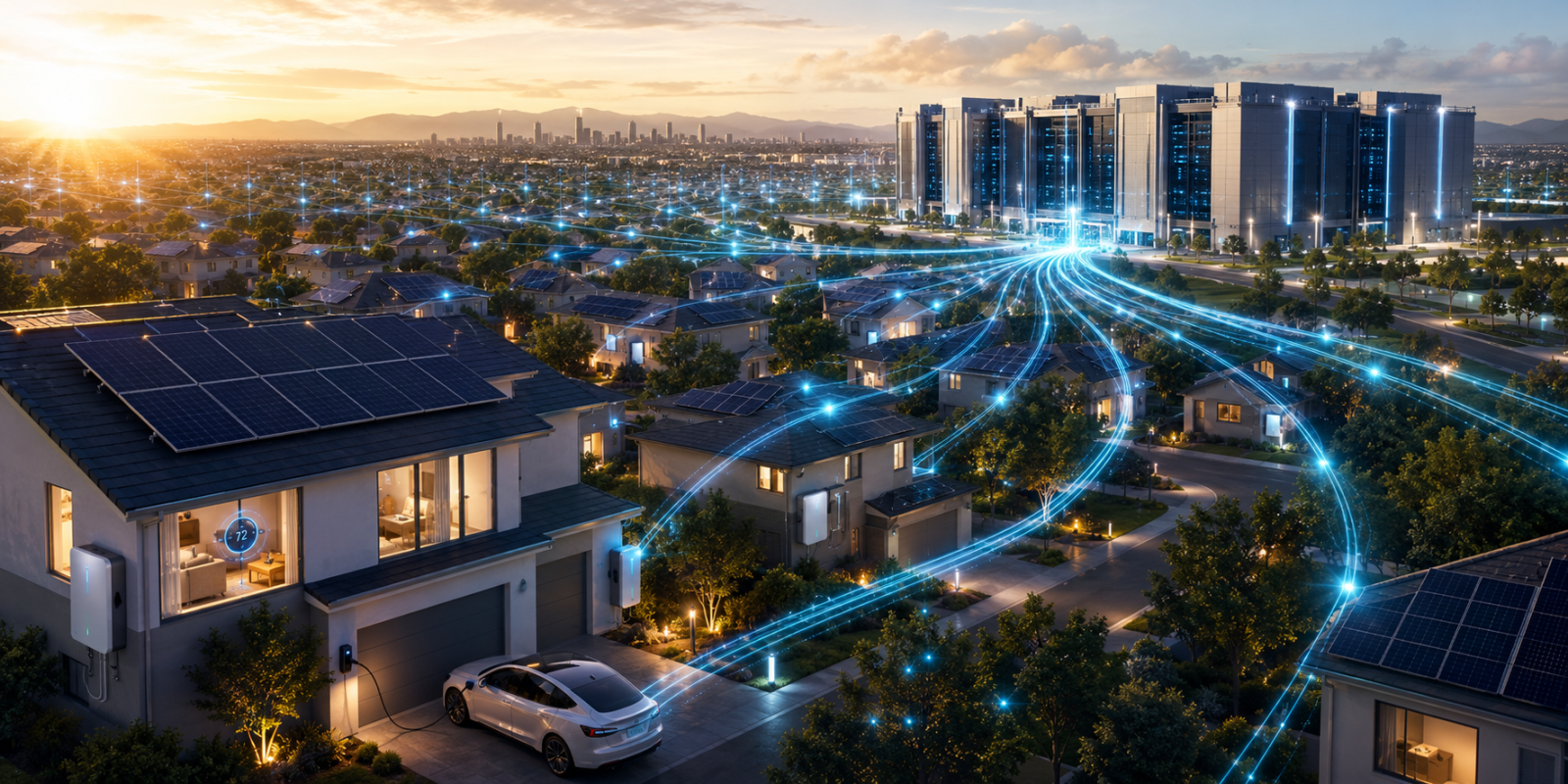
Sunrun, Tesla, and Renew Home announced an agreement today to aggregate more than 16 gigawatts of home batteries, thermostats, and other devices into what they say would be the largest distributed power plant in the country, aimed squarely at the surging electricity demand from data centers.
The deal sent Sunrun (RUN) shares up as much as 26% on Wednesday, as Wall Street bet the residential solar company can turn AI’s power crunch into a recurring revenue stream.
How the 16 GW gets built
The framework pools dispatchable capacity from hundreds of thousands of home battery systems operated by Sunrun and Tesla, plus flexible peak capacity from more than 8 million smart thermostats and devices managed by Renew Home.
Combined, the three companies say they can orchestrate more than 16 GW of capacity — 16.8 GW by their own infographic — across most major US electricity markets. They’re pitching it as a “capacity-as-a-solution” framework that data centers and utilities can tap with “no additional hardware, software, interconnection, water, or land usage.”
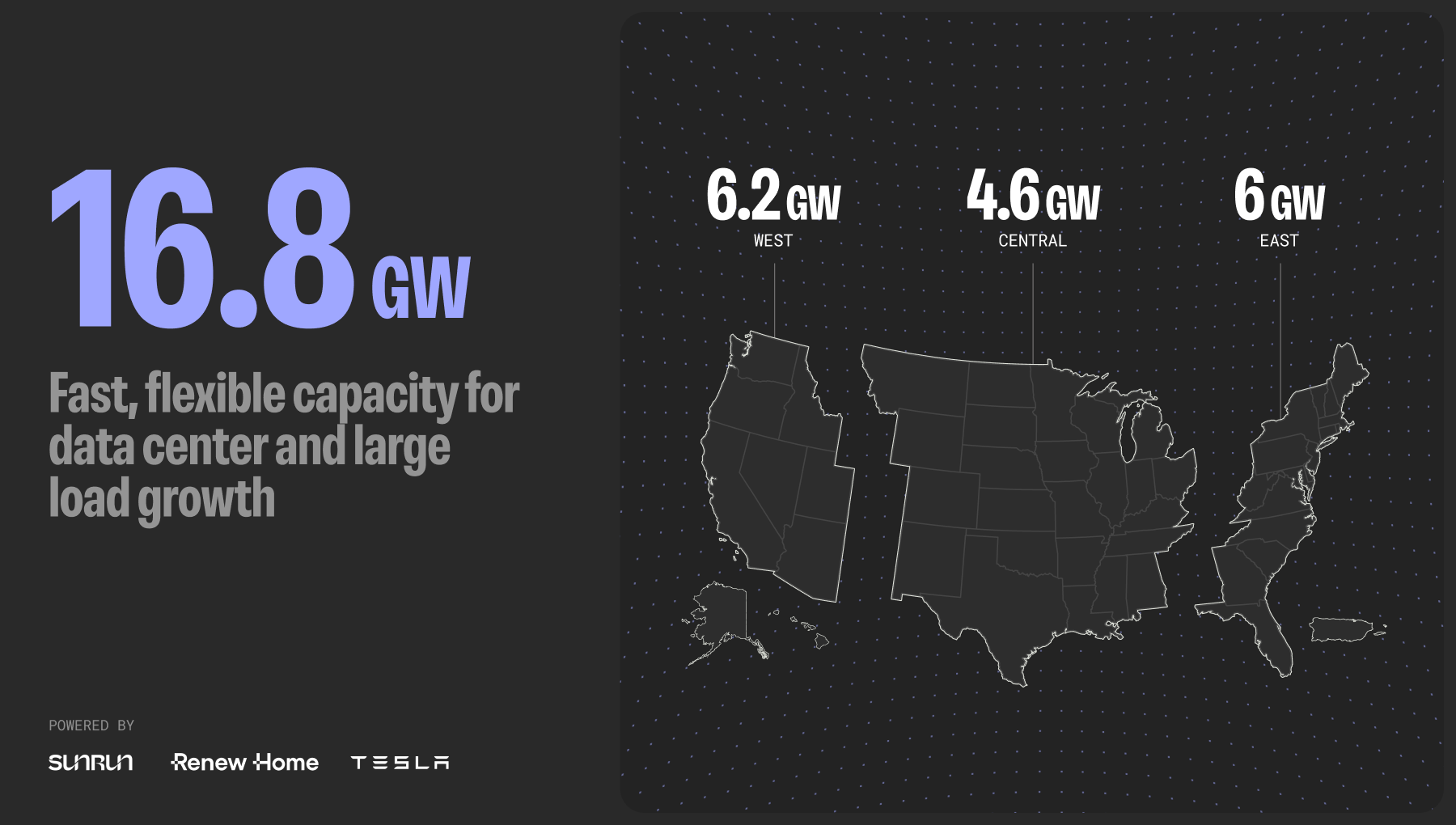
The selling point is speed. Distributed resources can be switched on “in months, not years,” the companies say, while new transmission lines, substations, and gas plants take far longer to permit and build.
This is the logical next step in a partnership we’ve been tracking for a while. Tesla and Sunrun already work together on Tesla’s electric utility plan in Texas, and Sunrun has been building some of the country’s biggest virtual power plants on its own, including the largest US VPP in California and a Texas VPP launched with NRG last December.
Data Center Alley first
The companies say they already have more than 300 megawatts of capacity ready for immediate deployment in Virginia — the heart of “Data Center Alley” — and expect that to grow to at least 500 MW by 2030 as more home batteries and thermostats come online.
They’ve also committed capacity to PJM’s proposed Reliability Backstop Process, which they say could unlock over a gigawatt today if accepted, with more available in the years ahead for peak shaving and fast-responding grid services.
The timing is no accident. US data center power demand is projected to hit 41 GW in 2026 and 66 GW in 2027, and interconnection queues are stretching for years. The companies are positioning their fleet as a “first-come, first-served” resource for hyperscalers racing to bring AI compute online.
“The grid of the 1800s cannot power the innovation of 2026,” said Sunrun CEO Mary Powell. “When data centers are asked to throttle down operations during the most expensive and stressful hours of the day, we can activate our distributed power plants to help provide them the power they need.”
The cost argument
The pitch leans heavily on a new analysis from The Brattle Group, which the companies cite as finding that better utilization of the existing grid could cut US electricity bills by $110 billion to $170 billion over the next decade while accelerating data center interconnection by several years.
The logic: the grid is built for peak hours that happen only a fraction of the year, leaving expensive infrastructure idle most of the time — a cost every ratepayer ultimately covers. Shaving those peaks with distributed batteries and thermostats, rather than building new “poles and wires,” is what the companies argue lowers rates for everyone.
Renew Home, a Sidewalk Infrastructure Partners company with more than 6 million connected households, says it convened the coalition. “We believe hyperscalers are motivated to drive down costs through this transition,” said Renew Home CEO Ben Brown.
Tesla framed the resource as something already sitting idle in American homes. “A huge piece of the answer is already in place — in the batteries, thermostats, and electric vehicles inside millions of American homes, waiting to be put to work,” said Colby Hastings, Tesla’s senior director of residential energy.
Electrek’s Take
This is a smart framing of distributed energy, and it’s the strongest version yet of an argument the VPP industry has been making for years: the cheapest, fastest power plant is the one made of assets that already exist behind the meter.
What’s new here is the customer. Until now, virtual power plants mostly sold capacity back to utilities and grid operators for reliability. Pointing 16 GW directly at data centers and hyperscalers reframes the whole pitch around the one buyer with unlimited urgency and deep pockets right now. That’s exactly why RUN jumped more than 25% — investors see AI demand turning Sunrun’s battery fleet into a recurring revenue machine rather than a regulatory cost center.
Top comment by Pedro
If these homes are being targeted for data center usage, they should get the solar installations free, or at a steep discount.
The idea of home solar and VPP's seemed so good, decentralization of power generation, sharing to lower costs for everyone etc.. But the enshitification of good ideas is almost immediate and inevitable in the age of monopolies and oligarchs.
Meanwhile back at Musk enterprises: xAI is using dozens of unauthorized methane gas generators for its data centers. To quote an article in the Telegraph:
When xAI first installed the portable turbines at Colossus 1, it took advantage of a local county loophole allowing the operation of generators without permits so long as the machines did not sit in one place for more than 364 days.
Guess picking up the phone to access to solar and batteries was too tough for the dirtbag.
The skepticism is warranted on the headline number, though. “More than 16 GW” is a theoretical aggregate of rated battery capacity plus one-hour peak load-shift potential from thermostats — not 16 GW of firm, around-the-clock generation. The 300 MW actually deployable in Virginia today is the more honest figure, and it’s a fraction of a single hyperscale campus. The framework also still depends on customer enrollment, utility program approvals, and PJM accepting the capacity — none of which are guaranteed.
Still, the direction is right. Tapping idle home batteries before pouring concrete for new gas peakers is the kind of grid solution that should be a no-brainer. The question is whether the three companies can convert a press release and a stock pop into signed offtake contracts. If AI demand is as desperate as everyone says, this is a real shot.
Ultimately, the data centers shouldn’t be allowed unless they can deploy their own power. Otherwise, ratepayers will foot the bill. This is another reason to go solar at home when possible.
If your home batteries could be earning you money while powering the grid, the first step is going solar-plus-storage in the first place. With electricity rates climbing nearly 10% last year, home solar protects you against future rate increases. And with lease and PPA options, you can go solar with zero upfront cost and start saving immediately. If you want to find the best deal, check out EnergySage. It’s a free service with hundreds of pre-vetted installers competing for your business, so you save 20 to 30% compared to going it alone. No sales calls until you pick an installer. Get your free quotes here.


FTC: We use income earning auto affiliate links. More.




Comments