
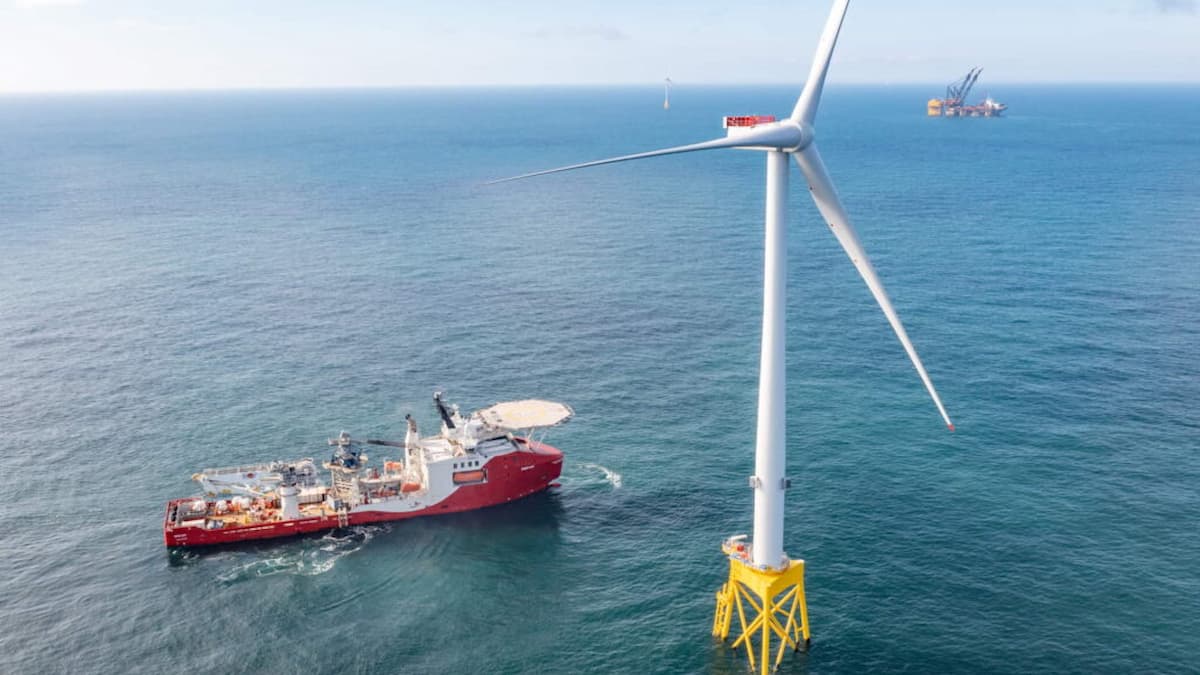
The Interior Department, which recently used $1 billion in taxpayer funds to bribe a foreign oil company into stopping development of cheap offshore wind in the US, had already decided on the deal before it had fabricated a legal justification for it, according to emails obtained by Congress.
TotalEnergies, formerly Total, is one of the largest oil companies in the world, considered one of the six “supermajors” of Big Oil. But it also operates and constructs wind farms in various parts of the world.
Two of those wind farms were going to be built in Carolina Long Bay and New York Bight, until the $1 billion payoff was announced in March.
In its press release after that payoff, TotalEnergies issued an Orwellian statement suggesting that wind power was not in the “national interest” of the US… despite it still operating wind farms in its native France, meaning this justification for the deal seemed puzzling. Why is it good for one country and supposedly not for another?
The deal attracted interest for other reasons, given recent moves by republicans to try to stop cheap wind power and advance dirty unreliable fossil fuels making energy more expensive and less available for Americans, and due to Doug Burgum’s history of connections to the oil industry, having received hundreds of thousands of dollars in bribes from it. Burgum himself tried to pass rules making it nearly impossible to build new wind and solar, but a court reversed those rules.
The fact of the matter is, wind power is one of the cheapest and most environmentally friendly forms of electricity generation, and also benefits national security by getting us off of foreign oil, which is a huge pain point for the world right now (also, uh, because of republicans). Intelligent countries worldwide are being spurred by this crisis to look for ways to increase energy independence, particularly from volatile and insecure fossil fuel supply.
So Interior’s, and Total’s, insistence that there were national security reasons for this $1 billion payout from taxpayer coffers raised eyebrows. Given that wind is so obviously good for national security, why are they saying it’s bad for it?
It turns out, newly released emails suggest that they just made the whole thing up.
Heatmap reported yesterday that it viewed emails obtained by Congressman Jared Huffman’s office which set a timeline suggesting that the national security concern was fabricated after Interior had already offered the billion-dollar bribe to French oil giant TotalEnergies.
In an email dated November 13, 2025, Interior emailed the Bureau of Ocean Energy Management (BOEM) with an attachment titled “DRAFT_Memorandum_of_Understanding.docx.” Contained was an MOU of the deal between Interior and Total, which had clearly been negotiated prior to November 2025.

But that email was dated before any mention of national security concerns in the email record, which only surfaced from Department of Defense in late November/December, in relation to another offshore wind project, Coastal Virginia Offshore Wind. That project, and four others, were stopped by Interior with the nonsense “national security” justification in late December, though Burgum’s Bullshit (hey, that has a nice ring to it) was overturned by court in January.
(Update: We have now seen a copy of the emails and can confirm the details above. The emails are sparse in text, which is a pattern I’ve noticed in other White House communications. It is my suspicion that this is a widespread intentional effort by this White House in order to minimize paper trails that could later be used to reveal its crimes.)
So given the dates, it’s clear that “national security” is a post-hoc justification for this unjustifiable action, and not a very good one either.
Another concern over the $1 billion payout was the source of the funding. It used the “Judgment Fund,” money that has been set aside to pay for lawsuits against the government. This fund recently made the news as former reality TV host Donald Trump, who cannot legally hold office in the US, used it to create a $1.8 billion slush fund to channel taxpayer money to his treasonous co-conspirators from his effort to overthrow the US government, after instructing the IRS to stop investigating his decades of tax fraud.
Top comment by K12
Why isn't NY State suing over this project being cancelled? Offshore wind power is less expensive than fossil fuel energy. The rate payers are clearly harmed by this deal.
But that fund is meant for settlements, not for paying off companies to stop building wind power. Burgum justified its use by stating that TotalEnergies could potentially sue for breach of contract if its wind farm lease was cancelled.
But even if that had happened and TotalEnergies won the lawsuit, the payout would have been calculated by a standardized formula and would have ended up as an amount smaller than the $1 billion paid.
Further, if Burgum wanted to avoid a lawsuit for breach of contract, the best way to do so would be to not breach the contract in the first place, and to instead encourage cheap and clean offshore wind. But that would require him to be working in the country’s interests – which he, his party, and the foreign oil giant involved in this scheme all are not.
Charge your electric vehicle at home using rooftop solar panels. Find a reliable and competitively priced solar installer near you on EnergySage, for free. They have pre-vetted installers competing for your business, ensuring high-quality solutions and 20-30% savings. It’s free, with no sales calls until you choose an installer. Compare personalized solar quotes online and receive guidance from unbiased Energy Advisers. Get started here. – ad*


FTC: We use income earning auto affiliate links. More.





Comments