
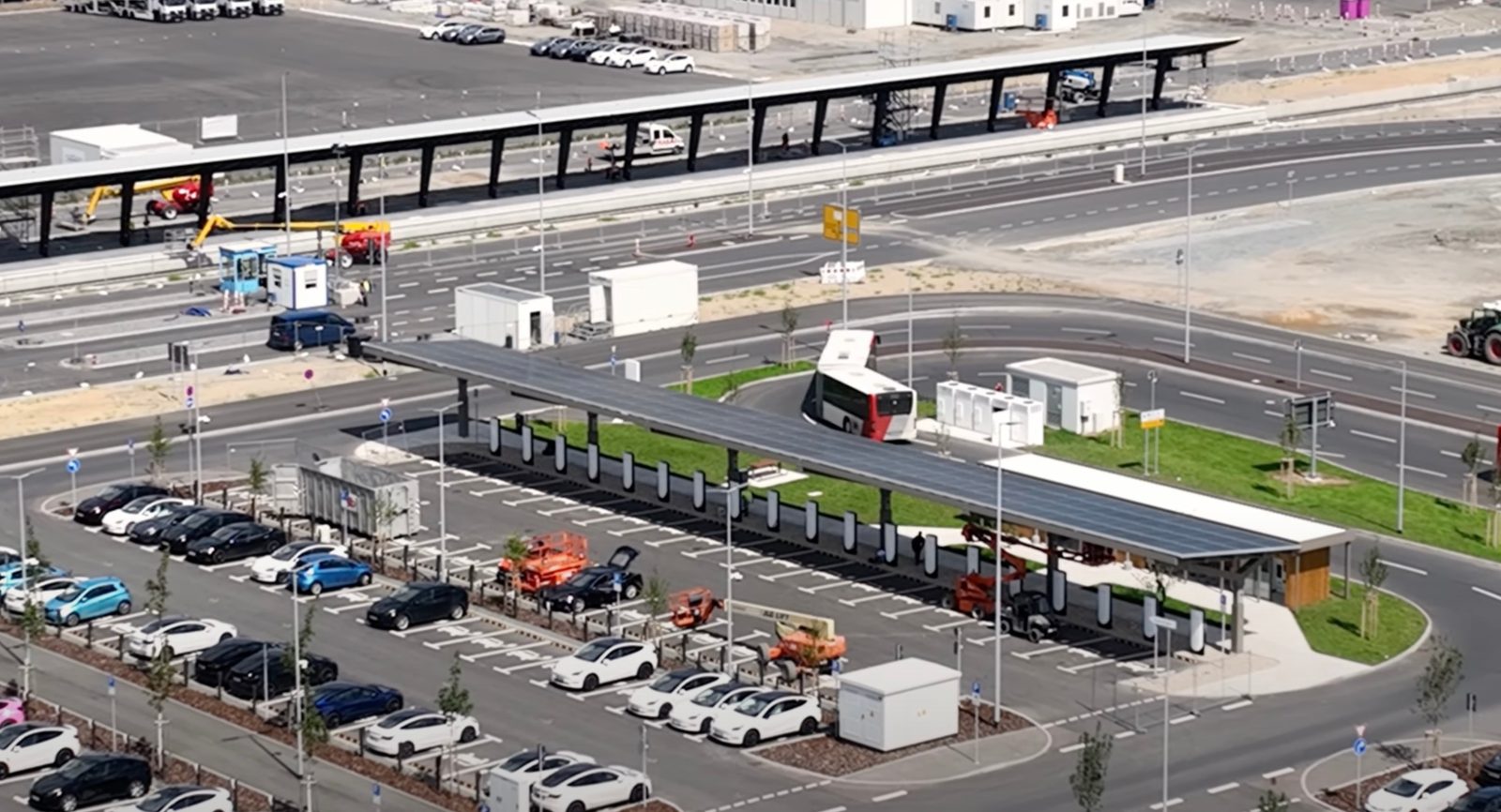
Tesla announced today that it will invest almost $250 million more in battery cell production at its Grünheide factory outside Berlin, more than doubling planned capacity to 18 gigawatt hours per year and creating over 1,500 battery-related jobs.
The investment comes just two months after the automaker successfully scared workers away from IG Metall in a contentious works council election — a vote where CEO Elon Musk explicitly threatened to halt expansion if the union gained control.
From 8 GWh to 18 GWh
With this latest round, Tesla is more than doubling its battery cell capacity target at Grünheide from the 8 GWh it announced in December 2025 to 18 GWh. Total investment in the site’s cell production unit now approaches €1 billion ($1.2 billion).
Tesla said in a statement:
“The ramp-up of battery cell production will also be accompanied by a significant increase in labour demand.”
The company estimates it will need more than 1,500 employees for battery cell production alone, and confirmed it has already begun recruiting for those positions, with cell production expected to start in the first half of 2027.
Tesla’s goal is vertical integration at a scale that no other automaker has achieved in Europe. The company’s December statement laid out the vision: “From battery cells to electric vehicles, everything is expected to be produced at a single location starting in 2027.”
If the 18 GWh target is achieved, Grünheide would produce enough cells for roughly 250,000 to 350,000 vehicles per year, depending on pack size — far more than the factory currently produces.
The union vote connection
The timing of this announcement is impossible to ignore.
In late February, Musk sent a pre-recorded video to Grünheide’s roughly 11,000 workers warning that expansion would not happen if IG Metall gained a majority in the upcoming works council election. He said that “things will certainly get more difficult if there are external organizations pushing Tesla in the wrong direction,” adding: “We will not close the factory, but realistically we will also not expand.”
The message was clear: vote for the union, lose the investment.
IG Metall’s vote share subsequently collapsed from 39.4% in 2024 to 31.1% in the March election. Tesla’s management-aligned list, Giga United, took 24 of 37 seats. IG Metall has since filed a legal challenge alleging unlawful interference in the election.
Now, two months later, Tesla is delivering on the implied bargain: the union lost, and the investment is flowing. Whether you view this as Tesla rewarding workers for making the right choice or as confirmation that the expansion threat was a coercive tactic to suppress unionization depends largely on your perspective — but the sequence of events speaks for itself.
A factory in recovery mode
The investment also comes as Giga Berlin is in the early stages of a broader recovery. The factory was reportedly running at just 40% capacity earlier this year after Tesla’s European sales collapsed 28% in 2025, with German registrations plunging 48%.
Tesla shed roughly 1,700 jobs at the plant during the downturn. But rising demand for the refreshed Model Y has shifted the trajectory. In April, Tesla announced plans to hire 1,000 new workers and boost production by 20%, and convert around 500 temporary workers into permanent contracts.
The $250 million battery investment signals that Tesla sees Grünheide not just as a vehicle assembly plant, but as a full-scale manufacturing hub that could reduce its dependence on Asian cell suppliers for the European market.
Electrek’s Take
Tesla has been talking about building battery cells at Grünheide since before the factory even opened. It applied for permits in 2021. It moved equipment to Texas in 2022. It announced and re-announced plans multiple times. So healthy skepticism is warranted — we’ve heard this before.
That said, the numbers here are more concrete than past promises. The 18 GWh target is specific, the €1 billion cumulative investment is substantial, and the 1,500-job hiring commitment gives Tesla a public benchmark it can be held to. The fact that Tesla has already started recruiting for battery roles adds credibility.
The uncomfortable reality is the union connection. Tesla dangled this exact type of investment in front of workers as a reason to reject IG Metall — and now it’s following through. The tactic worked, and regardless of how you feel about it, it sets a troubling precedent for labor relations in European manufacturing. IG Metall’s legal challenge to the election is still pending, and this investment announcement won’t help their case by making it easier to argue that Tesla made good on promises rather than threats.
If Tesla actually delivers 18 GWh of cell production by 2027-2028, it would be genuinely significant — a vertically integrated EV factory in Europe at a scale no competitor has matched. But that’s still a big “if,” and Tesla’s track record on battery production timelines is, to put it diplomatically, inconsistent.


FTC: We use income earning auto affiliate links. More.




Comments