
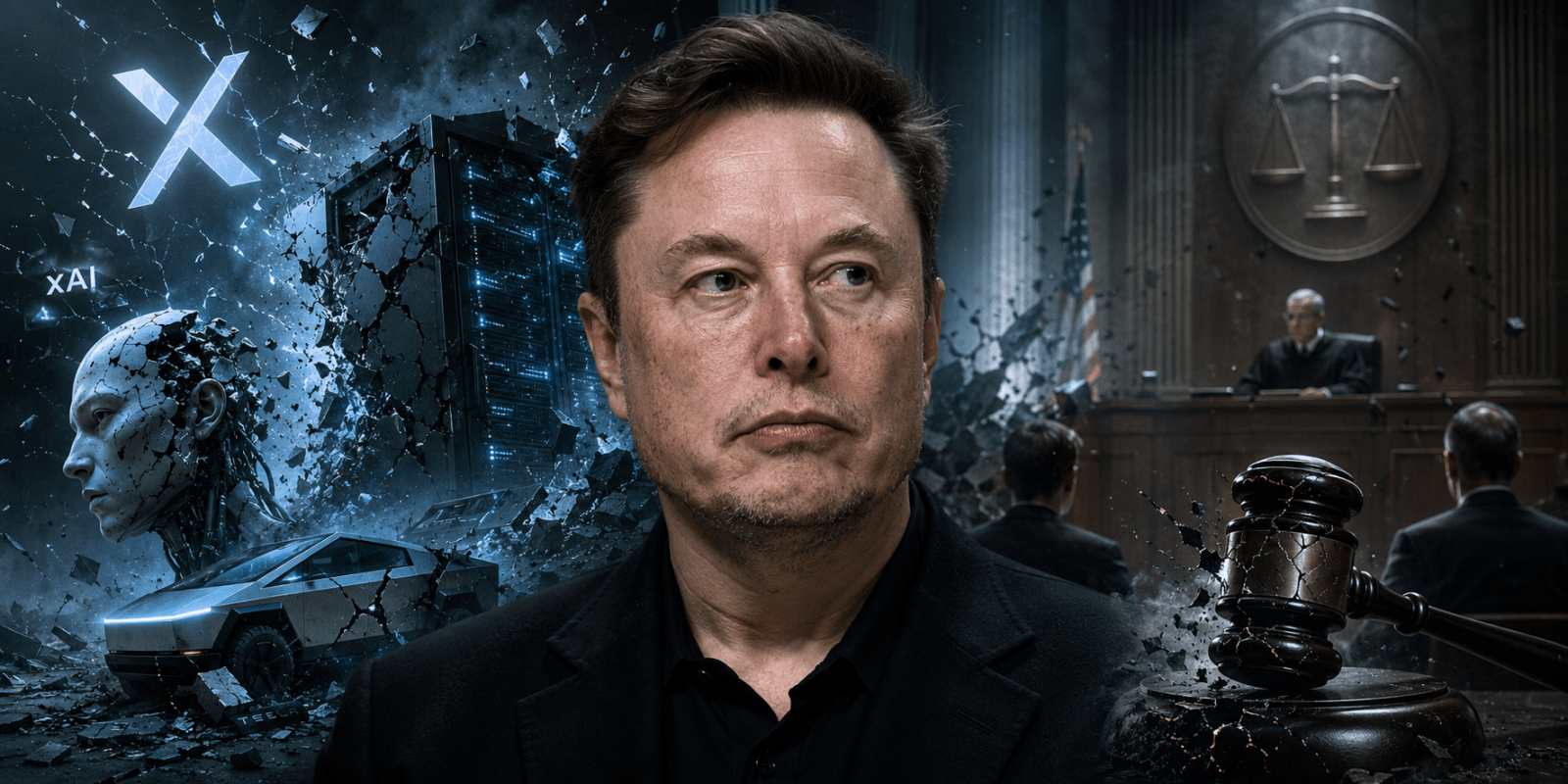
On March 4, 2026, Elon Musk posted on X that “Tesla will be one of the companies to make AGI and probably the first to make it in humanoid/atom-shaping form.” Less than eight weeks later, under oath in an Oakland federal courtroom, he was asked whether Tesla has any concrete plans to pursue AGI. His answer: “No.”
That single contradiction — between what Musk tells his millions of followers and what he admits when he’s facing perjury charges — captures the story of his decade-long obsession with artificial intelligence better than any timeline ever could. But here’s a timeline anyway, because the trial of Musk v. Altman is now exposing, under oath, what many of us have long suspected: Musk’s AI ambitions were never about safety, open access, or benefiting humanity. They were about control.
Last year, I wrote about cracks forming in Elon Musk’s armor of lies — how the convergence of the Tesla shareholder lawsuit over xAI and OpenAI’s countersuit was starting to expose Musk’s contradictions. Thirteen months later, those cracks have become chasms. The Musk v. Altman trial, now in its second week, is producing daily revelations that connect directly to Tesla shareholders.
Here’s the updated timeline.
2015–2017: OpenAI and the seeds of the pattern
December 2015: Musk co-founds OpenAI as a nonprofit with Sam Altman and Greg Brockman, pledging $1 billion (he ultimately contributed $38 million). The stated mission: ensure artificial general intelligence benefits all of humanity.
2016–2017: Musk emails NVIDIA CEO Jensen Huang to secure an early supercomputer for OpenAI, emphasizing the nonprofit status. Internally, he’s the biggest name on the letterhead, and he uses that leverage to recruit top AI talent — including researchers who, according to Brockman’s trial testimony, were as often repelled by Musk’s involvement as attracted to it.
Mid-2017: According to Brockman’s testimony this week, Musk begins pushing OpenAI to go for-profit — the very thing he would later sue them for doing. But there was a catch: he wanted full control. Brockman testified that Musk told him he needed $80 billion to build a city on Mars, and that controlling OpenAI’s AI could help him raise that money.
August 2017: Internal memos detail concerns from Brockman and chief scientist Ilya Sutskever about Musk’s desire for control. When the equity discussion didn’t go Musk’s way during an in-person meeting, Brockman testified that Musk said “I decline,” stood up, and stormed around the table so aggressively that Brockman thought Musk was going to physically hit him. Instead, Musk tore a painting off the wall and stormed out, threatening to withhold funding.
Late 2017: While still on OpenAI’s board, Musk secretly recruits OpenAI researcher Andrej Karpathy to lead Tesla’s self-driving AI effort. On the stand last week, Musk claimed Karpathy was already planning to leave. Brockman’s testimony directly contradicted this — he said Musk came to him with “an apology and a confession.” A 2017 email from Musk to a Tesla VP, presented as evidence, reads: “The OpenAI guys are gonna want to kill me. But it had to be done.”
2018: Musk loses control and walks away
February 2018: After failing to secure the CEO role at OpenAI, Musk resigns from the board. He frames the departure publicly as being about a conflict of interest with Tesla’s AI work. The trial evidence paints a different picture: he left because he couldn’t be in charge.
2018–2019: Musk begins telling Tesla investors that Tesla will be a major player in AI and that AI products — particularly “Full Self-Driving” — would be critical to Tesla’s future. He promises a fleet of one million robotaxis by 2020. This is where his AI obsession formally becomes a Tesla shareholder story.
2019–2023: The decade of broken AI promises at Tesla
This is worth its own list because the scale of it is staggering:
- 2019: Musk promises 1 million robotaxis on the road by 2020. None materialize.
- 2020: Promises “Full Self-Driving capability” by end of year. It doesn’t happen.
- 2021: Tells investors Tesla’s AI will have “reliability in excess of a human this year.” It doesn’t.
- 2022: Promises the dedicated robotaxi vehicle (later named Cybercab) will enter production by 2024. It doesn’t.
- 2023: Promises unsupervised FSD and a robotaxi service. Neither arrives.
- 2024: Promises unsupervised FSD in Austin by June 2025, and robotaxi coverage for “half the population of the U.S.” by year-end 2025.
- 2025: None of these promises are met. In January 2025, Musk admits Hardware 3 — installed in millions of Teslas sold with the promise of full autonomy — can’t actually deliver unsupervised FSD. Six years after customers paid thousands for it.
Throughout all of this, Musk is telling Tesla investors that Tesla’s AI capabilities are what justify the company’s inflated valuation. The stock price is, to this day, built largely on the promise that Tesla will crack autonomy.
2022–2024: The Twitter blunder, the xAI creation, and the conflict explodes
To understand why Musk created xAI — despite spending years telling Tesla investors that Tesla itself was an AI company — you have to understand the Twitter disaster.
2021–2022: Musk sells over $23 billion worth of Tesla stock to fund his $44 billion acquisition of Twitter (with additional billions sold for tax obligations). This slashes his Tesla stake from around 23% to about 13%. It’s a self-inflicted wound that changes everything that follows.
October 2022: The Twitter deal closes. Musk now controls a money-losing social media platform and holds a much smaller stake in Tesla — the company whose valuation he’d spent years inflating with AI promises.
Early 2023: With his reduced Tesla stake, Musk faces a problem: he told investors Tesla would be an AI powerhouse, but he no longer has the ownership position to fully benefit from it. His solution isn’t to buy more Tesla stock. It’s to create a separate AI company — one he controls entirely.
March 2023: Musk co-founds xAI, a private AI company under his full control, with a team of researchers recruited from Google DeepMind, Microsoft Research, and — inevitably — Tesla. The move is remarkable: the CEO of a company he’d been calling “an AI company” for years launches a competing AI startup on the side.
January 2024: A Delaware court voids Musk’s $56 billion Tesla compensation package, ruling it wasn’t “entirely fair” to shareholders. Musk responds by threatening to build AI products outside of Tesla unless shareholders give him more control — effectively holding Tesla’s AI future hostage to get more shares. The message is clear: give me what I want, or I’ll take the AI to xAI.
June 2024: Tesla shareholders sue Musk for breach of fiduciary duty, alleging he diverted Tesla’s AI resources — including thousands of NVIDIA H100 GPUs, key employees, and strategic focus — to his private company. Separately, shareholders re-approve the $56 billion compensation package in a new vote, giving Musk the control he demanded.
September 2024: Musk states publicly that Tesla has “no need to license anything from xAI.” Remember this.
2025: The entanglement deepens
April 2025: I wrote about the cracks forming in Musk’s armor of lies, connecting the Tesla shareholder lawsuit, the OpenAI countersuit, and the broader pattern.
October 2025: Tesla discloses it’s exploring an investment in xAI. The very company shareholders are suing Musk over, Tesla might now fund with shareholder money.
Late 2025: Tesla’s annual filing reveals xAI purchased $430 million in Tesla Megapack battery systems throughout 2025. Tesla is literally powering the data centers of the company its CEO created as a competitor.
2026: Everything unravels
January 2026: xAI tells investors their goal is to “develop self-sufficient AI to power robots like Tesla’s Optimus” — directly contradicting Musk’s “no need to license” claim from 16 months earlier.
January 28, 2026: Tesla invests $2 billion in xAI’s Series E round. Tesla shareholders are now funding the very company the shareholder lawsuit argues Musk had no right to create outside of Tesla.
February 2, 2026: SpaceX acquires xAI in an all-stock deal valuing xAI at $250 billion and the combined entity at $1.25 trillion. This is the largest merger in history. The timing raises questions: why does SpaceX need an AI company, and why now?
February 11, 2026: The answer starts to emerge. After the merger, key departures accelerate. Co-founder Tony Wu leaves, followed within 24 hours by Jimmy Ba. Musk announces xAI is being “rebuilt” following the departures — an extraordinary admission about a company just valued at $250 billion.
March 2026: By now, 9 of 12 original xAI co-founders have left. By late March, all 11 are gone, along with 80+ researchers and engineers, including chief engineer Igor Babuschkin. Musk posts on X that xAI “was not built right first time around, so is being rebuilt from the foundations up.”
Let me repeat that: every single co-founder left the company that SpaceX just bought for $250 billion.
March 4, 2026: Musk posts the tweet claiming Tesla will be “one of the companies to make AGI.” This is while he’s actively rebuilding xAI from scratch.
March 11, 2026: Musk confirms a joint xAI-Tesla “Digital Optimus” project — a direct integration of xAI’s Grok into Tesla products. This announcement obliterates his 2024 claim that Tesla had “no need to license anything from xAI” and hands the shareholder lawsuit plaintiffs exactly the evidence they need.
April 21, 2026: SpaceX announces a deal with Cursor — an AI coding startup — with an option to acquire it for $60 billion. The deal involves using SpaceX’s Colossus supercomputer to build a new AI model. Let that sink in: SpaceX paid $250 billion for xAI and its AI capabilities, and within two months, it’s paying another company up to $60 billion to build a new model. If xAI’s technology was worth $250 billion, why does SpaceX need Cursor?
April 23, 2026: On Tesla’s Q1 2026 earnings call, Musk admits that Hardware 3 lacks the memory bandwidth for unsupervised FSD. He pushes unsupervised driving to “probably Q4” — another goalpost move in a decade of goalpost moves.
April 25, 2026: Two days before his trial against OpenAI begins, Musk texts Greg Brockman to gauge interest in a settlement. Brockman suggests both sides drop their claims. Musk’s response: “By the end of this week, you and Sam will be the most hated men in America. If you insist, so it will be.”
The trial: what comes out under oath
April 28 – May 2, 2026 (Week 1 — Musk’s testimony):
The first week belongs to Musk on the stand, and it’s a parade of contradictions:
- He admits there was no written agreement governing the terms of his $38 million donation to OpenAI — undermining the foundation of his entire “they stole my charity” argument.
- He admits xAI distills OpenAI’s models to train Grok — a practice that violates OpenAI’s terms of service. He’s suing OpenAI while his company copies their work.
- He repeatedly tells the jury “you can’t just steal a charity” until Judge Yvonne Gonzalez Rogers strikes the phrase from the record, reminds him he’s “not a lawyer” and has “not taken a class in evidence.”
- He testifies that Tesla has no plans to pursue AGI — directly contradicting the tweet he posted just weeks earlier.
- OpenAI’s lawyer William Savitt uses Musk’s own tweets, emails, and deposition testimony to expose contradiction after contradiction. Microsoft’s lawyer gets Musk to acknowledge a single tweet — that Microsoft had “captured” OpenAI — and sits down. That’s their entire cross-examination.
May 5–6, 2026 (Week 2 — Brockman’s testimony):
Greg Brockman takes the stand and systematically dismantles Musk’s narrative:
- Musk wanted OpenAI to go for-profit — but only if he was in charge, partly to fund $80 billion for Mars colonization.
- Musk never expressed interest in open-sourcing OpenAI’s technology, despite repeatedly claiming on the stand that it was supposed to be a core principle. Brockman testified “it was not a topic of conversation.”
- The Karpathy recruitment was not Karpathy’s independent decision to leave. Musk came to Brockman with “an apology and a confession.”
- During the 2017 equity meeting, Musk stood up and stormed at Brockman so aggressively that Brockman thought Musk was going to physically attack him.
May 6, 2026: Anthropic announces it will use all the compute capacity of SpaceX’s Colossus 1 data center — over 220,000 NVIDIA GPUs. The company that Musk built to compete with OpenAI and Anthropic is now renting its data center to Anthropic because it has no competitive model to run on it.
The full picture
Step back and look at the complete arc:
Musk co-founded OpenAI to control AI development. When he couldn’t get control, he left. He told Tesla investors that Tesla would build AI and autonomy — promises that inflated Tesla’s valuation for years without delivery. He founded xAI as a private company using Tesla’s talent and resources. He got Tesla shareholders to invest $2 billion in it. He sold it to SpaceX for $250 billion. Every co-founder left. SpaceX is now paying Cursor to build the AI model that xAI was supposed to have, and renting xAI’s data center to a competitor because there’s nothing useful running on it.
And through it all, Musk used AI as a narrative tool — a story to tell whichever audience needed to hear it at any given moment. Tesla investors heard “Tesla will build AGI.” OpenAI heard “this should be a nonprofit for humanity.” xAI investors heard “$250 billion valuation.” Under oath, the story is different every time.
Electrek’s Take
We’ve been covering Musk’s AI contradictions for years, and the OpenAI trial is now confirming what the evidence has long suggested: this was never about building safe AI for humanity. It was about control.
Top comment by OliveQuill
Does it make sense to call something a sale when you have effective control of both players in a transaction?
The most damning revelation isn’t any single lie — it’s the pattern. Musk tells Tesla investors that Tesla will build AGI, then testifies under oath that it won’t. He tells the public xAI exists to keep AI safe, then admits xAI copies OpenAI’s models. He sues OpenAI for abandoning its nonprofit mission while his own trial witnesses testify he was the one pushing to go for-profit. He sells xAI for $250 billion, then the entire founding team walks out and the company has to be “rebuilt from the foundations up.”
For Tesla shareholders specifically, the question is simple: how much of Tesla’s valuation is built on AI promises that Musk himself admits, under oath, aren’t real? He said Tesla has no plans for AGI. He admitted HW3 can’t deliver unsupervised FSD. The robotaxi timeline has been pushed back for a decade straight. And the AI company he built with Tesla’s resources is now an empty shell renting its servers to competitors.
The cracks we wrote about last year aren’t cracks anymore. The armor has fallen off. What’s underneath is a decade of promises made to sell stock, recruit talent, and maintain control — promises that Musk can’t keep repeating when he’s under oath.


FTC: We use income earning auto affiliate links. More.


Comments