

Emails obtained by Reuters from European regulators reveal significant skepticism toward Tesla’s “Full Self-Driving” system, with officials raising concerns about speeding, icy road safety, and driver distraction — just as the company pushes for EU-wide approval.
The revelations come on the same day that the Dutch regulator RDW is presenting Tesla’s FSD approval to the EU’s Technical Committee on Motor Vehicles, a critical step toward broader European deployment.
Regulators raise red flags
Tesla secured its first European approval for “FSD (Supervised)” from the Dutch RDW on April 10, but regulators in Sweden, Finland, Denmark, and Norway — countries whose votes could prove critical to EU-wide approval — have raised multiple concerns about the technology.
A Swedish Transport Agency investigator wrote in an April 15 email that he was “quite surprised” to learn Tesla allowed FSD to speed, and said that should not be permitted. Other concerns include whether the system is safe on icy roads and whether drivers can circumvent features designed to prevent cell phone use while the system is active.
These are serious concerns for Nordic countries where icy road conditions are the norm for much of the year and where road safety standards are among the strictest in the world.
The “trust us” problem
Perhaps most concerning is the lack of transparency around the Dutch approval itself. RDW General Manager Bernd van Nieuwenhoven told Reuters last month: “We say: Trust us on this, we tested it extensively.” However, the Dutch regulator has not released any research or data explaining its decision to approve FSD.
This is a stark contrast to the rigorous, data-driven approach that European regulators typically demand. While Tesla says it provided 1.6 million kilometers of EU road test data and completed 4,500 closed-track tests, the approval itself raised questions about whether those tests adequately addressed the unique conditions of different European markets.
Tesla’s aggressive lobbying backfires
The emails also reveal frustration among regulators over Tesla’s lobbying tactics. A Tesla policy manager contacted Swedish authorities to approve FSD just four days after the Netherlands announced its decision — before Swedish regulators had even reviewed any documentation on the technology.
Regulators also expressed frustration with Tesla’s strategy of publicly encouraging vehicle owners to pressure officials to approve FSD. This approach, while common in American-style advocacy, does not sit well with European regulatory culture, where decisions are expected to be made on technical merit rather than public pressure campaigns.
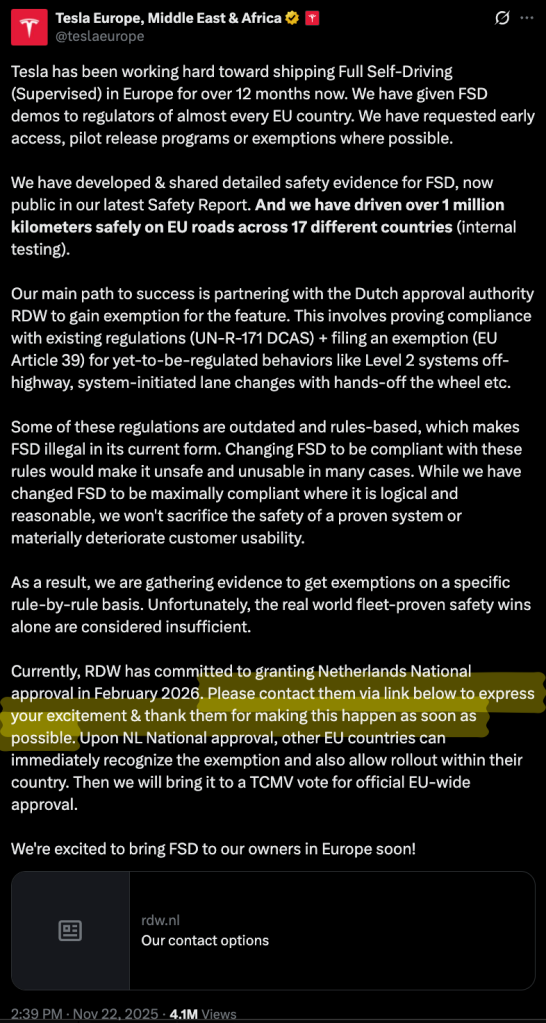
“Pressure from our customers in Europe to push the regulators to approve would be appreciated”, said CEO Elon Musk in a Tesla earnings call in late 2025.
EU-wide approval still months away
For FSD to receive EU-wide approval, committee members representing 55% of EU member states and 65% of the bloc’s population must vote “yes.” Critically, there is no vote scheduled this week — the next committee meetings are expected in July and October.
This means Tesla’s timeline of EU-wide FSD availability by summer 2026 is looking increasingly uncertain. The company’s European sales fell 28% in 2025 amid protests over Elon Musk’s political activities, and the brand cannot afford further delays in delivering features that could help justify its premium pricing.
Top comment by Doug T
Some European countries fine speeding based on income, for example daily income divided by 2
So if Tesla ever gets level 4, the speeding ticket would be $120 million USD
Meanwhile, Musk continues to project confidence publicly. But his track record on autonomous driving timelines — from coast-to-coast drives in 2017 to a million robotaxis in 2020 — gives European regulators every reason to demand hard evidence rather than trust. And as we recently reported, Musk’s claim that FSD is “10X safer” than human drivers doesn’t hold up to scrutiny.
Electrek’s Take
This Reuters report confirms what many suspected: the path to EU-wide FSD approval is far from the slam dunk that Musk has been projecting to investors and owners.
What’s most telling is the contrast between Tesla’s approach and how the European regulatory process actually works. Encouraging owners to pressure regulators, lobbying countries before they’ve even seen documentation, and asking officials to simply “trust us” — none of this builds the technical credibility that EU approval demands. The European system exists specifically to prevent companies from self-certifying safety claims, and Tesla seems to be struggling to adapt to that reality.
We expect the July committee meeting to be the earliest realistic window for a vote, and even that feels optimistic given the level of skepticism revealed in these emails. Tesla needs to answer these concerns with data, not marketing.


FTC: We use income earning auto affiliate links. More.


Comments